Attacks from Iran have slowed business activity in Dubai, but the expat tech community in the city remains resilient.
Over the past month, the United Arab Emirates has been the target of Iran’s attacks, primarily due to its strategic alliance with the U.S. Several high-profile sites in the UAE’s business hub, Dubai, including its airport — the busiest in the world for international passenger traffic — have faced damage due to falling debris from intercepted missiles and drones.
These attacks could have put Dubai’s reputation as a stable city in a volatile region at risk and spooked its massive expat community. But that doesn’t seem to be the case. Eight expat tech entrepreneurs, investors, and professionals who spoke to Rest of World said they are staying put — and in some cases, even returning.
The UAE Central Bank’s 1 trillion dirham ($270 billion) “resilience package” announced on March 18 to ensure liquidity and capital buffers in the economy has also enthused the expat community.
“The attacks have created noise, some flight disruptions, but not structural damage to the ecosystem,” Mohammed Soliman, a senior fellow at the nonprofit think tank Middle East Institute, told Rest of World. Soliman is based in Washington, D.C., and is the author of West Asia: A New American Grand Strategy in the Middle East. “The founders who chose Dubai over London or Singapore already made a calculation about operating in a volatile neighborhood. What we’re seeing now is that calculation being tested,” he said.
The view across the board is optimistic based on this region’s history. Once this conflict resolves, confidence should return quickly.”Daniyal Baig, co-founder of AI-driven conversational commerce platform MyAlice
In a region with a history of frequent conflicts, for some entrepreneurs, Dubai is a safer place than their home countries, despite the missiles and drones.
“I have lived most of my life in a war zone. Dubai was and still is the safest place I have ever lived in,” Mirna Mneimne, co-founder of AI-powered well-being platform Elggo, told Rest of World. Mneimne is a Lebanese founder who divides her time between Beirut and Dubai.
The Gulf has long been one of the world’s most geopolitically volatile regions, shaped by decades of conflict, including the Iran-Iraq War, the Gulf War, and recurring tensions involving Iran and the U.S. Lebanon has faced years of political instability, economic collapse, and periodic cross-border conflict.
Mneimne was in Lebanon when the war started and has plans to return to Dubai on March 31. “My life is set up there right now. It’s my home. I also have full confidence in the leadership of Dubai and its ability to keep us safe,” she said.
Over the past decade, Dubai has attracted a wave of global tech talent, drawn by zero income tax, long-term residency visas, and business-friendly regulations. By 2025, Dubai is estimated to have issued over 300,000 Golden Visas — a residency program for investors, entrepreneurs, specialized workers, and outstanding students. Expats constitute nearly 90% of Dubai’s population.
As of March 22, the UAE air defenses had intercepted more than 1,700 drones and 360 missiles launched from Iran following U.S. and Israeli strikes on the country. The attacks have killed at least seven in the UAE — including nationals from Pakistan, Nepal, Bangladesh, and Palestine — and injured 145.
The UAE has arrested 109 individuals of different nationalities for filming and sharing videos and photos of Iranian missiles and drone attacks “in a widening crackdown on threats to the Gulf state’s image of safety and stability,” Time reported.
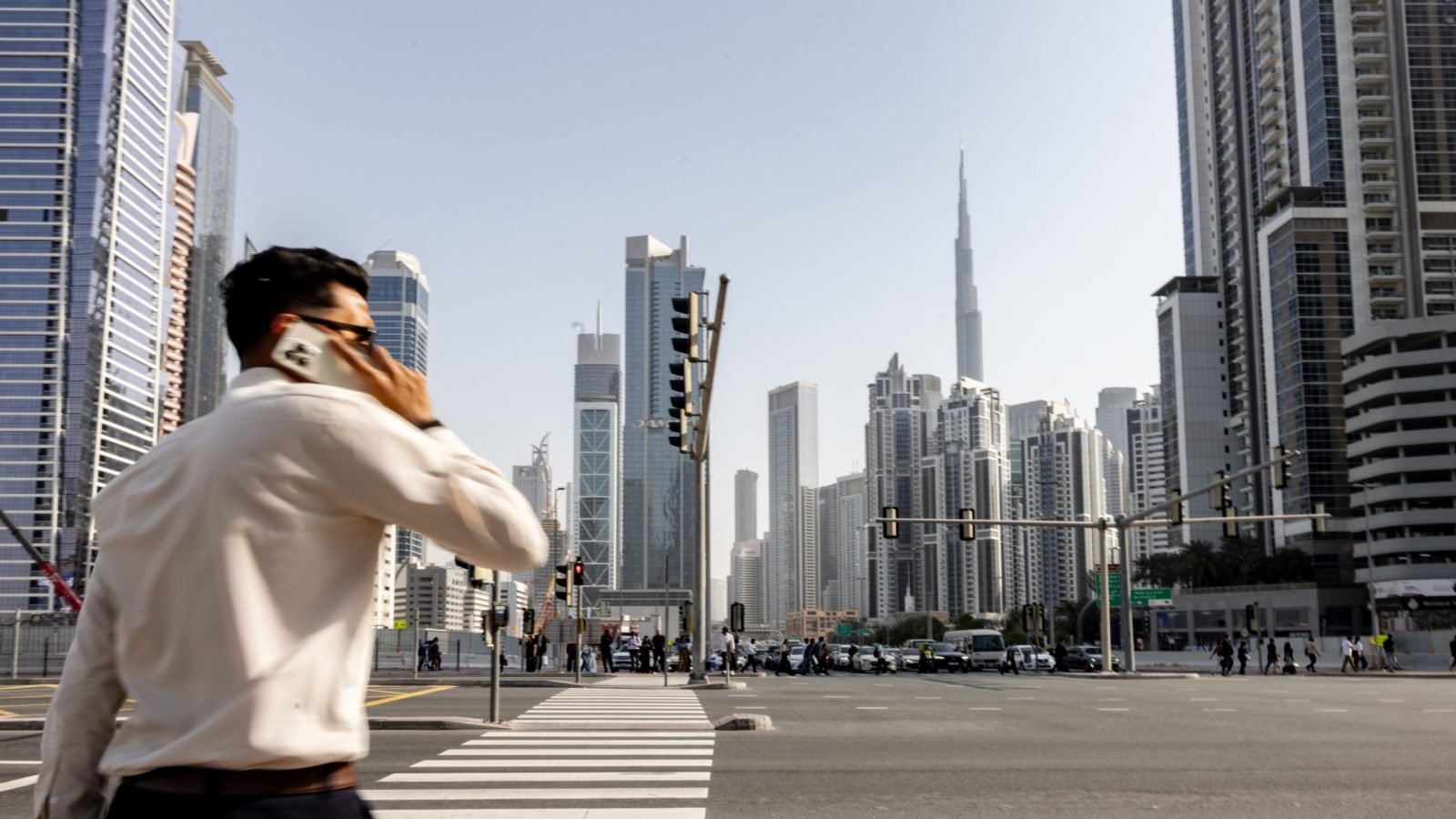
“While the sound of intercepted drones or missiles can be unsettling, daily life in Dubai has largely continued normally, with most public services, attractions, and transportation operating as usual,” Salman Waris, founding partner at tech law firm TechLegis, who divides his time between Dubai and Delhi, told Rest of World. “The UAE is not an active participant in the conflict, which further reduces direct risk.”
When the world feels volatile, global talent and capital gravitate here because they know the best companies aren’t built when the sun is shining.”Wes Schwalje, co-founder of Tahseen Consulting
The attacks from Iran have paused some investment conversations in the region, but investors are bullish about the UAE in the long term, Daniyal Baig, co-founder of AI-driven conversational commerce platform MyAlice, told Rest of World. Baig is a long-term Dubai resident of Pakistani origin.
“Some conversations have slowed or paused as people wait for clarity,” Baig said. “That said, the view across the board is optimistic based on this region’s history. Once this conflict resolves, confidence should return quickly.”
Sahil Makker, managing partner at capital advisory firm Brillwood Capital, said his team has been working with their clients to assess their business strategies and gauge their interest in the region following recent developments.
Investors believe the conflict “will clear more room and options for them and more opportunities for them,” Makker, who has been a resident of Dubai for 12 years, told Rest of World. “Even during Covid, the Dubai Economic Department gave a lot of boost to business by introducing friendly pricing and policies. They are already seeing some friendlier terms from business support providers.”
The UAE’s “resilience package” announced this month mirrors the measures the country implemented during the 2008 financial crisis and the 2020 Covid pandemic. The package allows banks to access 30% of their reserve balances and temporarily eases liquidity and funding requirements, allowing flexibility on what constitutes a problem loan while maintaining credit flow.
Four expat entrepreneurs told Rest of World their main priority was the safety of their teams, and that they have allowed flexible work-from-home schedules to ensure this.
Some are also taking steps to help their businesses remain insulated from the crisis, and exploring ways their offerings can align with the needs of the hour.
“We are being extra-vigilant in our underwriting criteria, given we work with lenders and want to limit the risk of non-performing loans in this environment,” Omair Ansari, CEO & co-founder of neobank Abhi, told Rest of World. “However, at the same time, one should never waste a crisis. Thus, we are looking at how we can help our customers and the government to soften the economic impact of this.” Ansari is a Dubai-based entrepreneur of Pakistani origin.
Wes Schwalje, co-founder of Tahseen Consulting, a public-sector strategy and government relations firm that helps startups scale in the region, is in the process of launching a new tech venture, “specifically because history shows that the UAE doesn’t just survive regional disruption, it wins,” he told Rest of World.
“When the world feels volatile, global talent and capital gravitate here because they know the best companies aren’t built when the sun is shining. They are built by founders and business owners comfortable in the trenches,” said Schwalje, who is originally from the U.S. and has been living in Dubai since 2007. He believes the UAE will see several high-potential startups being founded during this time of uncertainty.
Dubai’s tech ecosystem appears to be making a familiar calculation: that the benefits of staying outweigh the risks, Soliman of the Middle East Institute said.
“The UAE has spent 15 years building institutions specifically designed to decouple the business environment from regional turbulence,” he said. “The variable I’d watch is not the war itself but how long it runs.”