In early April, U.S. President Donald Trump launched a salvo of international tariffs that rocked the global economy. Targeting countries from Mexico to Fiji, the announced tariffs led to a market crash while governments around the world jumped into action in attempts to forestall them.
Bangladesh, which sells vast amounts of garments and textiles to the U.S., was particularly threatened. It suddenly faced a 37% rate — one of the highest on the list.
On April 7, Muhammad Yunus, chief adviser of Bangladesh, sent Trump an urgent letter. He listed all the ways that his country was trying to comply with Trump’s agenda and asked him to delay tariffs. The note included a curious addition: “We have executed the necessary steps to launch Starlink in Bangladesh.”
Since Starlink launched its first satellites in 2019, the internet provider owned by billionaire Elon Musk has attempted to expand into markets around the world, often facing regulatory red tape in doing so. But with Musk playing a high-profile role in Trump’s White House from January through May, Yunus and other leaders seemed to recognize that accommodating Starlink could be one means of appeasing the new administration.
The same day Yunus sent his letter, Starlink applied for a license with the Bangladesh Telecommunication Regulatory Commission. Three weeks after Yunus’ letter to Trump, the BTRC approved Starlink’s application. The service launched in Bangladesh the following month.
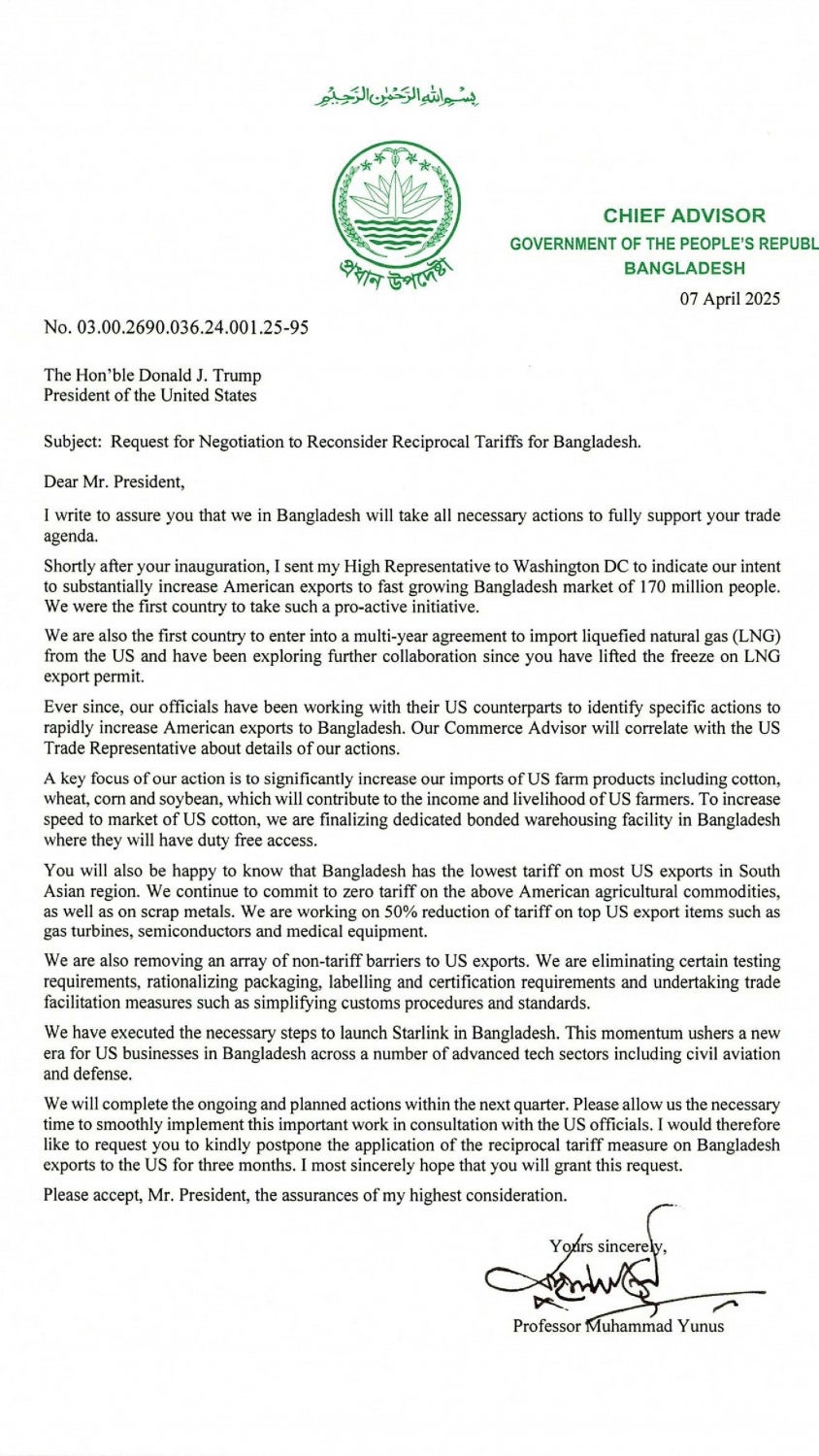
On April 7, Muhammad Yunus, chief adviser of Bangladesh, sent Trump an urgent letter. He listed all the ways that his country was trying to comply with Trump’s agenda and asked him to delay tariffs.
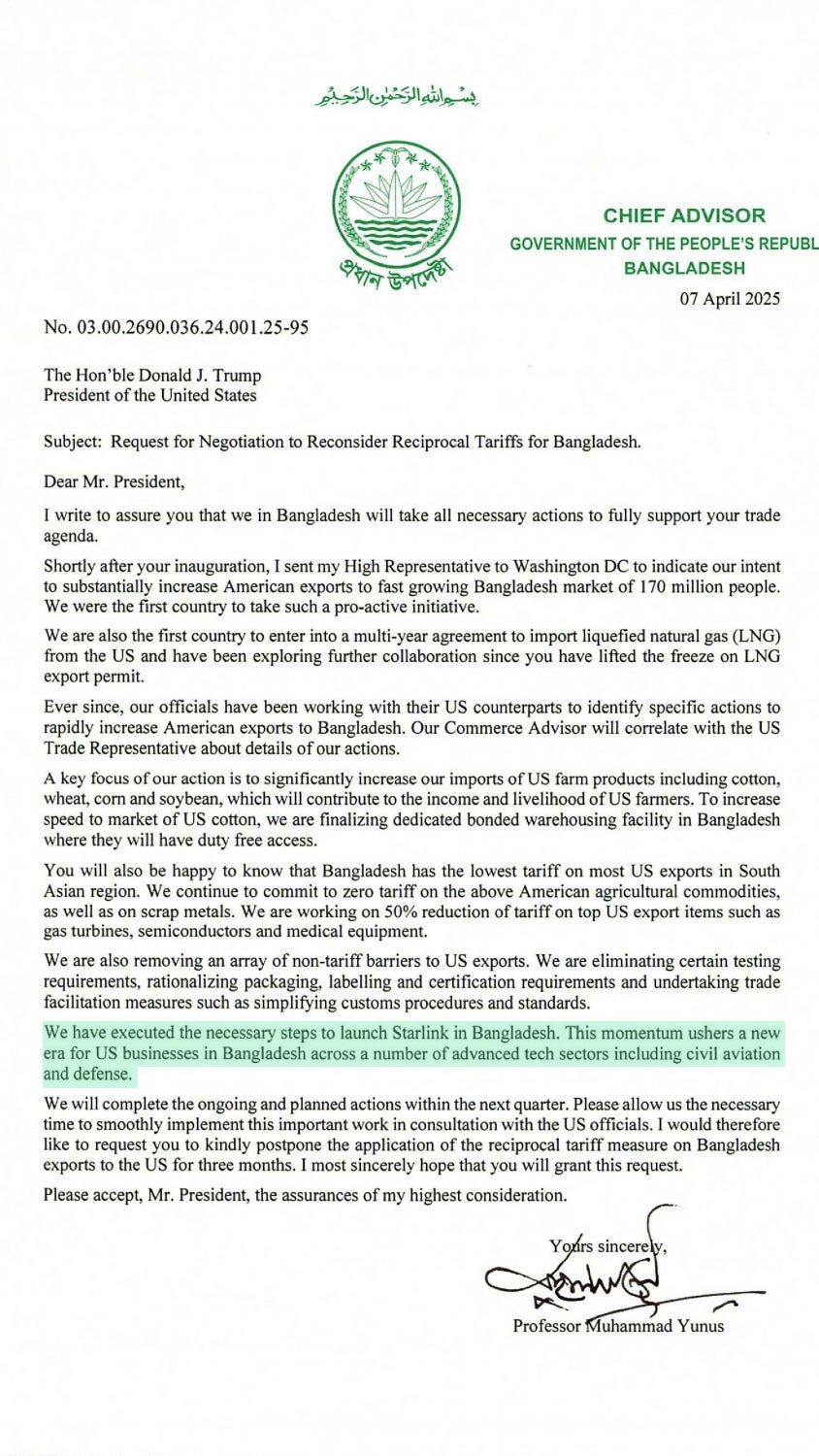
Yunus ended the note with a curious addition: “We have executed the necessary steps to launch Starlink in Bangladesh.” Three weeks later, Bangladesh approved Starlink’s application to operate in the country.
Bangladesh became the latest country around the world to expedite its regulatory approval process for satellite internet providers while Musk took part in Trump’s second administration. During the first five months of the year — as Musk assumed his lead role in the Department of Government Efficiency — Starlink announced it had become available in at least 13 countries, while its applications were approved in two more. In the six months since Musk broke ties with the administration, Starlink announced its entry into an additional 13 countries, totalling at least 26 countries in 2025.
In some cases, Starlink found quick success in countries it sought to enter for the first time. In others, Starlink’s applications had stalled for years until they were suddenly greenlit.
“With Starlink, none of [the] regular procedures have been followed,” said Mohammad Aminul Hakim, president of the Internet Service Providers Association of Bangladesh, which represents over 900 companies in Bangladesh’s internet sector. He told Rest of World that he had never seen any internet service provider being granted the right to operate in Bangladesh so quickly.
Reporting by outlets including ProPublica and The Washington Post suggests that the support and influence of the White House may have made the difference. Several countries that ushered in Starlink this year appeared to be trying to stave off Trump’s tariffs and were pressured by the U.S. State Department to expedite deployment, prompting calls from Democratic senators for an investigation into the company’s foreign deals.
In a new investigation of Starlink’s dealmaking across the globe, Rest of World obtained Bangladesh’s license agreement, which our research suggests has yet to be publicized. The document is embedded, in full, at the bottom of this article.
Rest of World also reviewed records and official statements in the public domain and interviewed industry stakeholders, satellite experts, and government officials across 10 countries, including some that welcomed Starlink this year and others that continue to elude the satellite internet provider.
We found that foreign government officials swept aside concerns around data sovereignty and privacy in hasty approval processes, which in some cases bypassed or changed standard processes. The details of Starlink’s previously unreported license contract lends credence to worries raised by researchers and activists about how Starlink and its government partners manage, access, and share user data.
The spate of Starlink deals has also left digital rights activists and civil society actors frustrated with the lack of safeguards and reliance on a foreign-operated satellite service for critical infrastructure. Their concerns may be justified: In 2022, Musk unilaterally decided to restrict Starlink’s satellite coverage over Kherson Oblast when Ukraine retook territory from Russia there, reportedly ordering an employee of Starlink’s parent company, SpaceX, to cut the coverage, according to a Reuters investigation. Starlink did not respond to requests for comment. Musk previously posted on X that “no matter how much I disagree with the Ukraine policy, Starlink will never turn off its terminals.”
Starlink is telling countries that “we’re going to help you bridge the digital divide,” Sascha Meinrath, the Palmer chairperson in telecommunications at Pennsylvania State University, told Rest of World. But he said that the scale of Starlink’s operations is unprecedented and will inevitably give rise to the technology’s integration into military and surveillance operations — for which civilians will pay the price.

Joan Wong for Rest of World
Last year, Reuters reported that SpaceX is helping to build surveillance capabilities for U.S. government agencies. Observers have argued that foreign governments could leverage Starlink to expand their surveillance infrastructure domestically. The U.S. Department of State did not respond to Rest of World’s requests for comment.
Digital activists and industry stakeholders across half a dozen countries told Rest of World their countries do not have adequate regulations around surveillance and data ownership to protect consumers and citizens, and that they’re concerned about the steamrolling of regulatory oversight in the name of political expediency and making nice with the U.S.
“If there are not enough safeguards for the people of Bangladesh … essentially, there is space for surveillance,” said Rezaur Rahman Lenin, a Bangladeshi digital rights activist who has been working in the sector for nearly two decades. “The problem is, when you fail to decide something without having a needs assessment, without having a proper consultation, without having an appropriate ownership and participation of the people of Bangladesh, then this isolated good work will not necessarily help Bangladesh.”
The Bangladeshi government did not respond to requests for comment.
In his election victory speech in November 2024, Donald Trump gushed about his newfound political ally, Elon Musk. The South Africa-born co-founder of iconic companies such as Tesla and SpaceX had donated almost $300 million in 2024 to get Trump and other Republicans elected, and became a fixture in his inner circle. By January, Musk was a regular sight in the Oval Office and seemed to lead the new Department of Government Efficiency.
Concerns about corruption and Musk’s companies receiving preferential treatment surfaced early. In March, the president transformed the White House lawn into a Tesla showroom, touting Musk’s cars and buying a Cybertruck for his granddaughter. The event was livestreamed by the deputy chief of staff on X.
Starlink also stood to benefit from the close relationship between its founder and the U.S. president. The company, which already held some federal contracts with the government, started expanding its domestic footprint, with several agencies reportedly exploring the idea of integrating Starlink coverage into their work. (The White House told NBC News in March that “any contracts connected to Elon Musk’s very successful companies will comply with every government ethics rule as it pertains to potential conflicts of interests.”)
“There were [American] government officials, whether authorized or not, who were basically saying, if you want favorable treatment from Trump, you better be good to Musk,” said Blair Levin, a policy adviser with New Street Research, who led the Obama administration’s National Broadband Plan and was formerly chief of staff with the Federal Communications Commission.
Global leaders quickly took note. Bangladesh’s Yunus approached Musk within a month of Trump’s inauguration.
Getting a license to operate a satellite internet service in Bangladesh is usually a lengthy and complex process. It can take up to a year to be approved by the regulatory commission, and requires jumping through multiple hoops to receive security and intelligence clearances, according to Mohammad Aminul Hakim of the Internet Service Providers Association of Bangladesh. For Starlink, this went both rapidly and smoothly this year.
In February, Yunus dispatched a special envoy to Washington to meet with U.S. government representatives. According to The Washington Post, the Bangladeshi representative met with Musk and discussed negotiations for Starlink’s entry into the country — while Bangladesh told the publication the meeting did not happen. Around the same time, Musk and Yunus met virtually and “agreed to work together.”
Three weeks later, Faiz Ahmad Taiyeb, a special assistant to Yunus on telecommunication and information technology, announced that local companies had begun working on a ground station for Starlink’s services. By late April, BTRC had granted Starlink a 10-year operating license.
Rest of World obtained the previously unpublished 27-page licensing agreement, which details provisions on revenue sharing, ground stations, and data access. Under the terms, Starlink will begin to share its revenues with the Bangladeshi government from its third year of service, with revenue-sharing starting at 3% and escalating to 5.5% for the sixth year and beyond.
The agreement also requires Starlink to operate at least one local gateway in Bangladesh and to provide law enforcement agencies with the ability to surveil communications in some circumstances, including in the case of a “national security” threat. Starlink can receive a 25% reduction of various application and licensing fees if it connects to a government-owned gateway or partners with a Bangladeshi satellite operator.
Tim Farrar, a satellite communications consultant who reviewed the agreement at Rest of World’s request, said there was nothing “exceptional” in the agreement “other than perhaps the speed with which the license was granted.” The regulatory fees are “high but not so high that it makes the service infeasible,” Farrar told Rest of World.
Indian Prime Minister Narendra Modi also moved quickly to accommodate Starlink this year. During a February trip to Washington to meet Trump, Modi sat down with Musk, alongside Musk’s three young children.
Starlink had been trying to enter India since 2021, but had difficulty procuring licensing and security clearances. The Indian government had demanded that the company commit to storing all data from users in the country, and give it the ability to monitor or regulate traffic through local ground stations. In April, during a meeting with India’s Commerce and Industry Ministry, Starlink representatives raised concerns over the slow pace of clearances, according to a source privy to the conversation.
Within a few weeks — and after another conversation between Modi and Musk — the company finally received government approval. In July, it was given a license to launch commercial operations in the country. Starlink, in turn, accepted India’s requirements on data storage and localization.
The Indian government did not respond to Rest of World’s requests for comment. Starlink did not respond to questions about Musk’s meeting with the government.
Similar turnarounds took place in Vietnam and Pakistan, where Starlink’s license applications had been stalled over local ownership requirements and other concerns. This February, the Vietnamese government lifted its strict requirement for foreign companies to have a partner in the country and approved a five-year license for Starlink the next month. Pakistan similarly granted Starlink provisional permission to start its services in March.
“When Trump came, everything sped up,” Tariq Mustafa, a Pakistani network engineer who has worked with internet service providers in the country for more than 25 years, told Rest of World.
The Pakistan Space Activities Regulatory Board directed Rest of World’s request for comment to the Ministry of Information Technology and Telecommunication, which did not respond to queries.
The previously unpublished license agreement between Starlink and Bangladesh reveals details about how the company will treat customer data. Under the terms of Bangladesh’s agreement with Starlink, the agency can permit the company to identify and monitor communication to and from a customer’s device to prevent “harassing, unsolicited, offensive, fraudulent or unlawful communication” as well as share user information with other partners. The data sharing provisions are “common for telecoms services in developing countries,” said Farrar.
But B M Mainul Hossain, director of the Institute of Information Technology at the University of Dhaka, said the arrangement triggers “major privacy concerns.” Hossain, who reviewed the agreement at Rest of World’s request, argued the terms are not clearly defined and “can be exploited.”
He called “any concerns about the government jurisdiction [over citizen data] … or about privacy concerns” valid. “The right to personal data must belong to users, not be determined by any other organization,” Hossain said.
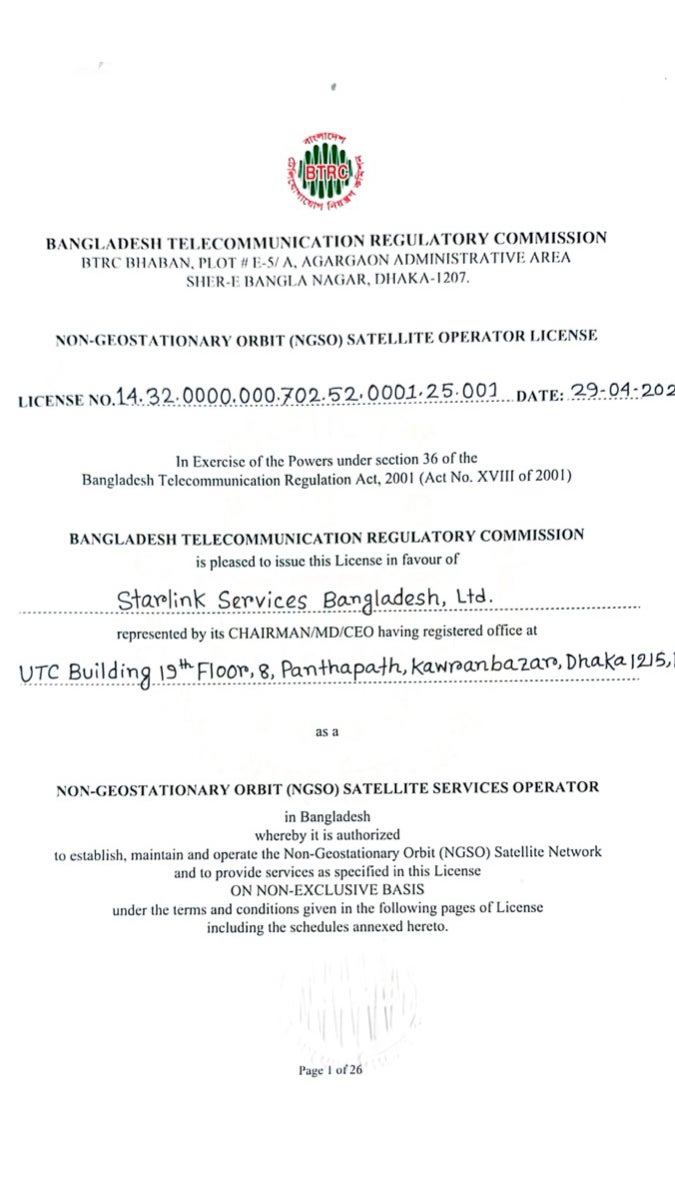
Rest of World obtained Starlink’s previously unpublished 27-page license agreement to operate inside Bangladesh.
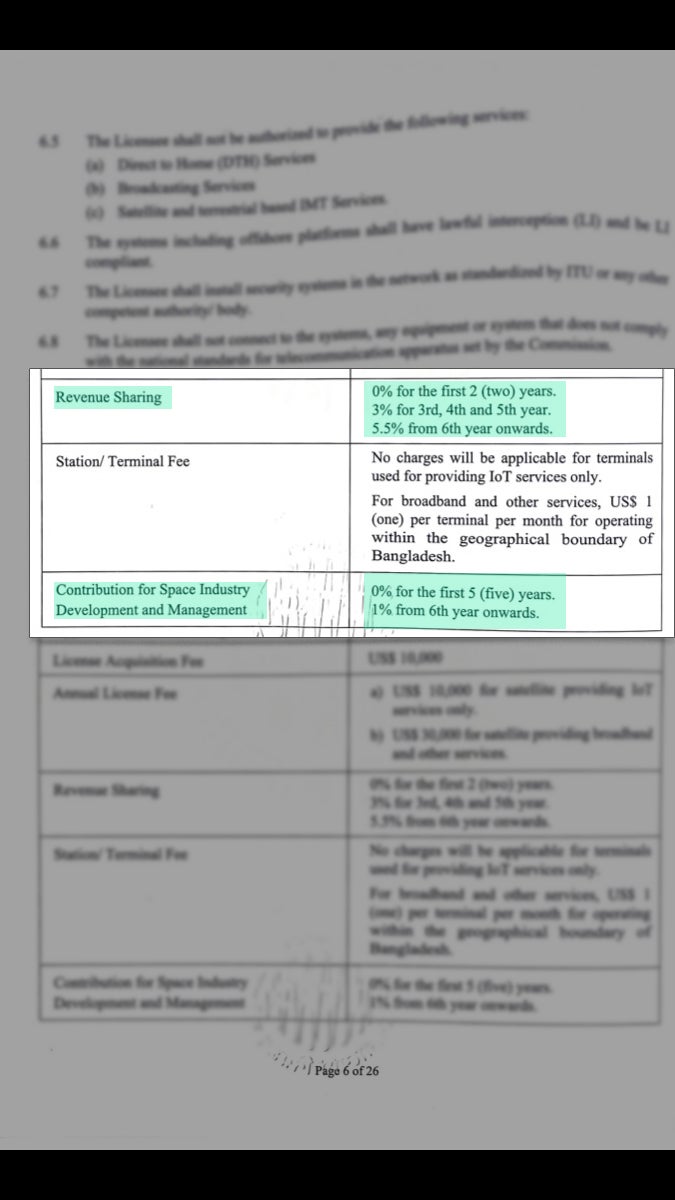
Starlink will begin to share its revenues with the Bangladeshi government from its third year of service, with revenue-sharing starting at 3% and escalating to 5.5% for the sixth year and beyond.
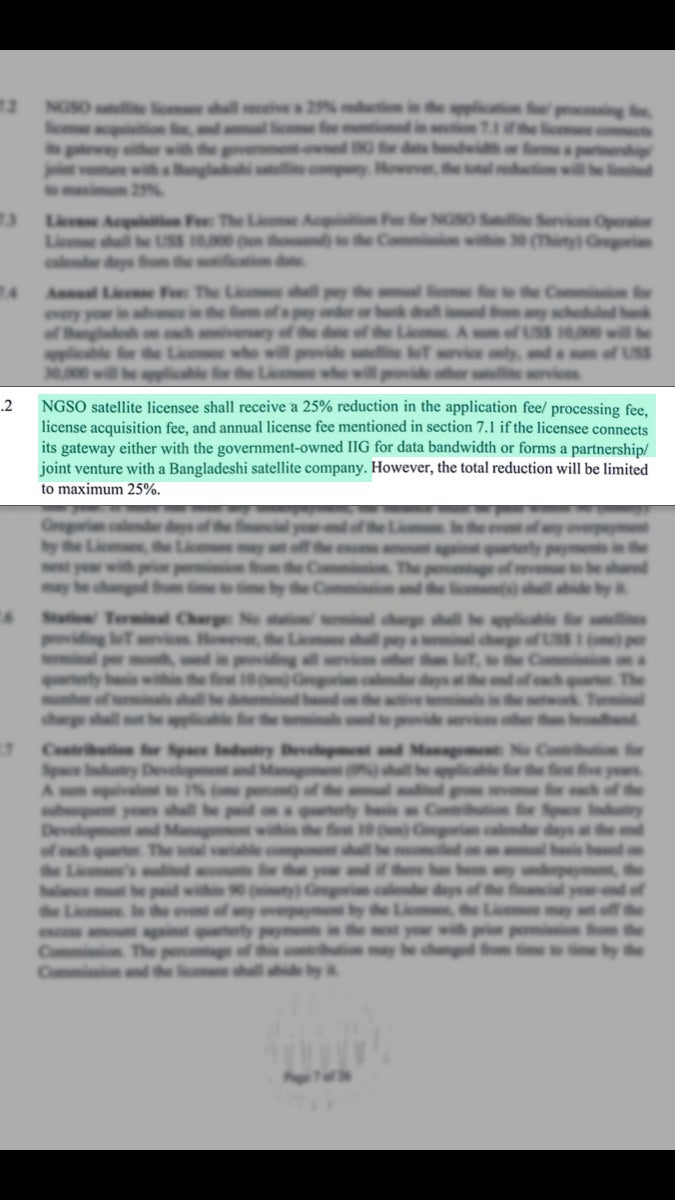
Starlink can receive a 25% reduction of various application and licensing fees if it connects to a government-owned gateway or partners with a Bangladeshi satellite operator.
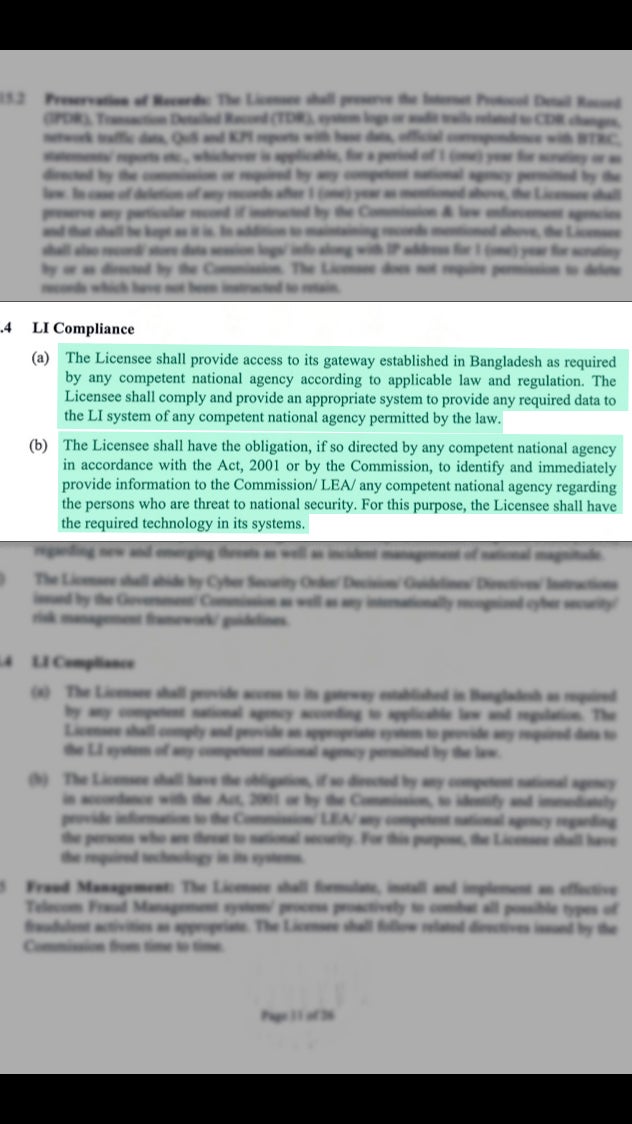
The agreement requires Starlink to provide law enforcement agencies with the ability to surveil communications in some circumstances, including in the case of a “national security” threat.
Bangladesh’s agreement with Starlink also details “lawful interception” — a process in which a telecommunications provider allows law enforcement to legally access and surveil a target’s communications. Human rights groups and lawyers in Bangladesh, including Hossain, contend the country does not have a well-established and complete protocol surrounding lawful interception that includes detailed procedural requirements, oversight, and transparency.
“Starlink’s rapid entry into Bangladesh has been framed as a solution to internet shutdowns and an investment magnet,” said Sabhanaz Rashid Diya, executive director at Tech Global Institute, an international tech policy nonprofit, and former head of public policy for Bangladesh at Meta. “In reality, it raises deep risks for sovereignty and rights. Satellite internet is vulnerable to foreign interference, jamming, and cyberattacks, and Bangladesh lacks the domestic capacity to defend against such threats.”
Taiyeb, the special assistant to Bangladesh’s chief adviser on telecommunications, told Rest of World there are “ongoing discussions with the Ministry of Home Affairs regarding lawful interception of communications. Since this is a new technology, it will take some time to develop the technical knowledge and legal framework for interception.”
In March, Bangladesh issued new satellite internet guidelines that require service providers to route internet traffic through at least one gateway system in the country before commencing their service, according to a copy of the regulations reviewed by Rest of World. Though Starlink’s license echoes that requirement, in May, the commission granted the company an “extraordinary” 90‑day waiver to operate without a local gateway. When the gateway is located outside a country, user traffic may be routed through foreign servers, which some experts say could lead to mass surveillance and data interception by foreign intelligence services or actors.
Starlink ultimately established four local gateways in Bangladesh in September.
Not every foreign government, however, has been willing to grant Starlink access to its markets. Rest of World reporting documents how some of these countries have expressed concern over privacy and ownership.
In Musk’s native South Africa, Starlink’s efforts to enter the country continue to be held up over his refusal to comply with a regulation requiring 30% ownership by historically disadvantaged groups. In Turkey, where Starlink first established a legal entity in 2020, according to trade registry documents obtained by Rest of World, the company’s licensing application remains pending — despite public outcry for its approval following the devastating 2023 earthquake. The Turkish government did not respond to requests for comment.
Joan Wong for Rest of World
Earlier this year, Starlink also got bad news in Belize. Its application for a license to operate as an internet service provider in the Central American nation was denied. While Belize’s Public Utilities Commission left the door open for individual users to import Starlink terminals in limited circumstances, the decision fell far short of the access that Starlink had asked for. Among the factors the agency listed to explain the outcome were concerns around data sovereignty raised by industry stakeholders.
According to the Public Utilities Commission of Belize, the regulator received a “record number” of comments from the public about Starlink’s application. Some comments reflected support for satellite internet services while other institutions stated their opposition.
“The transfer of Belizean data to foreign servers raises concerns about data localization requirements and potential foreign surveillance or censorship,” the Belize Communications Workers Union had written in October 2024, according to regulatory records reviewed by Rest of World.
“Starlink operates global networks thus inherently pose challenges related to data sovereignty,” wrote the chair of Belize Telemedia Limited, the country’s leading telecommunications provider. “This is because significant amounts of local data could be routed and stored outside national boundaries.”
“Citizens have a right to their data and how it is used,” commented the Belize Business Bureau. “A nation without control over its communication is exposed and its sovereignty threatened.”