Washington’s new anti-cartel coalition turns Ecuador into a test case for a broader regional doctrine, one that links military force, migration control, and strategic rivalry with China, while asking Latin American governments to trade autonomy for security in public view.
A Summit That Redrew the Map
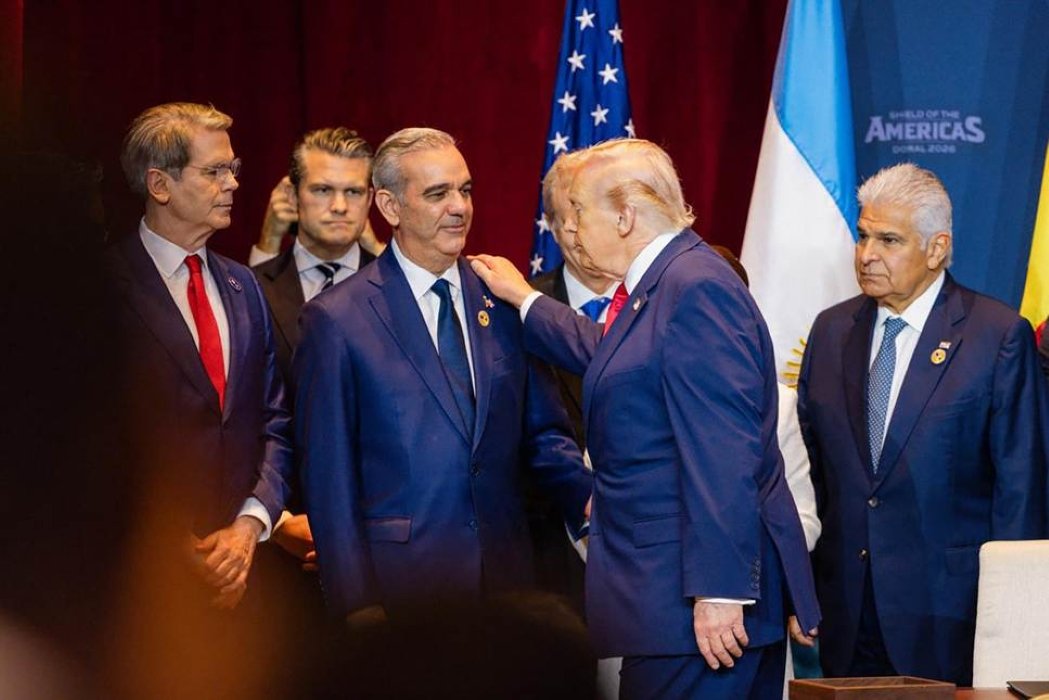
The image was as blunt as the message. Donald Trump stood at the Shield of the Americas Summit with a cluster of Latin American leaders behind him and signed a proclamation calling for hemispheric coordination to build what it described as “the most effective fighting force” possible against cartels. Before signing, he cast the mission in unmistakably martial terms, calling it “a commitment to using lethal military force to destroy the sinister cartels and terrorist networks,” then told the region’s governments that Washington needed only one thing from them: locations. “You have to just tell us where they are.”
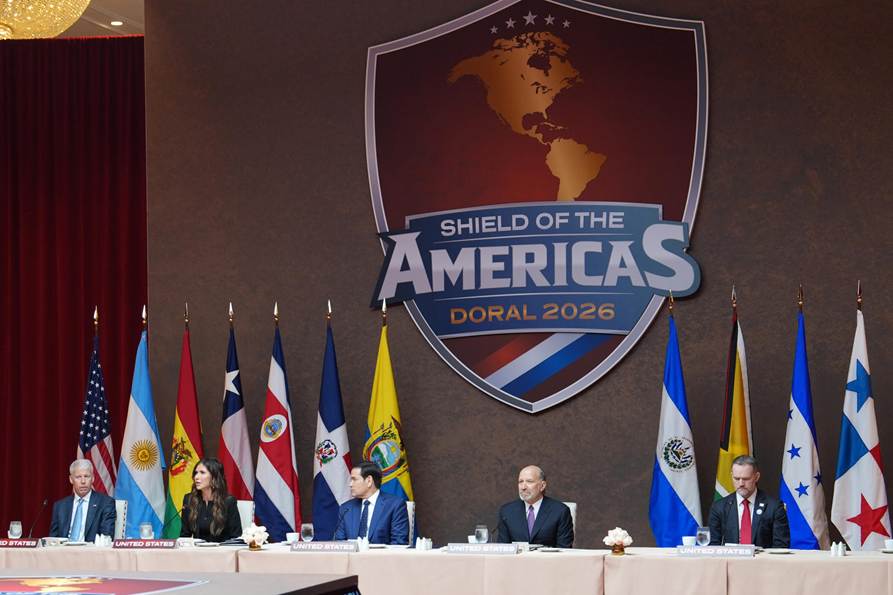
That language matters because it goes beyond the old vocabulary of aid, training, or counternarcotics coordination. This is a doctrine of operational alignment. Seventeen countries signed a joint security declaration with Defense Secretary Pete Hegseth at the inaugural Americas Counter Cartel Conference, and the new push now carries the formal banner of the Americas Counter Cartel Coalition. In Trump’s telling, the United States is no longer asking Latin America to cooperate around a shared problem in cautious diplomatic language. It is asking governments to plug into an openly militarized architecture led by Washington.
The first test case is already Ecuador. U.S. Southern Command announced this week that American forces joined Ecuadorian security forces against what it called narco-terrorist organizations, and that was followed by what the U.S. military described as targeted “lethal kinetic action.” Reuters reported that the joint operation targeted a drug traffickers’ camp in Ecuador near the Colombian border, underscoring how quickly this new coalition is moving from summit language to live fire.
For Latin America, that is the true hinge of the moment. The summit was not just about Ecuador, and not even just about drugs. It was about defining the hemisphere again as a strategic space where Washington intends to lead through force, security promises, and selective partnerships. Trump said the region had been abandoned by the United States for too many years and made clear that he now sees it as a central arena. The implication is simple, even if the consequences will not be: the hemisphere is back at the center of U.S. foreign policy, but under a logic that is harder, more ideological, and more openly geopolitical than the language of partnership usually suggests.
Drugs, Migration, and China in One Frame
The coalition is being sold as a response to cartels, but the notes point to a broader structure. The Trump administration’s hemispheric push is also about migration control and reducing China’s influence in Latin America, an approach some have started calling the Donroe Doctrine. The proclamation Trump signed did not mention China by name, but it committed the United States and its allies to keeping out “malign foreign influences from outside the Western Hemisphere,” a line that lands as an unmistakable reference to Beijing’s growing economic and military footprint in the region.
That fusion of agendas is what gives the policy its geopolitical weight. Drugs are the emergency argument. Migration is the domestic political argument. China is the strategic argument. Bound together, they allow Washington to present a single security framework for almost every major regional issue it wants to shape. A government that joins the coalition is not only helping target traffickers. It is also entering an American sphere of influence designed to limit rival power, police mobility, and reward alignment. That may bring military backing and diplomatic favor. It also narrows room for maneuver.
This is where Latin America’s history starts murmuring beneath the present. The region knows what it means when Washington talks about civilization, security, and external threats in the same breath. Hegseth explicitly linked the current moment to the Monroe Doctrine, saying the hemisphere still needed protection from outside powers and secure access to trade and key terrain. That kind of language lands differently in Latin America than it does in Washington. In the United States, it sounds like strategic restoration. South of the Rio Grande, it can also sound like hierarchy returning with new packaging.
Regular governments in the region will read this through their own needs. Leaders facing criminal violence may welcome a U.S. umbrella. Leaders already close to Trump, like Daniel Noboa, Javier Milei, and Nayib Bukele, are likely to see political and material advantage in standing close to the new coalition. But even for friendly governments, there is a cost hidden inside the embrace. Once cartel policy becomes explicitly military and openly tied to wider U.S. strategic rivalry, domestic security decisions become more entangled with great-power politics. A police problem becomes a geopolitical alignment test.
A Region Asked to Choose
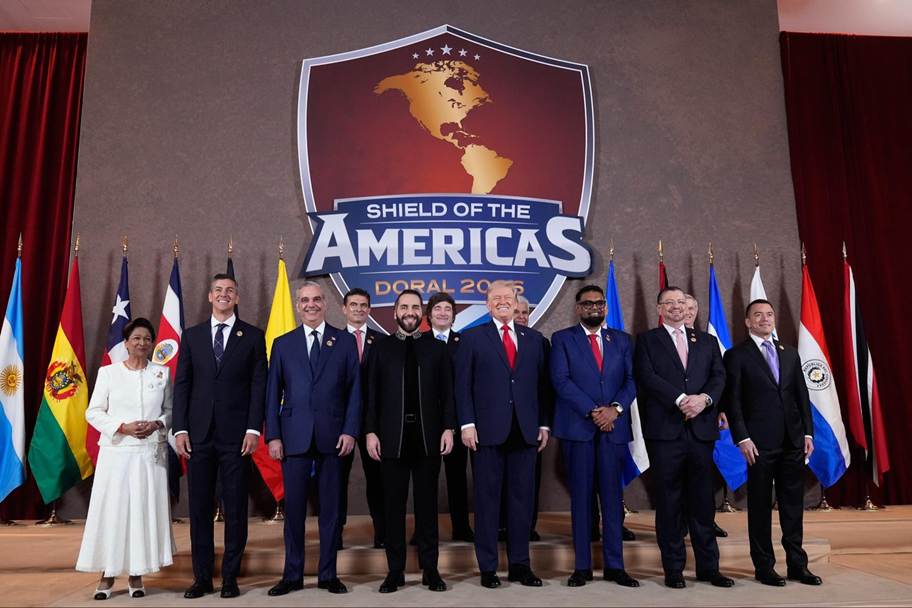
The attendance list itself told a story. Noboa was there. Milei was there. Bukele was there. Chile’s president-elect José Antonio Kast was there too, alongside leaders from Bolivia, Chile, Costa Rica, the Dominican Republic, Guyana, Honduras, Panama, Paraguay, and Trinidad and Tobago. Even countries whose leaders did not attend had representatives sign on to the broader effort. This is not yet a single bloc, but it is clearly the outline of one: a U.S.-anchored coalition in which security cooperation becomes the preferred grammar of hemispheric politics.
That shift could deepen divisions inside Latin America. Countries that sign on may gain easier access to Washington’s attention, resources, and political backing. Countries that hesitate may find themselves treated less as autonomous actors than as weak links, or worse, as spaces open to “malign influence.” The region has always been fragmented, but this policy risks sorting that fragmentation into camps more sharply. The old left-right divide does not disappear here. It hardens under military vocabulary. And because the coalition also aims to curb migration and roll back China’s influence, governments are being asked to choose not only how to fight crime, but where they stand in a renewed contest over the hemisphere itself.
There was another revealing detail. The summit was partly overshadowed by the war with Iran, already entering its second week, and Trump left Miami for Delaware to attend the dignified transfer of six U.S. soldiers killed in a drone strike in Kuwait. Asked about that war, he rated it a “15” out of 10. That jarring overlap matters. It shows how this new Latin America policy is being born inside a broader White House posture that prizes force, theater, and escalation across multiple fronts at once. The hemisphere is not being invited into a patient diplomatic reset. It is being folded into a harder global security mood.
So what does this mean for Latin America geopolitically? It means the region is being recast as a frontline again, not only against cartels but against migration pressure and outside influence, with Washington expecting loyalty, intelligence, and operational access in return for protection. It means Ecuador may be remembered less as an isolated strike and more as the opening scene of a wider doctrine. And it means many governments will soon have to decide whether they are joining a coalition, borrowing a shield, or quietly surrendering part of their strategic independence.
Also Read:
Ecuador Finds a Narco Sub and Latin America Sees Itself