Amal El Fallah Seghrouchni has spent her career building artificial intelligence. Now she regulates it.
Morocco appointed her Minister of Digital Transition and Administrative Reform in October 2024. With a Ph.D. in computer science, 200-plus research papers, and a track record of running Africa’s first UNESCO center for AI, her job now is to make the technology work for the people it has ignored.
Under her watch, Morocco has put 660 government services on a single national portal and is rolling out chatbots so citizens who aren’t comfortable with screens can still access them. The country has partnered with France’s Mistral AI to build language models that understand Arabic and also Darija and Amazigh, Morocco’s widely spoken but digitally neglected languages.
Seghrouchni wants Morocco, along with Africa and the Arab world, to offer what she calls a “third voice” on AI, separate from the U.S., European, and Chinese approaches. Her argument is blunt: Eighty languages across Africa have been ignored by the big tech companies. If nobody else is going to build AI that speaks to them, Morocco will.
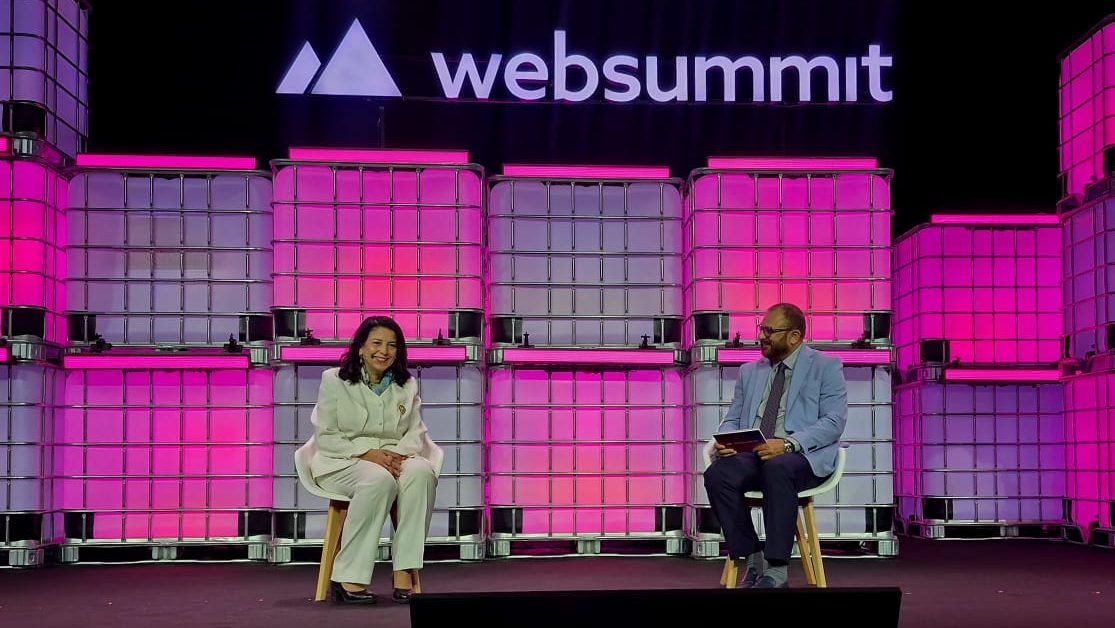
Seghrouchni spoke with Rest of World at the Web Summit Qatar 2026 in Doha. The conversation has been edited for length and clarity.
Morocco has positioned itself as a digital leader in Africa and the Middle East. But AI governance feels like trying to regulate something that is changing faster than policy can keep up. How do you govern something you can’t fully predict?
Nowadays, nothing is completely predictable, so we have to govern in uncertainty. This means you have to make decisions while keeping the ability to adjust as much as possible. Our actions should be in an open world that moves and changes, and we have to make decisions all the time while keeping the ability to backtrack if necessary.
Can you provide a concrete example of the AI-driven governance Morocco has implemented — not a pilot, but something that has actually changed how the government works?
Morocco has developed many applications based on AI deployed as administrative services. We have a national portal with 660 services, and what we are doing now is pushing inclusion by using chatbots that can interact with citizens, even in situations where people are not familiar with digital and AI.
What surprised you most during implementation? Did everything go as planned?
No. The most difficult thing was coordination between all administrations, because the national portal includes 660 services. Now we are launching our e-wallet that can be used as a super-app providing these services on mobile. The most difficult thing is not technology — it’s how to conduct change. In AI, it’s tricky to get everybody on board and move to smart applications that talk to people.
This idea that regulation kills innovation is false.”
How do you regulate AI without killing innovation, especially when you’re competing regionally for investment and talent?
This idea that regulation kills innovation is false. Today, what people are looking for is confidence — trustworthy AI. If you provide services with confidence, you can sell more services than those without regulation. We have seen cybersecurity threats in Morocco. When people see their personal data on the dark web, everybody wants confidence. The best guarantee to get AI adopted by the majority is to provide trustworthy AI.
When you look at the U.S., the EU, and China, whose model is Morocco learning from the most? Is there space for a distinct regional approach?
Morocco is learning from everybody. All existing frameworks are necessary to understand — we are benchmarking everything. But I think Morocco can provide, with Africa and the Arab world, a third voice for AI. What does that mean? We are in between. Morocco can push for ethical, responsible, frugal AI — AI that respects dignity and takes care of populations. We push for this at the continental level. Of course, we are open to cooperation with other countries — Europe, the U.S., China — as much as possible, when our sovereignty is protected and guaranteed.
Morocco has partnered with Mistral AI to develop language models in Arabic, Darija, and Amazigh. Why is this linguistic dimension so important?
A good tool is one that speaks your language. If you deploy a chatbot that speaks English to people who have never spoken English, you eliminate many people from using it. To spread this use, we need tools that talk to people in their native languages while preserving their culture and values. Today, existing large language models are not designed to speak Darija or Amazigh — they are not native to that. We have 80 languages and dialects in Africa, and nobody cares about them. So we have to do it ourselves.
Morocco is preparing to co-host the 2030 FIFA World Cup. You’re building data centers and rolling out 5G, but you’ve also talked about serving the broader Sahel region. How do you see Morocco’s role in helping other African nations develop their AI capabilities?
First, we organized the Africa Cup of Nations very recently, and the entire world saw that Morocco is up to date in terms of infrastructure and welcoming populations from abroad. For the World Cup, we are ready. Morocco, when engaged in global action, shows the world we can do fantastic things.
From a technological point of view, we are building a data center intended to be a data embassy for the Sahel region. We have many projects developed toward Africa — providing capacity for storage, computation, and support for shaping data and developing new models for Africa.
In the past, I launched a program called African Women in Tech and AI. I have incubated more than 350 women from 28 countries in Africa. Last September, we were appointed a digital hub for Africa in data science and AI. This means we have to co-build the third voice of AI in Africa and abroad.
You’ve given us the vision. Please also give us the doubt. What keeps you awake at night?
Lots of work — in particular, the tasks I haven’t finished. But I think we should use AI. This is a fantastic opportunity for the world, and in particular for our countries, because we can use AI to leapfrog in development. But I also see AI as a means for introspection — in our civilization, in our cognition, in our relationships. AI is shifting from the individual to society.
It’s not a question of using a tool; it’s a question of redefining our relationships together. We should take this opportunity to make this introspection in our civilization, to understand and to elevate vulnerable people.