Bad Bunny’s Super Bowl halftime became a cultural flashpoint, then a regulatory threat. Republicans urged the FCC to fine or jail people tied to the broadcast, citing lyrics and choreography. The numbers say viewers stayed. The politics says somebody panicked.
Sugar Cane, Stadium Lights, and a Familiar American Switch
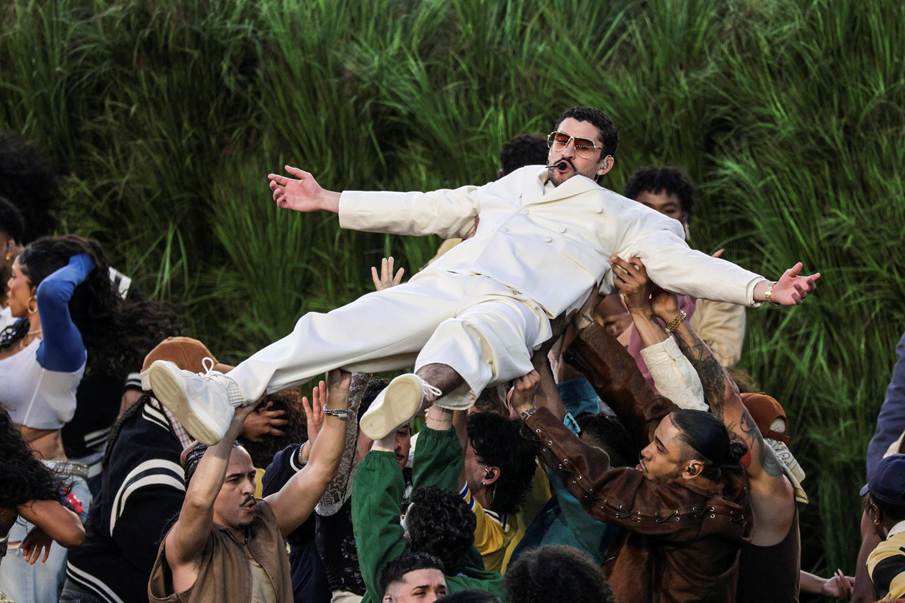
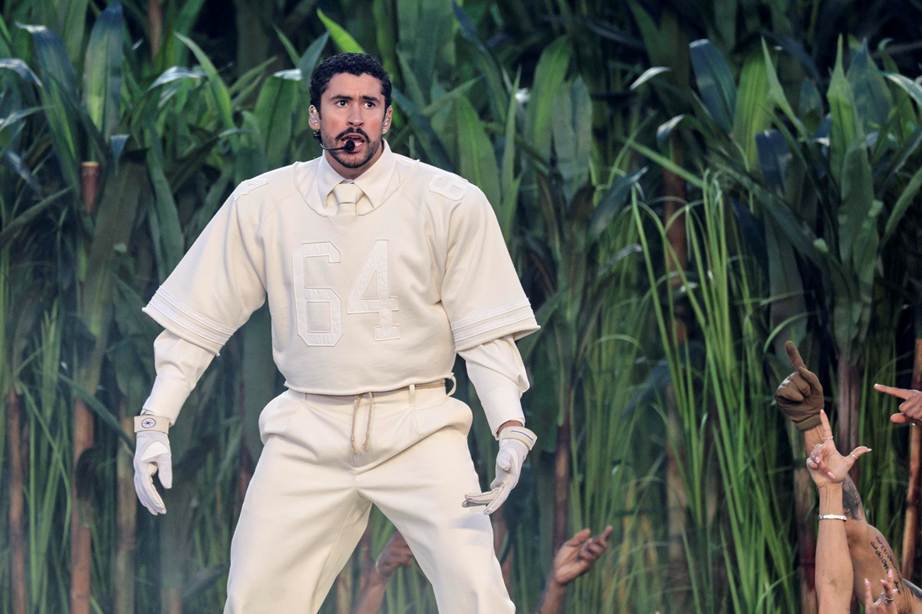
It starts where the notes insist it started, on a football field made to look like somewhere else. A sugar cane field built for cameras. Palm trees and island vegetation where yard lines usually rule the eye. Street-life vignettes. Vendors. Farmers in traditional hats. A moving crowd that kept re-forming so the lens could travel through it like a short film, not a concert.
Under stadium lights, bodies moved in tight unison and then broke loose again. The set was designed as an immersive trip through Puerto Rico, the notes say. It stayed kinetic and party-forward, powered by choreography that looked like Puerto Rico rather than generic halftime choreography.
A sensory detail that mattered, even through a screen, was the shine. Sweat catching light. The kind of sheen that tells you this is effort, not a tableau. A lot of bodies, a lot of motion, and little room to pretend it was anything but alive.
Then, the everyday observation implied by the notes is familiar to anyone who has watched the Super Bowl at home. The switching. Living rooms do what living rooms do. People toggle. A remote in one hand, attention split between the official broadcast and whatever else is being offered. Rep. Mark Alford described doing exactly that, saying he was switching back and forth with a Turning Point USA halftime show meant as an alternative to the official halftime.
The trouble is that the Super Bowl is never just entertainment. It is a national ritual, with regulators and politicians watching the same footage as everyone else, sometimes with very different purposes.
Bad Bunny’s performance was anchored in Spanish and in dance styles that do not apologize for their origins. The perreo section, especially during “Yo Perreo Sola,” leaned into adult movement vocabulary as the point, not the accident. Low, grounded reggaetón phrasing. Hip isolations. Pelvic rolls. Quick level changes. Confidence and control rather than Broadway leaps. The staging treated it like a scene inside Puerto Rican nightlife, not a “twerk break” pasted onto a football field.
And the language mattered. The notes say the performance was primarily, and per Reuters entirely, in Spanish. That became part of the cultural statement. It also became the spark.
Because when the wrong people hear Spanish in a space that they think belongs to them, they do not reach for subtitles. They reach for enforcement.
When a Cultural Complaint Becomes a Regulatory Threat
By Tuesday, the notes say, Republican members of Congress were calling on the Federal Communications Commission to punish not just a network but individuals. “Multar” and “encerrar,” the Spanish text reads, fine and jail. The demand was not subtle.
Rep. Randy Fine argued the show was illegal, claiming it included words that, if translated into English, would warrant suspending the broadcast, plus what he called pornographic filth. He said he was sending a letter to Brendan Carr, president of the FCC, seeking dramatic action, including fines and license reviews against the NFL, NBC, and Bad Bunny, then summed it up with a command: ” Lock them up.
Fine’s argument leaned on translations into English that included words like “dick,” “ass,” and “fuck,” words that cannot be expressed on broadcast television. The notes also add a key detail that undercuts the claim’s simplicity: in concerts like the Sunday event, singers avoid those words to comply with the rules. That tension, between what people assume was said and what rules usually push performers to do, is part of what makes this controversy feel less like due process and more like performance.
Andy Ogles, the Tennessee congressman, added a separate push. He sent a letter to the Energy and Commerce Committee requesting a formal investigation into the NFL and NBC for facilitating what he called an indecent broadcast. He claimed the music glorifies sodomy and other “unnamable depravities.” He argued that children were forced to endure explicit displays of gay sexual acts, women moving explicitly, and Bad Bunny grabbing his groin while thrusting.
If you are looking for the policy dispute, it is right there, not in the choreography itself but in the leap from choreography to punishment, from discomfort to jurisdiction. What this does is turn culture into a compliance problem, and it does so with a familiar American instinct: if you cannot control what people love, you try to control who is allowed to show it.
Alford, the representative from Missouri, said Republicans were already investigating the performance. On Real America’s Voice, he said this could be worse than the Janet Jackson incident in 2004. He said he does not speak fluent Spanish, that he knows how to ask where the bathroom is, but if the lyrics translation is true, there are questions for broadcasters, and he would be talking with Carr at the FCC.
The wager here is that ignorance can still be operational. Not speaking Spanish did not slow the impulse to police Spanish. It simply shifted the claim onto translation as a weapon, with the implication that meaning is assumed and enforcement comes first.
The notes say President Donald Trump called the show one of the worst in history and an affront to the greatness of the United States. He described the dancing as disgusting. The language is blunt, but the move is strategic. If you label it disgust, you can sell punishment as protection.
The numbers tell a parallel story. Nielsen data in the notes says the halftime show became the fourth-most-watched in Super Bowl history, averaging 128.2 million viewers. That figure exceeded the overall audience average for the year’s Super Bowl broadcast and placed Bad Bunny behind Kendrick Lamar’s record, Michael Jackson’s 1993 performance, and Usher’s 2024 show. Nielsen also said the halftime broke records across social media platforms, with moments shared widely and turning into worldwide trends during and after the event. The full worldwide audience, the notes add, was expected later.
So the public watched. Then watched again on their phones. Then replayed clips. And while that was happening, politicians talked about fines, license reviews, and jail.
There is a deeper context in the notes that makes this feel less like an isolated scuffle and more like a governance style. Carr, the FCC chair, has previously urged the media to align with the administration. The notes cite September 2025, when he warned of measures against ABC, including reviewing permits, if the network did not punish Jimmy Kimmel for comments about the assassination of Charlie Kirk.
Put together, it forms a pattern that is hard to ignore. Broadcast regulation becomes a political tool. Cultural controversy becomes a pretext. The FCC becomes a stage.
And Puerto Rico, in this telling, is both the subject and the excuse. A halftime show that foregrounded Puerto Rican movement, Puerto Rican Spanish, and Puerto Rican visibility is being treated as something to discipline.
Not because it was unseen. Because it was seen by everyone.
Also Read:
Brazil Recife Film Tour Turns Oscar Fame into Living Urban Memory