U.S. President Donald Trump said yesterday that, once the ongoing U.S.-Israeli conflict with Iran is finished, regime change in Cuba will be a “question of time”.
He also told POLITICO that “Cuba’s going to fall” and suggested that change on the island could come within the next two weeks.
His comments come amid mounting U.S. pressure on the island, including sanctions and a near-total oil embargo. However, it remains unclear how change will come about and what it will entail.
“We cut off all oil, all money, or we cut everything coming in from Venezuela, which was the sole source, and they want to make a deal,” Trump told POLITICO in an interview on Thursday.
Trump has previously said that there is growing diplomatic dialogue between the two nations. But the American leader does not appear to be as concerned with Cuba’s fate as that of Iran, saying: “How long have you been hearing about Cuba — Cuba, Cuba — for 50 years? And that’s one of the small ones for me”.
The Trump’s administration’s approach to Cuba has so far consisted of a campaign of maximum economic pressure, which has seen the U.S. government threaten tariffs against any nation that supplies Cuba with oil and order the seizure of Cuba-bound oil tankers.
The effects have been devastating: the UN warns that the blockade is affecting health care, food distribution and water services. 84% of Cuba’s water pumping systems rely on electricity, as do certain key treatments for thousands of pregnant women and cancer patients.
So far, the Trump administration has refrained from military action like that used to extract strongman Nicolás Maduro from Venezuela earlier this year. Nevertheless, a group of Cubans residing in the U.S. who reportedly belong to the anti-Cuban regime People’s Self-Defense Forces (ADP) group last week attempted an armed “infiltration” of the island. The consequent shootout with the Cuban Coast Guard left 4 ADP members wounded, 6 dead and a Cuban coast guard commander injured.
The ADP promotes clandestine armed action against the Havana government. Although the U.S. government denied any involvement with the incursion, the ADP’s actions symbolise growing tension between the Cuban government and the U.S.-based Cuban opposition. Various Cuban-American opposition groups signed the “Liberation Accord”, a document which outlines their plans for regime change, on Monday.
U.S. government support for a military operation is nevertheless conceivable. As Washington’s recent strikes against Iran and the capture of Cuban ally Maduro demonstrate, the current U.S. administration is willing to use military force against foreign adversaries when it believes diplomacy does not work.
In this vein, if the reported diplomatic negotiations with the Cuban government fall through, a military option may be considered.
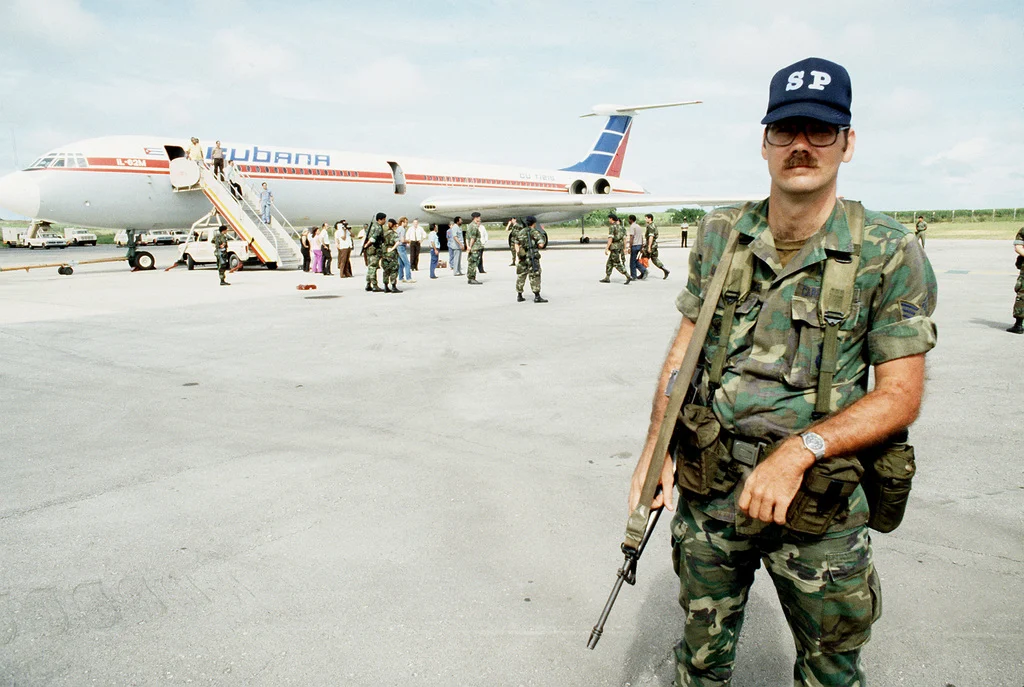
Featured Image: American soldiers stand in front of a Cuba-bound Cubana plane. The plane was carrying Cuban POWs captured by American forces during Operation Urgent Fury, the U.S. Invasion of Grenada
Image Credit: Unknown via NARA & DVIDS Public Domain Archive
License: Creative Commons Licenses