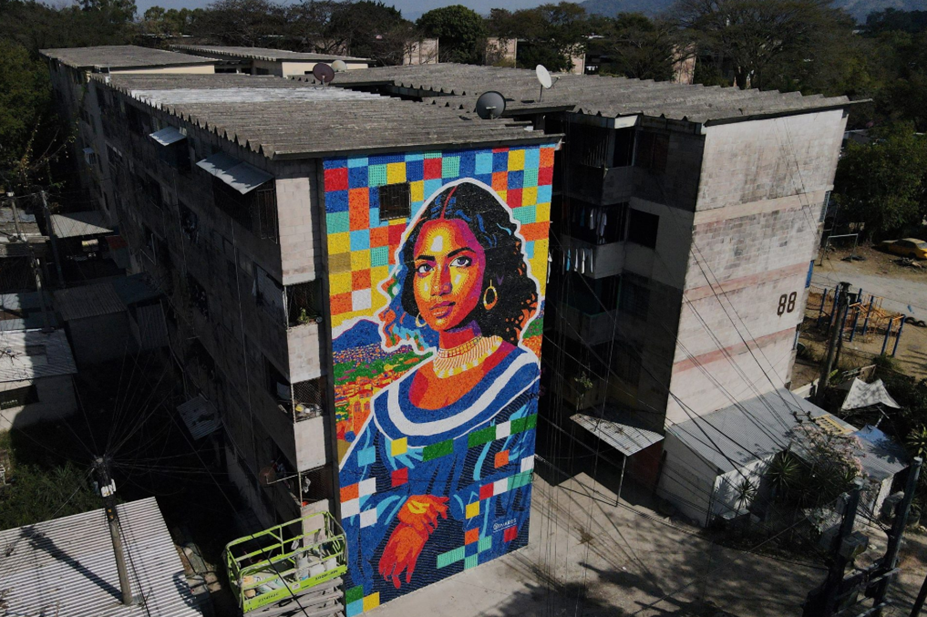
A Venezuelan artist used over one hundred thousand plastic caps to create a Mona Lisa-inspired portrait on a wall in San Salvador, honoring Salvadoran and Latin American women. In a neighborhood affected by war and gangs, residents joined in turning trash into public art.
A Mona Lisa Made of Plastic in a Place That Remembers
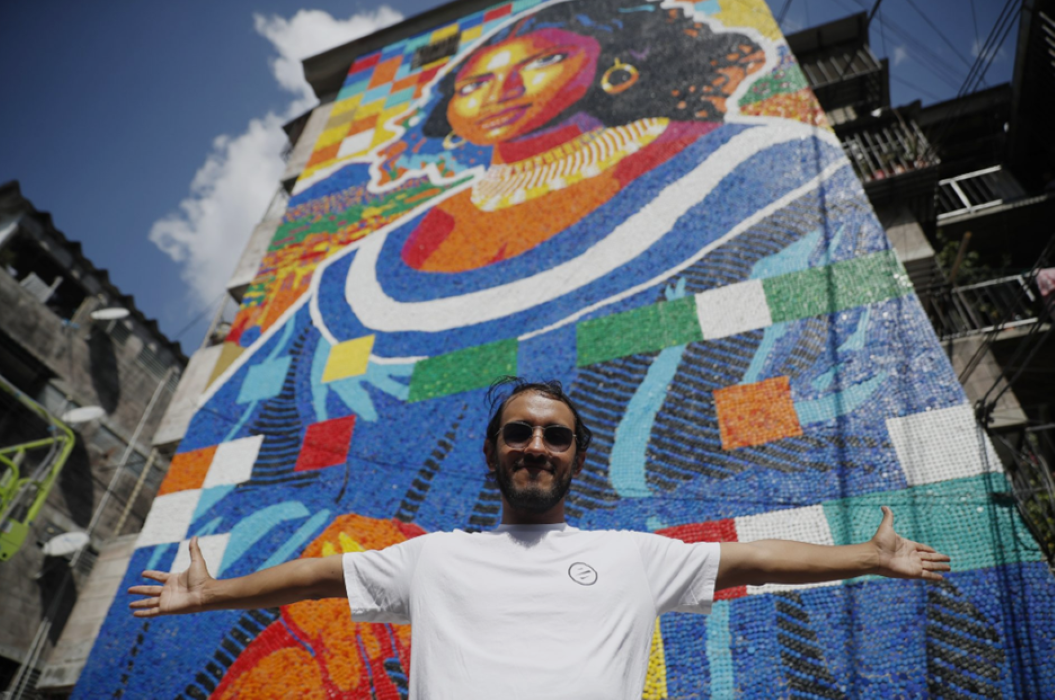
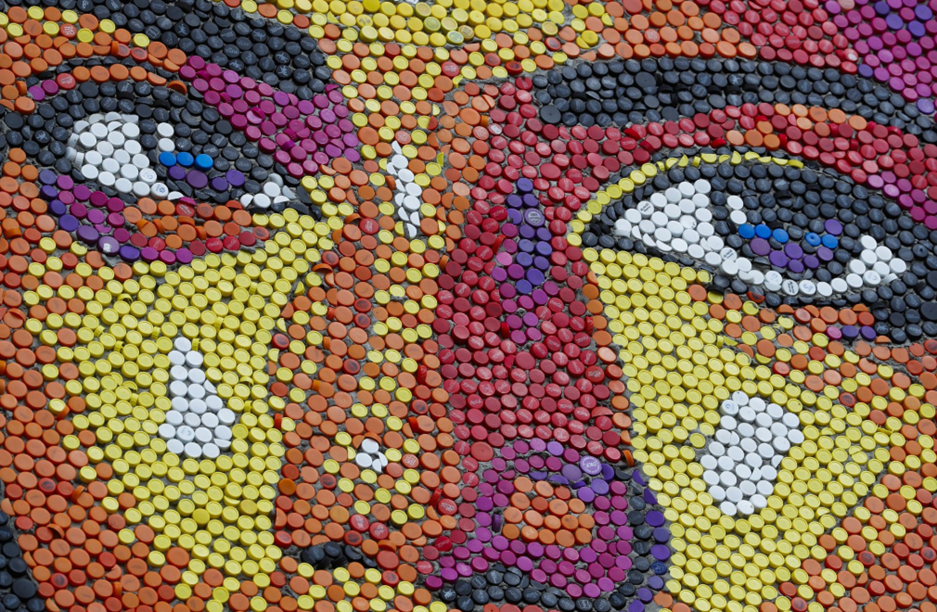
From afar, the mural looks like a familiar face with a calm gaze and a slight smile—an image known worldwide for centuries. Up close, it breaks into thousands of small circles, each a plastic bottle cap from everyday life—soda, water, something grabbed, emptied, and thrown away.
Oscar Olivares, a Venezuelan artist inspired by Leonardo da Vinci’s La Gioconda, built the image using more than 100,000 recycled, colored plastic caps on a multifamily building in a populous area of San Salvador, as a tribute to Salvadoran and Latin American women, EFE reported.
The mural sits in the historic Colonia Zacamil. The mural is located in Colonia Zacamil, a historic neighborhood over fifty years old that was deeply affected by the final offensive of El Salvador’s civil war in 1989 and later by violent gangs, according to EFE. Measuring thirteen meters tall and seven meters wide, the face seems to watch over the street, giving the building a new purpose. It is the tallest cap mural in the world,” Olivares told EFE in a conversation.
The process brings a sensory detail that’s hard to miss: the soft, repetitive snap and scrape of plastic caps against concrete as each one is placed. Day after day, for twelve days, the work required patience and left hands familiar with the material’s shape long after stepping back to admire it.
The trouble is that in places like Zacamil, outsiders often arrive with a single story. Violence. Poverty. Fear. The wager here is that a mural can interrupt that reflex, even briefly, by asking people to look again at what they thought they knew.
The project didn’t begin with Olivares arriving alone. A year earlier, the Italian group Custom Made Stories Foundation reached out to him. Since 2023, they’ve been painting murals on apartment buildings in Colonia Zacamil and plan to complete 50 buildings by 2029, EFE reported. Olivares is now part of that effort.
Over twelve days, neighbors, recyclers, and environmental groups got involved, EFE reported. Residents helped gather, clean, and deliver the caps to the artist. He then attached each cap one by one to the wall of building eighty-nine, without painting over them or removing some of the brand logos, EFE said.
That choice isn’t just about looks. It’s part of the message.
“The idea is to show that this waste, exactly as it could have ended up in the trash or in the ocean, is there forming this work of art,” Olivares told EFE.
In that line, the material becomes a kind of public record. The caps are not disguised. They are not made to disappear into an illusion. They remain what they are, the leftovers of consumption, reorganized into something that can be seen and claimed.
For Olivares, the neighborhood is changing into a public gallery. The place, he said, “is becoming a huge open-air museum that reclaims and re-signifies everything this area is and its history,” he told EFE.
The phrase matters because Zacamil carries layers of meaning. Built as social housing. Shaken by the war’s final offensive. Marked later by gangs. A neighborhood like that can be reduced in national conversation to shorthand. The mural effort pushes back by insisting that history is not only what happened to a community, but what a community can still make.
A local collective, Full Painting, has also joined the initiative, and its members have intervened about twenty building facades over the last two years with large-format murals, EFE reported. The result, slowly, is a corridor of images where blank walls once stood.
What this does is change the way a person walks through their own block. The same route to the store, the same doorway, the same stairwell. But now with color and scale, with a visual claim that says this place is not only a site of damage. It is also a site of creation.
A Venezuelan Homecoming Feeling Far From Home
Olivares said that from the first day he arrived in the neighborhood, he found it easy to adapt. “I felt like I was arriving at a new home, and literally that is how it is, because I leave a big part of myself here,” he told EFE.
That feeling of welcome doesn’t happen on its own. It’s built, often through working together. According to the report, residents weren’t just watching an outside artist fix a wall. They contributed to the change by sorting, cleaning, and delivering the caps. The art didn’t appear like magic—it came from everyday work.
“I felt a lot of affection and that people were very grateful because they could be part of it. Seeing the emotion and joy of citizens when they see what their community is becoming is very special,” Olivares told EFE.
He said, “When I make a mural, I get to know a place differently than just being a tourist.” He added something deeper about public art: “This mural reflects what I wanted to say about El Salvador without even realizing it,” he told EFE.
In other words, he came without a full understanding of the country’s history, but creating the mural helped him learn about the place through its people, their rhythms, and their willingness to work together.
Olivares said he studied the technique of pointillism in France and that this helped him understand “that if it was possible to make art with points of color, plastic caps could be interpreted as small points of color that mix in our vision,” he told EFE.
This idea brings the mural back to its basic form: thousands of small parts that together form a bigger picture visible only from a distance. It’s also, perhaps without meaning to, a political metaphor for Latin America, where individual efforts may seem small and alone, but together they create something clear, public, and powerful enough to change the skyline.
Olivares said the mural represents “a challenge overcome and also a milestone. Not only because of how popular it can be, but because of the impact that I have seen it has generated in the community,” he told EFE.
He said what he learned through this work will be taken to his country and the rest of Latin America as “evidence of how it is possible for our communities and cities to be transformed with art as the protagonist,” he told EFE.
In total, he has created forty-six murals with plastic caps, thirty in Venezuela and the rest in eleven countries, including El Salvador, he told EFE.
The debate here isn’t just about recycling or making things look nicer. It’s about who has the right to claim public spaces in neighborhoods shaped by conflict, and whether cultural projects can be seen as part of healing instead of just decoration.
In Zacamil, the mural doesn’t erase the past. It can’t. But it does something quieter. It gives residents a new image to point to when they talk about their home. A new memory to gather around. And a reminder, cap by cap, that a community can still reshape what it’s been given.
Also Read:
Costa Rica Sloth Santi Shows the Hidden Cost of Wildlife