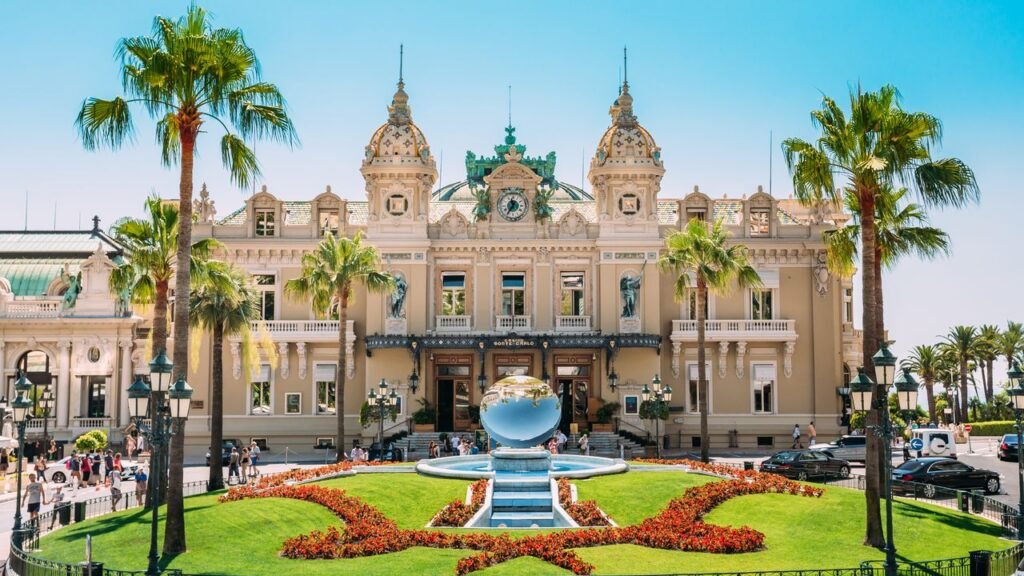
“Europe has one Eldorado—Monte Carlo! It is nothing but a rock, yet it is a realm where Illusion is queen. The skies and sea, there, are blue more often than elsewhere, and time suspends its flight, for roulette turns much faster than the hands of a watch.” So began a dispatch from Monte Carlo in the May 1936 issue of Vogue.
By then, the magazine had already been chronicling life on this tiny patch of the Mediterranean for decades. In 1917, with Europe at war, Vogue reported—under the wonderfully improbable headline “Monte Carlo Is as Gay as—Monte Carlo”—on a social season that carried on nonetheless. That same year, Puccini’s La rondine had its world premiere at the Opéra de Monte-Carlo, one chapter in a performing-arts history that Vogue would follow through decades of opera and ballet.
Monte Carlo has also proved irresistible as a backdrop for fashion. Helmut Newton returned to it repeatedly, including for two extraordinary Vogue shoots a decade apart, in 1979 and 1989. It is easy to understand the attraction. Few places come with such ready-made mise-en-scène: Belle Époque hotels, palace terraces, casino tables, convertibles, diamonds, bathing suits, yachts, and the startling blue of the Mediterranean, all compressed into a principality barely larger than Central Park.
Monte-Carlo poster by Roger Broders. c. 1930Photo: Getty Images

Monte Carlo poster by Michel Bouchaud. c. 1930Photo: Getty Images
Of course, glamour here has never necessarily meant restraint. Writing for Vogue, Alan Jolis once described Monte Carlo as “vulgar, both nouveau riche and old rich, classy and totally déclassé,” before conceding that somehow its “fairy-tale princesses and princes manage to outweigh the sleaze, the coarseness, the hype.” That contradiction remains part of its appeal. Monte Carlo can be flashy, even absurdly so, but it also possesses a depth of history that is easy to miss amid the supercars and superyachts.
Look beyond them, and you find the Monte Carlo that has fascinated Vogue for more than a century: Diaghilev and Puccini, the Grimaldis and Grace Kelly, Charles Garnier’s opera house and casino, grand hotels that have been receiving guests since the 19th century—and, increasingly, ambitious new additions reshaping the coastline. The illusion, in other words, is still very much intact. A guide to the municipality, below.
What to See

Photo: Getty Images