By Ron Cheong
News Americas, TORONTO, Canada, Weds. April 1, 2026: The war with Iran is reshaping modern warfare, revealing critical failures across military, economic and psychological fronts. Fresh off its stunning strike on Venezuela, capturing President Nicholas Maduro in a display of technological and military prowess, the United States, in coordination with Israel, launched a surprise attack on Iran, even as negotiations for a peace deal were underway.
In the first days of Operation Epic Fury, launched on February 28, the administration basked in an aura of invincibility. Ignoring consultation with allies or NATO, it flaunted military superiority, predicted swift victory, and declared the Iranian leadership “put into the stone age.”
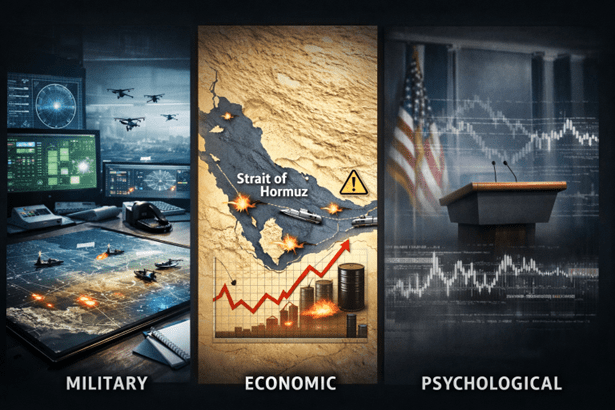
But modern warfare is no longer decided solely on the battlefield. It unfolds across three interlocking fronts: military, economic, and psychological. Victory requires coherence across all three – failure on any one can unravel the rest.
One month into the war with Iran, the picture is not just of setbacks, but of a deeper strategic failure: a conflict launched without clear objectives, without an exit strategy, and with a profound misunderstanding of the adversary.
1. The Military Front: Fighting The Wrong War
On paper, the United States entered with overwhelming superiority. Aircraft carriers, stealth systems, satellites, and precision-strike capabilities have long created an aura of near-invincibility.
But as seen in Ukraine and now Iran, modern warfare has shifted. Dominance in conventional military assets no longer guarantees victory. We live in the era of asymmetric warfare, where weaker opponents avoid direct confrontation and exploit vulnerabilities.
Iran has done exactly that. Instead of matching U.S. air and naval power, it relies on cheap drones, missile swarms, naval mines, and proxy forces. Low-cost drone systems have successfully threatened high-value assets, undermining traditional force hierarchies. Even after heavy bombardment, Iran continues to project power through decentralized and resilient systems.
This is doctrinal, not accidental. History, from Vietnam to Afghanistan, shows that a weaker adversary need not win outright; it only needs to avoid losing while increasing the cost of victory. The United States appears prepared for a conventional war. Iran prepared for a different kind entirely.
2. The Economic Front: The Strait Of Hormuz Miscalculation
If the battlefield revealed tactical misjudgments, the economic front exposes strategic blindness.
At the center is the Strait of Hormuz, through which roughly 20% of the world’s oil supply flows. Iran’s ability to disrupt this chokepoint has proven decisive. Shipping through the strait has collapsed, global oil prices have surged, and inflationary ripple effects are destabilizing energy markets and supply chains worldwide.
Remarkably, Iran has achieved this leverage despite suffering major conventional military losses. This underscores a crucial shift: economic disruption can outweigh battlefield success. Washington may destroy targets, but Tehran can impose costs on the global system itself, turning international pressure back onto the U.S.
This raises a critical question: Was there ever a viable plan to secure the economic front – or was it simply assumed that military dominance would suffice?
3. The Psychological Front: The Collapse Of Deterrence Mythology
Perhaps the most consequential front is psychological.
For decades, U.S. power rested on a potent intangible: the belief in its overwhelming superiority. That belief alone deterred adversaries.
Wars are not just fought with weapons; they are fought with perceptions. Today, that perception is eroding. Iran has withstood sustained bombardment, struck back, and demonstrated that U.S. power, while immense, is not absolute.
Within the United States, conflicting narratives are emerging: official claims of success clash with visible disruptions such as the prolonged closure of Hormuz and rising economic fallout. Globally, allies hesitate, adversaries are emboldened, and neutral actors grow skeptical.
This is how great powers lose more than battles – they lose aura. And once the psychological edge is gone, it is extraordinarily difficult to restore.
The Deeper Problem: No Clear Objective, No Exit
Underlying all three fronts is a more fundamental flaw: What is the objective of this war? Regime change? Deterrence? Elimination of nuclear capability? Restoration of maritime security?
The answers are inconsistent, even contradictory. Recent statements suggest both confidence in victory and uncertainty about outcomes, with talk of withdrawal even if key objectives, like reopening Hormuz, remain unresolved.
That is not a strategy. That is improvisation. Without a clearly defined end state, there can be no coherent path to victory, only drift toward escalation or withdrawal under pressure.
Hubris And The Strategic Trap
History offers a warning: the moment of greatest triumph often precedes the greatest overreach.
Buoyed by successes in Venezuela and technological dominance, the United States appears to have entered this conflict with strategic overconfidence, underestimating Iran’s resilience, asymmetric doctrine, willingness to absorb punishment, and ability to shift the battlefield beyond the military domain.
This is the classic trap of great powers: fighting the war they expect, not the war that is actually being fought.
A Turning Point In Modern Warfare
This conflict may ultimately be remembered not for who won militarily, but for what it revealed:
- Cheap technology can neutralize expensive dominance
- Economic chokepoints can outweigh battlefield victories
- Psychological perception is as decisive as firepower
Most importantly, even the most powerful military is vulnerable when it enters a war without clear objectives, strategic coherence, or a full understanding of its adversary.
If that lesson is not absorbed, this may not just be a difficult war. It may be a defining one.
EDITOR’S NOTE: Ron Cheong is a frequent political commentator and columnist whose recent work focuses on international relations, economic resilience, and Caribbean-American affairs. He is a community activist and dedicated volunteer with extensive international banking experience. Now residing in Toronto, Canada, he is a fellow of the Institute of Canadian Bankers and holds a Bachelor of Science degree from the University of Toronto.
RELATED:
CARICOM News: How U.S. And China Are Shaping Caribbean Energy
The Long Siege Of Cuba: CARICOM At Last Begins Pooling Cash For Cuba Relief Supplies
The Long Siege Of Cuba & Caribbean Geopolitics: The Prequel To King Kong And The Island
King Kong And The Island: America’s Moral Collapse And Cuba