Caracas, Venezuela — María Corina Machado, Venezuela’s opposition leader, says she will return to the country after leaving last December to attend the 2025 Nobel Peace Prize ceremony in Oslo, Norway.
Machado, who vocally supported U.S. military attacks on Venezuela ahead of the January 3 operation that captured President Nicolás Maduro, has since been sidelined by the Trump administration who lent its support to Maduro’s Vice President Delcy Rodríguez.
With Machado’s return to Venezuela increasingly more likely, her supporters are anxious as to what role — if any — she’ll play in the political transition of the country.
Machado was in hiding inside Venezuela for nearly a year before being spirited away on go-fast boats on a December night with the aid of a non-profit staffed by former U.S. military members.
Analysts who spoke to Latin America Reports said that if she returns and no attempts are made on her life, it could be a clear sign from the Rodríguez government that they are willing to open up political participation in the country.
Alejandro Armas Díaz, a journalist and political researcher, believes that if Machado’s possible return goes smoothly, it will be a giant step forward for the country.
“We are talking about the leader of the majority opposition. On the other hand, if she returns but suffers any reprisals, it would be an equally big setback,” he told Latin America Reports.
Historian and political analyst Alejandra Martínez Cánchica, director for Latin America at the Freedom and Development Foundation, agrees. She believes that Machado’s return is a litmus test to show whether Venezuela is truly in a process of transition.
She told Latin America Reports that the politician’s safe return would be “the definitive proof that Venezuela is indeed on a path towards a democratic transition.”
U.S. pressure, said Armas, could also force the Venezuelan government to create the right conditions for her return.
“In Venezuela, we have seen changes that until recently were unthinkable. The source of these changes is pressure from the United States,” Armas said. “Will Washington push for Machado to be able to return without any problems? We don’t know. It may not. It may consider that it is better to leave it for later, when the country is more stable.”
The U.S. has formulated a three-stage plan for Venezuela, with stabilisation and economic recovery coming before political transition.
“Given that Machado has suggested that her return is imminent, we will know sooner rather than later whether she [Machado] will actually do so. I find it hard to believe that she will do so without certain guarantees,” Armas added. “If she does not, it could cause some disappointment among her supporters, for announcing something she could not do.”
Martínez sees this as an ideal moment for the opposition leader’s return.
“Since at least mid or late January of this year, we have been seeing political leaders and activists in Venezuela take to the streets to engage in politics. Many were in hiding, many were imprisoned, and they are now protected under the Amnesty Law,” she said, referring to a law that frees political prisoners, but has also been criticized as exclusionary.
Read more: Families of military members criticize Venezuela’s new amnesty law as exclusionary
María Corina Machado’s leadership would be strengthened
Experts agree that one inevitable effect if Machado returned would be an even greater appreciation from her base.
Martínez said that María Corina “still has the majority preference among the population and also continues to have the highest voting intention … So, the fact that she can come to Venezuela to engage in politics on the ground will undoubtedly reconfigure the balance of power and the Venezuelan political map.”
The analyst cited a poll from Gold Glove Consulting, which estimates that the Venezuelan opposition leader has a mathematical advantage of 67% over interim President Rodríguez, should elections be held in the coming months.
She also said that Machado’s return could help her recapture her political base which helped her win 92% of votes during the 2023 primaries and — after he was sidelined by Maduro — helped propel her candidate, Edmundo González, to win disputed 2024 elections, according to voter tallies published by the opposition.
“In January-February 2023, the political landscape in Venezuela, at least on the opposition side, was completely deserted. There was great demoralization, people were demobilized. And yet, from the beginning of 2023, María Corina fuelled a movement within Venezuelan society that by July 2024, a year and a half later, was an unstoppable force,” Martínez added.
Returning from exile too, could help shore up her image among voters, said Armas.
“Many people are left with the impression that [those in exile] have comfortable lives while the masses in Venezuela continue to suffer. This is not necessarily the case in reality, but that is the impression that, I repeat, remains. So it is in Machado’s best interest to return to the country as soon as possible. Whether she can do so is another matter,” he said.
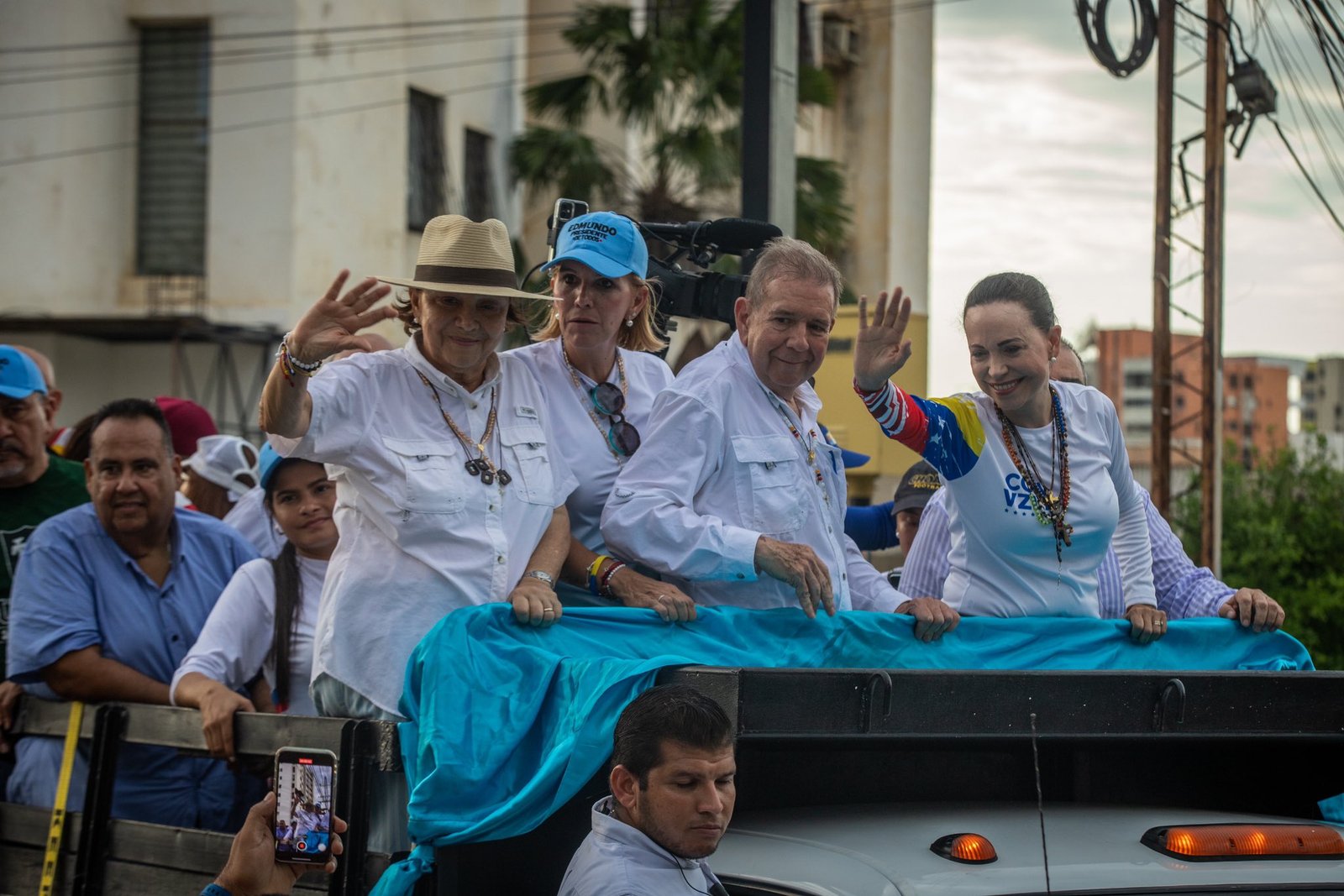
Featured image: María Corina Machado and former presidential candidate Edmundo González in 2024.
Image credit: Edmundo González Via X.