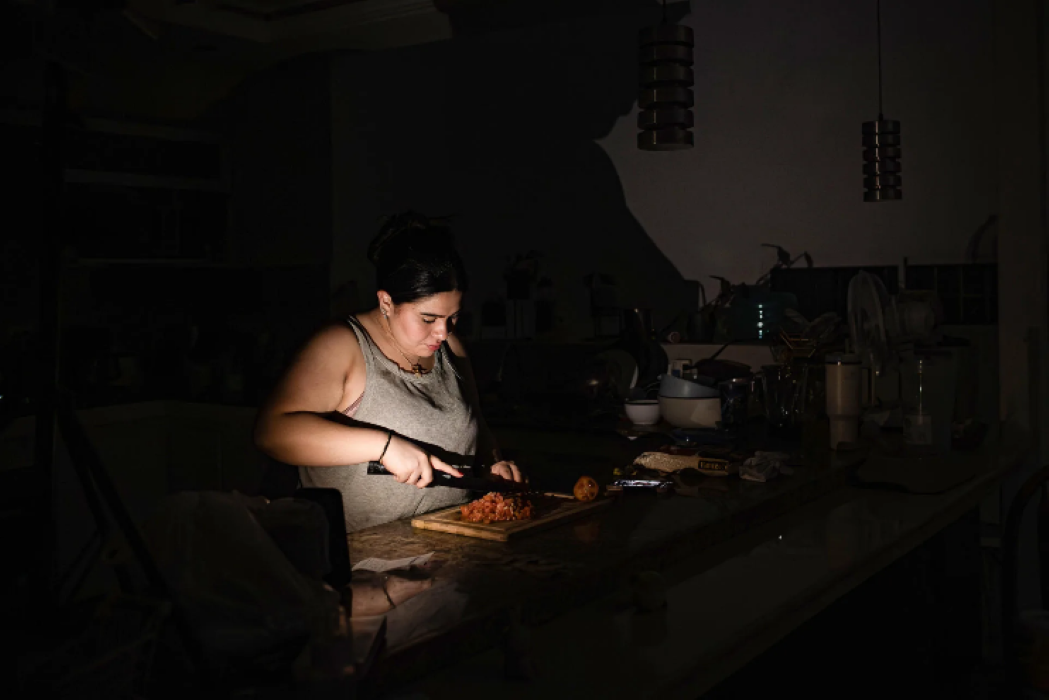
As Venezuela courts foreign investment and speaks of economic recovery, rolling blackouts in Zulia and other western regions are exposing the fragile wiring beneath that promise, leaving families, merchants, and engineers asking whether the country can truly rebuild.
The Lights Go First in the West
In Maracaibo, people have learned to read by the threat of darkness. Dinner moves earlier. Cellphones are charged when there is still time. Neighbors keep half an ear on the refrigerator, the fan, the sudden silence. Then the power disappears, not with a warning, not with a schedule, but like a hand passing over the city.
For many Venezuelans in Zulia, the country’s talk of a new economic era arrives through dead outlets and sweating rooms. The government is trying to lure foreign investment, revive key sectors, and sell the idea that Venezuela is moving beyond the worst years of collapse. But in the west, especially in Zulia and Mérida, electricity rationing is cutting into that story hour by hour.
According to residents interviewed by EFE, outages lasting several hours returned in February after what many had felt was a partial stabilization of the electrical crisis in 2025. The crisis itself is older, rooted in more than 15 years of infrastructure deterioration, underinvestment, centralization, and political management that left the country dangerously dependent on a fragile grid.
It was not until March 22 that interim president Delcy Rodríguez announced an “energy saving plan,” saying the country had to confront a solar phenomenon expected to raise temperatures for 45 days. That period ended on Wednesday. The lights did not return to normal for many people after that.
The government has pointed to demand. The Sectoral Vice Presidency of Public Works and Services said that as of May 7, Venezuela reached what it called a milestone in electricity demand, hitting 15,570 megawatts, the highest level in nine years. Authorities attributed the rise to high temperatures and economic growth. They said they were carrying out stabilization and protection maneuvers to balance the system.
But in a city where people can lose power for up to seven hours, official language can sound distant, almost theatrical. What matters is not only how many megawatts the country demands. It is whether a mother can cook before nightfall, whether a small store can open, whether an elderly person can sleep without heat pressing against the walls.

Russian Roulette by the Power Switch
“It’s a surprise, a Russian roulette what we’re experiencing with the electrical system when the power goes out,” Gustavo Aguilar, a 68-year-old resident of the Zapara community in Maracaibo, told EFE.
His phrase carries the weary precision of a person who has stopped expecting explanations. Aguilar said there is no official information about why the cuts are happening. He also described himself as skeptical about government-announced negotiations with Siemens and General Electric to address the electrical crisis in Zulia. However, he added that any improvements, if real, would be welcome.
That is the emotional territory of Venezuela now: skepticism mixed with hunger for relief. After so many announcements, so many plans, so many recoveries declared before they reached the street, citizens have learned to hope carefully.
The grid’s geography helps explain why western Venezuela suffers so sharply. Maracaibo and Mérida sit at the far end of a system largely fed by the Guri dam, located in the Venezuelan southeast. Zulia, an oil-producing state that once symbolized national wealth, became one of the most severely affected territories during the electricity crisis. The irony is brutal and very Latin American: a region that helped fuel the nation now waits in the dark.
Even Caracas, historically protected from the harshest blackouts, is no longer untouched. The capital suffers almost daily voltage fluctuations, a reminder that the crisis has spread beyond the regions once expected to absorb the deepest pain quietly.
In Zulia, electricity is not a technical issue. It is a social border. Medium- and large-sized companies can install alternative systems, buy generators, and build private defenses against public failures. Small businesses cannot. They stand closer to the outage, exposed.
Dino Cafoncelli, president of the Maracaibo Chamber of Commerce, told EFE that although larger companies have managed to protect themselves with alternative systems, that option remains out of reach for small businesses. The chamber’s data shows the long economic scar. In 2022, 60 percent of businesses had closed in Zulia. By 2025, when the system seemed more stable, that figure had fallen to 40 percent. But in the guild’s latest survey, more than 90 percent of respondents named the electricity crisis as their main concern.
“We hope that these companies that are arriving will, of course, bring fast and effective solutions for the region,” Cafoncelli said.
That hope is practical, not ideological. Business owners do not need speeches about stabilization. They need refrigeration, payment systems, lights, fans, security cameras, operating hours, and customers who are not trapped in the same uncertainty.

A Country Waiting in Doorways
Engineer Alejandro López, from the Technological Research Center at the private Rafael Belloso Chacín University in Maracaibo, told EFE that recovery requires decentralizing the system, reactivating regional thermoelectric plants, and training personnel. He specifically pointed to the need to recover turbines at the Termozulia plants installed by Siemens and General Electric, calling the approach to those companies correct for restoring the thermoelectric park in the oil-producing region.
That diagnosis cuts through the fog. Venezuela’s crisis cannot be solved only by asking citizens to consume less during heat waves. Nor can it be solved by treating blackouts as weather events. The grid needs machinery, maintenance, regional resilience, technical knowledge, and a political culture that admits that infrastructure is not propaganda. It either works, or people sit outside in the dark.
The details of the negotiations with Siemens and General Electric remain unknown. It is also unclear when work might begin, or how fast any repair could change daily life. For now, the most reliable fact is uncertainty.
Jennifer Andrade, 45, told EFE that she prefers to cook early because rationing has no fixed time. On one recent day, she said, the power went out at 6 P.M., when everyone had already finished eating. That small victory, dinner completed before darkness, says more about the country than any official milestone.
When the lights go out, many residents move to entrances and sidewalks, waiting through heat and stories until the service returns. Sometimes it does. Sometimes they sleep in darkness.
This is the contradiction Venezuela cannot hide. A country can announce investment, court global firms, and speak the language of recovery. But if the electrical system remains unpredictable, every promise flickers. Economic rebirth requires more than oil, foreign partners, and official optimism. It requires confidence in the ordinary miracle of a light switch.
In Zulia, that miracle still feels like a chance.
Also Read:
Venezuela and Barbados Bet Big on Caribbean Trade’s Fragile Promise