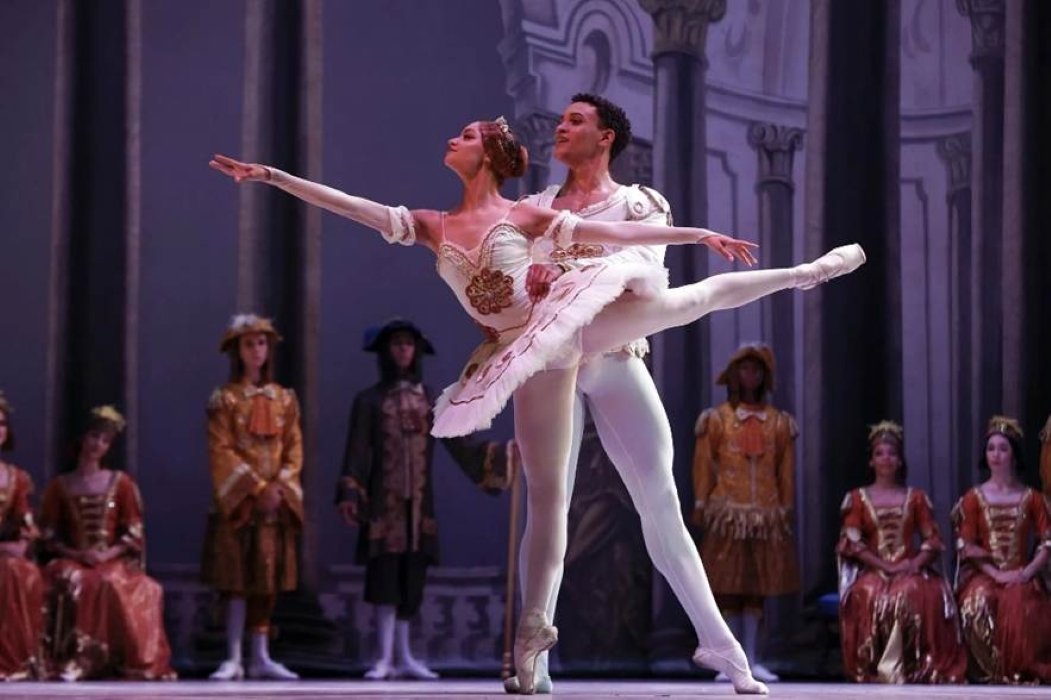
As Cuba sinks deeper into shortages, blackouts, and economic paralysis, the Cuban National Ballet has returned to Havana’s stage with classics by Alicia Alonso, turning an evening of dance into a defiant portrait of cultural survival under pressure.
When the Lights Return, So Does the Body
In Havana, where darkness has become part of daily arithmetic, the return of the Cuban National Ballet felt less like a cultural listing than a small act of national insistence. The country is short on fuel, short on electricity, short on patience. But for three nights at the National Theater of Cuba, bodies lifted, turned, leaped, and trembled beneath the lights, carrying a repertoire older than the present crisis and still somehow wounded by it.
The program, titled “The Magic of Dance,” brought back fragments of Giselle, The Nutcracker, and Don Quixote, all based on the versions shaped by Alicia Alonso, the legendary Cuban dancer and choreographer who turned ballet into one of the island’s most elegant forms of state memory. Alonso died in 2019, but in Cuba, her presence never entirely leaves the stage. She remains there in the wrists, the neck, the hard discipline under the beauty.
The Cuban National Ballet, known by its Spanish initials BNC, framed the performance as an act of endurance. “No matter how difficult the times are, nothing will stop us: we will keep dancing, because a piece of Cuba beats in every performance,” the company said in a communiqué quoted by EFE. In another promotional statement for the show, also reported by EFE, the company declared, “We will meet again to show that art is stronger than any storm.”
Those are grand words, and in calmer countries they might sound ceremonial. In Cuba now, they land differently. They are being spoken on an island where prolonged blackouts have reshaped ordinary life, where the state economy has been nearly paralyzed, and where the United States oil embargo has deepened an already severe crisis.

A Stage Against the Storm
The crisis has reached even the island’s cultural calendar, long one of the revolution’s proudest showcases. Fuel shortages have disrupted programming despite official efforts, and some traditional events, including the Havana International Book Fair, have been suspended. In that context, ballet becomes more than performance. It becomes proof that something still moves.
That does not mean art cancels hunger, or that a pirouette softens the frustration of a family waiting for power to return. Cuba’s cultural endurance has often been romanticized from outside, polished into the image of musicians in doorways and dancers in cracked halls, as if hardship itself were a kind of aesthetic. That is too easy. Shortage is not poetry to the person living it.
Yet it is also true that Cuban culture has repeatedly turned scarcity into form. Not because scarcity is noble, but because the people who survive it refuse to let it write the final sentence. The Cuban National Ballet is one of the clearest examples of that contradiction. It is an elite classical institution born in a country that has long claimed culture as a public right. It belongs to marble theaters and disciplined academies, but also to the island’s broader belief that art can carry national dignity when politics and economics fail to do so.
Founded in nineteen forty-eight under Alicia Alonso’s name, alongside Alberto and Fernando Alonso, the company became the highest expression of the Cuban school of ballet. In 2018, it was declared Cultural Heritage of the Nation, a recognition extended not only to the company but also to its repertoire, archive of images, objects, and institutional documents.
That declaration matters because the BNC is not merely a company. It is an archive that breathes. Every production carries the weight of technique, ideology, sacrifice, memory, and international prestige. In Latin America, where many countries have struggled to fund high art outside private privilege, Cuba made ballet one of its official languages of excellence.
Now that language is being spoken through exhaustion.

Alicia Alonso’s Shadow in Havana
“The Magic of Dance” is built from the company’s most recognizable repertory moments. It includes selections from Giselle, The Sleeping Beauty, The Nutcracker, Coppélia, Don Quixote, and Swan Lake, works that sit at the heart of global ballet tradition. But under Cuban feet, they have never been merely imported European relics. Alonso and the Cuban school absorbed them, reinterpreted them, and trained generations to perform them with a particular mix of technical sharpness, dramatic clarity, and emotional intensity.
There is also a tribute inside the program: “Gottschalk’s Symphony,” a piece that choreographically recreates two movements, “La Noche” and “Fiesta Criolla,” from A Night in the Tropics by American composer and pianist Louis Moreau Gottschalk. The historical echo is striking. Gottschalk’s work premiered in eighteen sixty-one at Havana’s former Tacón Theater. On this site, the Gran Teatro Alicia Alonso now stands.
That connection folds time back on itself. A nineteenth-century American composer in colonial Havana. A twentieth-century Cuban ballerina who became a national symbol. A twenty-first-century island dancing through blackouts and economic siege. The stage becomes a place where history does not disappear. It changes costumes.
The artistic bill is led by BNC director and dancer Viengsay Valdés, who performs Giselle, one of ballet’s most haunted roles. The program also gathers major Cuban figures, including principal dancers Anette Delgado, Dani Hernández, Ányelo Montero, Yankiel Vázquez, and Ernesto Díaz; principal dancer Gabriela Druyet; soloists Laura Kamila and Alianed Moreno; and other rising artists.
That mix of veterans and younger performers adds another layer to the production. In a country marked by migration and fatigue, artistic continuity is not automatic. It must be trained, protected, and persuaded to stay. Every rising dancer on that stage is also a question about Cuba’s future: who remains, who leaves, who can afford to dream, and what kind of country asks beauty to keep proving its loyalty?
There is something almost unbearable in the image of ballet during a blackout crisis. The form demands light, music, rehearsal, discipline, transportation, shoes, fabric, food, and functioning bodies. It depends on systems. When systems falter, the dancer feels it first in the muscles. Still, the curtain rises.
That is why the BNC’s return matters beyond Havana’s cultural elite. It does not solve Cuba’s crisis. It does not erase the anger of those living without reliable electricity or economic relief. But it reveals one of the island’s oldest truths: Cuba has often survived by making performance carry what politics cannot fully explain.
On Friday night, at the Avellaneda Hall of the National Theater, the country did not stop suffering. But for a few hours, it watched itself move.
Also Read:
Uruguay Finds Its Heartbeat Again Around One Public Square Table