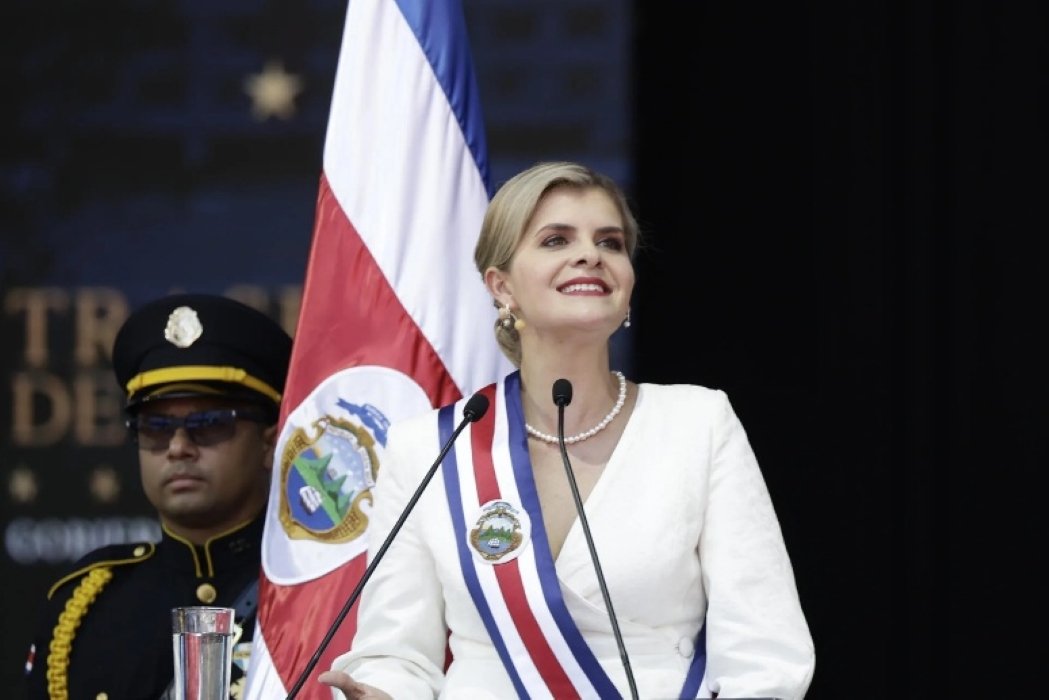
At San José’s National Stadium, Laura Fernández became Costa Rica’s fiftieth president and second woman to hold the office, turning a carefully staged transfer of power into a regional signal about democracy, continuity, ambition, and the country’s conservative turn now.
A White Dress, a Presidential Sash, and a Country Watching
Laura Fernández Delgado arrived dressed entirely in white, walking into the National Stadium with her husband, Jeffry Mauricio Umaña, as thousands of Costa Ricans filled the stands for a ceremony built to feel both solemn and popular. There were official delegations, military protocol, music, applause, cameras, and the kind of civic theater Costa Rica has long used to tell the world who it believes itself to be.
Then came the image that will likely outlive the speeches. Yara Jiménez, the pro-government president of the Legislative Assembly, placed the presidential sash on Fernández and swore her in as Costa Rica’s new leader. For the first time in the country’s history, one woman formally handed the oath of power to another woman.
Fernández, thirty-nine, took the oath with visible confidence. After returning to her seat, she appeared emotional. That brief shift, from command to feeling, gave the ceremony its human pulse. A young president from the right-wing Sovereign People’s Party had just stepped into one of Latin America’s most symbolically charged offices, not through rupture, not through military pressure, not through a constitutional crisis, but through an orderly democratic transition.
That matters in the region. In Latin America, presidential ceremonies are never only about protocol. They are about memory. They are about whether institutions survived the last storm and whether the next one is already gathering.
Outgoing President Rodrigo Chaves handed power to his former minister of the presidency, making the inauguration not just a transfer between administrations, but a continuation of a political current. Fernández does not enter office as an outsider, tearing down the old house. She enters as an heir, a loyal figure transformed into head of state.

Democracy as Ceremony, Power as Continuity
The president of the Legislative Assembly described the act as proof of the solidity of the Costa Rican state and the civic maturity of a country that has made democracy its greatest strength. It was a polished sentence, but not an empty one. Costa Rica has spent decades cultivating an international identity based on peace, elections, civilian rule, and institutional credibility.
That identity is one of its most valuable political exports. In a region often described through coups, corruption, militarization, and democratic fatigue, Costa Rica has marketed itself as the exception. No standing army. A tradition of social investment. A reputation for stability. A country small enough to be overlooked, yet symbolically large enough to be invited into conversations about democratic health.
But the ceremony also revealed a more complicated present. Fernández’s rise comes from the right, inside a political environment shaped by public frustration, security concerns, economic anxiety, and distrust of traditional parties. Costa Rica may still be internationally recognized for peace and democracy, but that does not mean its society feels calm. Like much of Latin America, it is living with the pressure of inequality, crime, migration routes, culture-war politics, and the hard question of whether democratic institutions can still deliver daily dignity.
The presence of delegations from seventy-one countries and eighteen international organizations underscored that Costa Rica’s transition was being watched far beyond San José. King Felipe VI of Spain attended, along with regional and international leaders including Bernardo Arévalo of Guatemala, Nasry Asfura of Honduras, José Raúl Mulino of Panama, José Antonio Kast of Chile, Isaac Herzog of Israel, and Luis Abinader of the Dominican Republic.
That guest list gave the inauguration a diplomatic charge. Costa Rica was not simply staging a national ritual. It was presenting itself as a democratic platform in a tense hemisphere. In this place, power can still change hands in daylight, before crowds, cameras, and foreign witnesses.
Francisco Gamboa was sworn in as the first vice president. Douglas Soto became second vice president and is expected to serve as ambassador to the United States. This detail quietly points to one of the administration’s major priorities. Washington remains central to Costa Rica’s security, trade, and diplomatic positioning. In an era when China, the United States, Europe, and regional blocs all compete for influence in Latin America, even a ceremonial appointment can carry strategic meaning.

The Promise and the Risk of a New Presidency
Fernández’s challenge now is that symbolism ages quickly. The white dress, the sash, the applause, and the emotional pause will become a memory. Governing will begin in less cinematic rooms, in budget negotiations, security meetings, rural visits, diplomatic calculations, and confrontations with an opposition that may test the limits of her mandate.
Her youth may be an asset. At thirty-nine, she can embody generational renewal in a political class often accused of recycling the same figures. Her gender also carries weight, particularly in a region where women have often been asked to represent change while governing inside systems built long before they arrived. Being Costa Rica’s second female president places her in the history books. It does not protect her from its pressures.
The deeper question is: what kind of Costa Rica will her administration defend? A country can be peaceful and still unequal. Democratic and still polarized. Stable and still anxious. The stadium ceremony projected unity, but a government is judged by what happens when the ceremony ends, and friction begins.
For Latin America, Fernández’s inauguration offers a useful paradox. Costa Rica remains a symbol of democratic continuity, yet its politics are not frozen in the old story of exceptionalism. It is changing, leaning rightward, negotiating its place among regional conservatives, democratic reformers, international partners, and citizens who want the state to feel less ceremonial and more present in their lives.
The free public event, the concerts, and the cultural activities turned the inauguration into a civic festival. That was intentional. Power needed to look close to the people, not sealed behind palace doors. In a country without the usual militarized presidential mythology of the region, the stadium itself became the stage of legitimacy.
Still, the most important audience was not the foreign delegations or the officials seated near the front. It was the ordinary Costa Rican watching to see whether this new president could turn national pride into practical governance.
Fernández received the sash in a country proud of its democratic soul. Now she must govern a country that knows pride alone is not policy. The ceremony said Costa Rica’s institutions remain standing. Her presidency will determine whether they can still bear the weight of what citizens expect of them.
Also Read:
Mexico’s Sheinbaum Is Right to Put Cortés Back on Trial Again