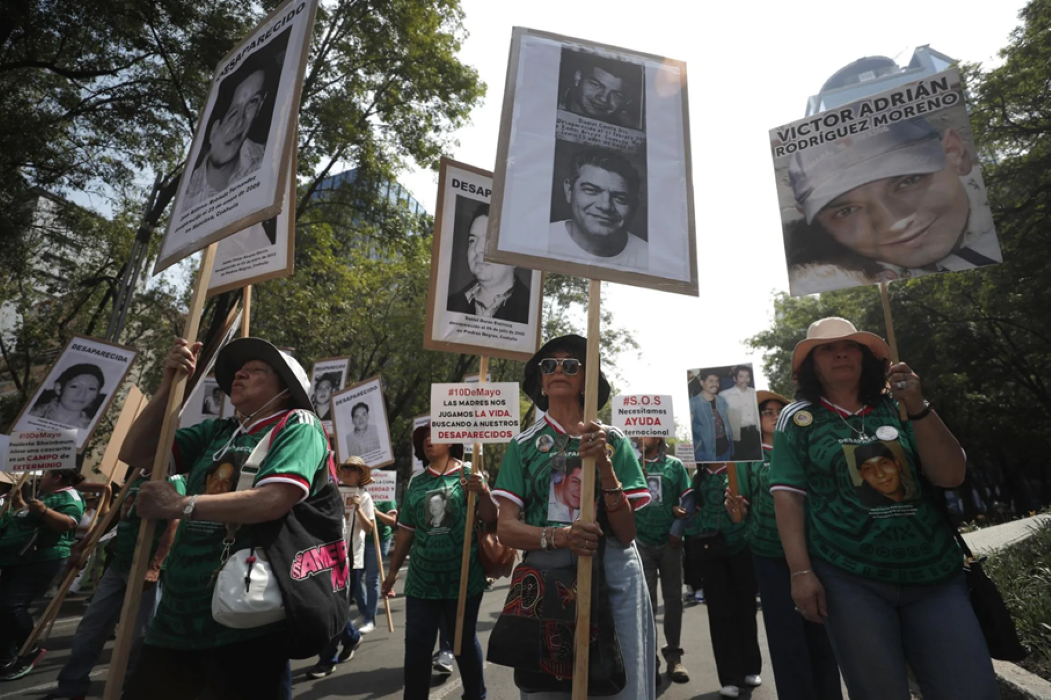
As Mexico readies stadiums for the 2026 World Cup, searching mothers marched on Mother’s Day with missing-person flyers, grief, and anger, demanding that a country preparing to celebrate goals finally confront its 133,601 disappeared and unlocated people.
A Mother’s Day Without Children
On Reforma Avenue, where Mexico usually learns how to celebrate itself, the mothers came carrying absence.
They marched from the Monument to the Mother to the Angel of Independence, that golden landmark where soccer fans gather when the national team wins, where strangers hug, and flags wave. The city pretends for a few hours that history can be washed in green, white, and red. But on Sunday, the Angel did not belong to victory. It belonged to faces printed on paper. Sons. Daughters. Brothers. Sisters. People last seen on ordinary days, in ordinary clothes, before their names became part of Mexico’s deepest wound.
Thousands of family members, activists, and collectives joined the fourteenth National March for Dignity, led by searching mothers on Mother’s Day, which Mexico celebrates on May ten. Their timing was deliberate and painful. One month before the 2026 World Cup opens in Mexico, they turned the country’s most public ritual of sporting joy into an accusation.
Hundreds of activists covered the Angel of Independence with missing-person flyers. A large Mexican flag affixed to the monument bore the message “133,000 missing.” Other signs cut sharper: “Mexico will shine in the World Cup, mothers among graves,” “On Mother’s Day our children are missing, and the executioners remain free organizing World Cups,” and “The wound is what unites us.”
The number is staggering: 133,601 missing and unlocated persons, according to figures cited in the most recent annual report referenced by the collectives. It is a number so large that it risks becoming abstract, which is exactly why the mothers march. They force the country to see that every digit once answered to a name.

When Soccer Language Becomes a Plea
Mexico is preparing for a spectacle. Stadiums, hotels, security plans, broadcast schedules, airports, and tourist campaigns are being polished for the world’s arrival. The opening match between Mexico and South Africa is set for June eleven at the Azteca Stadium, one of the cathedrals of global soccer. But on Saturday night, before the march, searching mothers and relatives placed missing-person flyers around that same stadium.
It was a devastating image. The Azteca has seen legends, titles, national delirium, and myth. Now it also stands near paper faces, asking where the disappeared are.
At the Angel of Independence, the families read a statement that used the game’s language to draw attention to the crisis. They said that since the first disappearances in Mexico, sixteen FIFA World Cups have passed. They promised to score every possible goal against impunity, to keep playing every necessary cup until the disappeared return home, and not to be defeated. They added that they hoped the hundreds of thousands who would shout for national team goals would also shout for justice and truth for the disappeared.
The metaphor works because it is uncomfortable. Soccer is one of Mexico’s shared languages, one of the few spaces where class, region, and politics can briefly blur. But the mothers used that language to reveal another national team: the search brigades, the women in hats and masks walking through fields, ravines, empty lots, and clandestine graves with shovels, rods, and photographs.
For Daniela Gonzalez, from the collective Una Luz en el Camino, the World Cup will be “full of broken families.” She is searching for her son Axel Daniel, who disappeared on June twenty-three, twenty twenty-two, when he was sixteen. Her words place the tournament in its moral frame. A country may host the world and still fail the families inside its borders. A country may decorate its stadiums while mothers search for dirt.
She said families continue fighting every day, demanding that the government fulfill its duty to work to find people and return them home. That demand sounds simple only to those who have not had to make it.

The State as the Hardest Opponent
The crisis of disappearances in Mexico is not new. The families said the country has suffered enforced disappearances for nearly six decades, with impunity as the norm. That long history matters. It means this is not only a cartel story, not only a security story, not only a tragedy born from the drug war. It is also a story of institutions that failed to investigate, officials who delayed, police files that disappeared, forensic systems overwhelmed, prosecutors who asked families to wait and wait, as if waiting were not another form of violence.
Tomasa Cedillo, from the collective Renacer, whose son disappeared two and a half years ago, described the hardest part of the search as having the government itself as the opponent. She said what she asks is basic: to be heard, to have action taken, to know where her son is, to know something about him.
That “something” is where Mexico’s grief becomes almost unbearable. Families are not always asking for miracles. Many are asking for a clue, a bone, a record, a witness, a phone ping, a search that actually happens, a prosecutor who does not treat their pain like paperwork.
María del Carmen Ayala Vargas, who is searching for her son Iván, missing since August twenty twenty-one in Coatepec, Veracruz, called the search “a calvary, a martyrdom, an ordeal, the most atrocious thing that can happen to a family.” Her description belongs to the religious vocabulary of suffering, but it also sounds like the geography of modern Mexico. A country of highways and shrines, of stadiums and graves, of mothers who have become investigators because the state did not arrive in time.
International pressure is growing. In early April, the United Nations Committee on Enforced Disappearances suggested that the scale of disappearances in Mexico could constitute a crime against humanity, an assessment President Claudia Sheinbaum rejected. On April twenty-three, the Inter-American Commission on Human Rights announced that it is preparing a specific report on Mexico’s disappearance crisis, placing the country under international observation due to the scale of the problem.
The IACHR has described disappearances and the forensic emergency as a grave humanitarian crisis. It also warned of rising femicides, transfemicides, murders of LGBTQ+ people, trafficking, and violence against women. The disappearance crisis is therefore not isolated. It sits inside a larger landscape of bodies made vulnerable by gender, poverty, migration, territory, organized crime, and institutional abandonment.
According to the National Registry cited by the IACHR, the states with the highest figures are the State of Mexico, Jalisco, and Tamaulipas. But the pain is national. It crosses accents, borders, parties, and administrations.
The World Cup will bring an avalanche of cameras. Mexico will know how to host them. It has done so before. It will show color, food, stadiums, music, hospitality, and the enormous emotional force of its people. All of that is real.
But the mothers are asking the world, and Mexico itself, to look at what stands outside the frame. They are not asking for the tournament to stop. They are asking the country not to confuse celebration with absolution.
On Sunday, the Angel of Independence carried flyers instead of glory. The mothers had already learned what the state still resists admitting: a nation cannot truly shine while so many families are still searching in the dark.
Also Read:
Peru’s Femicide Fight Turns Into a Battle Over Legal Memory