
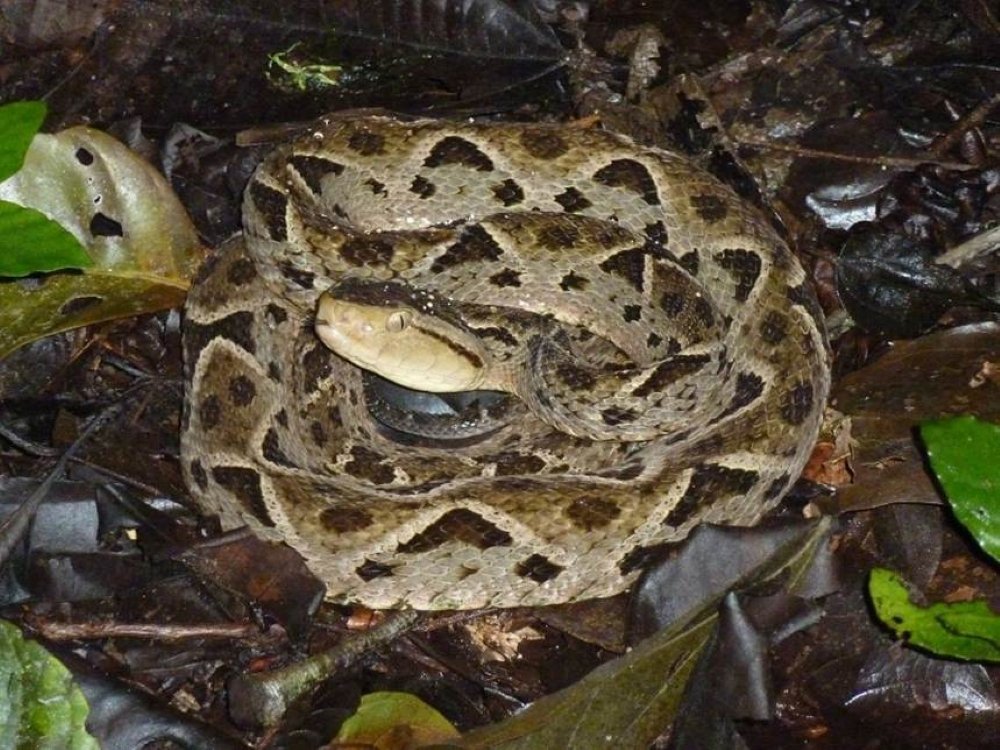
A new snake-strike study credits Central and South American vipers with nature’s brutal math: speed, venom, muscle, and timing compressed into milliseconds, revealing how evolution shaped one of Latin America’s most feared predators and why it still matters today.
The Bite Before the Flinch
In the forest margins of Central America and northern South America, danger does not always announce itself with a roar. Sometimes it waits in leaf litter, coiled and still, its body folded like a question the jungle already knows how to answer. The terciopelo, known scientifically as Bothrops asper, is not the largest predator in the region, nor the loudest, nor the one that dominates the imagination from a distance. Its power is intimate. It happens close to the ground. It happens fast enough that the body understands before the mind does.
Research reported in the Journal of Experimental Biology places this pit viper at the center of a broader question about predation: is it better to be strong, hidden, or impossibly quick? In the animal kingdom, peregrine falcons and cheetahs chase at open speed. Lions and pike gamble on ambush. But venomous snakes occupy a stranger category. They do not need a long pursuit. Their violence is a fraction of a second, a biological contract signed with fangs.
Scientists studying 36 snake species at Venom World near Paris used two high-speed cameras filming at 1,000 frames per second to reconstruct strikes in 3D. The prey was not alive, but it was disturbingly convincing: warm medical gel designed to mimic muscle, mounted like a small animal at the end of a stick. Researchers coaxed vipers, elapids, and colubrids to lunge, capturing more than 100 strikes in detail that earlier video technology could not reliably capture.
The result was both elegant and unsettling. Vipers embedded their fangs within one hundred milliseconds. Some struck far faster. A blunt-nosed viper landed its bite in twenty-two milliseconds. Bothrops asper, the terciopelo of Central and South American landscapes, reached speeds above 4.5 meters per second, with accelerations greater than 370 meters per second squared. In simpler terms, it moved fast enough to beat the nervous system of many prey animals before escape had fully become an option.

A Predator Built by Landscape
This is not just a laboratory curiosity. It is a story about terrain. Latin America’s tropical forests, farms, river edges, plantations, and humid rural paths have always forced humans and animals into tight proximity. The terciopelo thrives in precisely those blurred spaces where wilderness and livelihood touch. It hunts rodents and birds, which means its speed is not theatrical excess. It is an ecological necessity. A rodent may flinch in as little as sixty milliseconds. A bird may be airborne almost instantly. To survive, the snake must become faster than hesitation.
The study’s details matter because they reveal that venomous snakes are not all doing the same thing. Vipers coil and spring, using muscular bodies to launch smooth, explosive strikes. Larger snakes often strike faster because they have more muscle available for propulsion. Once their fangs enter flesh, they may adjust, withdrawing and reinserting a fang at a better angle, almost walking the weapon forward before closing the jaw and delivering venom. It is not random savagery. It is mechanics, precision, and ancient trial-and-error.
Elapids, including cobras, rely on a different approach, often creeping closer before biting repeatedly and using jaw pressure to squeeze venom into prey. Colubrids, with fangs set farther back, lunge over greater distances and may tear crescent-shaped wounds to maximize venom delivery. Each strategy is a map of evolutionary compromise. The viper’s answer is compression: distance, speed, fang placement, venom, all packed into an instant.
For Latin America, that instant carries cultural weight. The terciopelo is not merely a snake in scientific Latin. It is part of rural memory, part of plantation fear, part of the stories told by fieldworkers, Indigenous communities, farmers, and children warned not to step blindly where the grass thickens. Its reputation has often been wrapped in panic, but the data gives that fear structure. People feared it because generations noticed something true. This animal does not simply bite. It arrives before the body has time to negotiate.

Science, Venom, and Regional Power
The geopolitical meaning begins there, in the uneasy meeting between biodiversity and inequality. Latin America holds extraordinary venomous biodiversity, but many of the people most exposed to snakebite live far from the hospitals, antivenom stocks, and transport networks that turn a terrifying encounter into a survivable one. The terciopelo’s speed is a marvel of evolution. For a rural worker without ready access to medical care, it can also become a measure of state absence.
That is where this research extends beyond animal behavior. Venom is not only a danger. It is medicine, industry, and scientific capital. Venom World, where the study was conducted, collects venom for medical and pharmaceutical uses. Around the world, snake venom contributes to antivenom production and biomedical research. Latin America, then, is not just the habitat of feared species. It is a living archive of biochemical possibility. Yet the value chain often runs unevenly: biodiversity in the Global South, laboratories and patents elsewhere, rural risk remaining local. At the same time, scientific and pharmaceutical benefits circulate globally.
The Journal of Experimental Biology study helps correct one part of that imbalance by making the animal harder to flatten into a folk tale or a fear. It shows the terciopelo as a specialized predator, not a monster. But the political question remains. Who funds venom research in the regions where these snakes actually shape daily life? Who guarantees access to antivenom in remote communities? Who treats snakebite as a public health and labor issue rather than an exotic accident?
In Central and South America, the answer touches old patterns. Rural bodies have long carried the costs of extractive economies, from plantations to cattle frontiers to mining zones. The same landscapes that produce export crops and raw materials also produce daily encounters with heat, insects, floods, and venom. A snakebite in that world is never only biology. It is infrastructure. It is the ambulance distance. It is whether a clinic has refrigeration, whether a worker has boots, whether a state sees the countryside as a population or merely a production zone.
There is also a cultural lesson in the snake’s precision. Latin America is often described from outside through spectacle: violence, jungle, danger, miracle. But the terciopelo’s strike asks for a more disciplined kind of attention. The forest is not chaos. It is designed. The rural path is not empty. It is layered with relationships older than the republics that now claim it. The snake is feared because it is efficient, but also because it reminds humans of their limits.
The data does not make the terciopelo less frightening. If anything, it makes the fear more honest. A body moving faster than a bird can escape, a fang adjusting inside muscle-like tissue, venom delivered only after placement feels right. Few images better capture the brutal intelligence of evolution. And few better expose the obligation of politics: to respect the ecosystems Latin America carries, while protecting the people who live closest to them.
*Results reported in the Journal of Experimental Biology: https://journals.biologists.com/jeb/article/228/20/jeb251554/369407/How-venomous-snakes-bite-in-all-their-deathly
Also Read:
Chile and Argentina’s Tiny Mouse That Carries a Cruise Ship Mystery