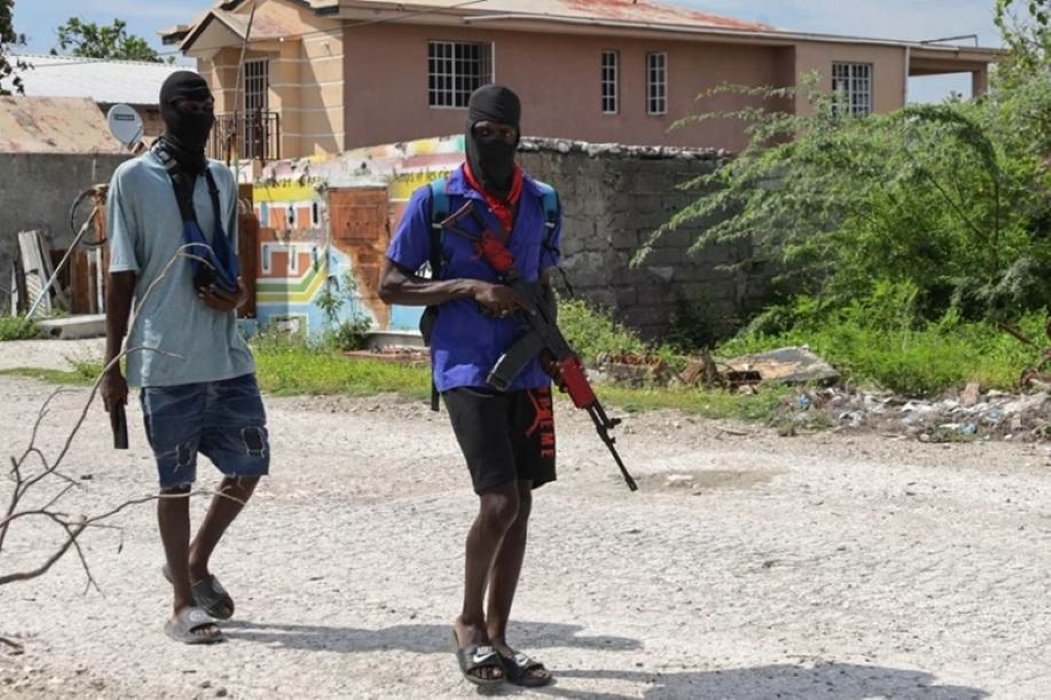
Haiti’s latest gang clashes near Port-au-Prince have killed more than eighty people, exposing a security collapse where armed groups fight for territory, hospitals retreat, families flee, and Latin America confronts the cost of looking away.
A Capital’s Wound Reopens
The smoke over Cité-Soleil is not just smoke. It is a message from a country where neighborhoods have become front lines, where the poor learn the geography of survival by listening for gunfire, and where the state’s absence is measured in burned homes, closed clinics, and bodies counted first by human rights groups.
More than eighty people have been killed and nearly one hundred wounded in clashes between armed gangs in Cité-Soleil, roughly five kilometers north of Haiti’s capital, according to human rights organizations cited by the local press. Many homes have been set on fire. Hundreds of residents have fled toward areas they hope are less exposed, though in today’s Haiti, safety can feel more like a rumor than a place.
Fritznel Pierre, head of Combite Pour la Paix et le Développement, told the local outlet Magik9 that the attacks are being carried out by a coalition of armed groups, including Chien Méchant, 400 Mawozo, and the Talibanes. He said the gangs are fighting for control of territories where companies operate, contributing thousands of dollars to the national economy.
That detail changes how the violence is read. This is not chaos for chaos’s sake. It is an armed struggle over economic corridors, influence, taxation, intimidation, and control. In Cité-Soleil, a poor neighborhood long marked by political abandonment and social exclusion, gangs are not merely hiding in the cracks of the state. They are turning those cracks into a system.
For families caught in the middle, the analysis comes later. First comes the decision: stay and risk the bullet, or leave and risk everything else. A woman walking with a few belongings after clashes in Port-au-Prince, captured in an EFE image by Jonet St Élois, becomes a national portrait. No banner. No speech. Just movement, loss, and the old Caribbean burden of carrying home in your hands.

Armed Groups Fill the Vacuum
The latest hostilities reportedly resumed last Sunday between the Canaan gangs, led by Jeff Gwo Lwa, an ally of Chien Méchant in the Plaine du Cul de Sac, and 400 Mawozo, led by Lamò Sanjou. They are facing a rival bloc formed by gangs from Cité-Soleil, Village Renaissance, and Pierre 6. The names may sound local, but their effects are national. Each armed faction redraws the map by force, and every new line cuts through homes, markets, schools, roads, and clinics.
The Haitian office of Médecins Sans Frontières warned Tuesday about the fighting and temporarily evacuated one of its hospitals in Cité-Soleil due to worsening security. That evacuation is one of the clearest signs that the crisis has moved beyond ordinary criminal violence. When a humanitarian medical organization cannot safely operate a hospital, the emergency becomes layered. The wounded are trapped. Pregnant women are exposed. Children with fever wait. Chronic illness becomes more dangerous. Fear becomes a public health condition.
That same day, Prime Minister Alix Didier Fils-Aimé chaired an extraordinary council of ministers to address the issue of insecurity. He gave officials what they described as clear instructions and concrete measures to immediately strengthen law enforcement’s operational capacity and ensure a coordinated, forceful, and lasting response to all forms of crime.
The words are necessary, but Haiti’s tragedy is that official language has often arrived after armed reality has already occupied the street. Authorities have not released a death or injury toll for the recent clashes. That silence matters. A state that cannot quickly count its dead risks losing not only territory, but the authority to narrate what is happening to its own people.
The broader figures are devastating. Haiti’s violence left at least 1,642 people dead and 745 wounded in the first quarter of this year alone, according to the latest report by the United Nations Integrated Office in Haiti, known as BINUH. In three months, the country recorded a level of bloodshed that would shake any democracy in the hemisphere. In Haiti, it risks becoming another entry in a grim routine.
The data points to something deeper than a spike in insecurity. It suggests a political order being contested by armed groups that operate like territorial powers. They profit from movement, fear, routes, extortion, and scarcity. They know where the state is thin. They know which neighborhoods can be punished. They know how to make civilians into messages.

A Caribbean Crisis With Regional Consequences
For Latin America, Haiti is not an island apart. It is a mirror held at an uncomfortable angle. The region has often treated Haiti as a humanitarian exception, a tragic place to be pitied from afar, rather than as a central warning about what happens when institutions collapse, inequality hardens, armed groups learn governance, and international response arrives late, divided, or too weak to matter.
The geopolitics are clear. Haiti’s violence fuels displacement, and displacement travels. It pressures the Dominican Republic, the wider Caribbean, Mexico, South America, and the United States. It reshapes migration routes. It strengthens smugglers. It becomes a talking point for politicians who prefer walls to responsibility. It also tests whether Latin American governments can imagine security beyond military deployment.
Haiti’s gangs are not merely a Haitian problem. They are part of a hemispheric pattern in which criminal organizations exploit weak institutions, social abandonment, and lucrative territories. From port cities to borderlands, from informal mining zones to urban peripheries, Latin America has seen how armed actors move into places where the state arrives only as police, or not at all. Haiti shows the endpoint of that failure in its starkest form.
But Haiti also carries a unique historical burden. It was the first Black republic, born from the only successful slave revolt in modern history. Its independence terrified colonial powers and inspired oppressed peoples across the Americas. For generations, it paid for that freedom through isolation, debt, intervention, elite extraction, and outside pressure. Today’s gang crisis cannot be reduced to the past, but neither can it be separated from it. The ruins of sovereignty are rarely built in one generation.
The regional response must therefore avoid two easy lies. The first is that Haiti can be rescued by force alone. Armed groups must be confronted, but without institutions, courts, hospitals, economic alternatives, and civilian protection, force becomes another temporary storm. The second lie is that Haiti’s suffering can be contained. It cannot. A country that loses hospitals, neighborhoods, and economic zones to armed groups becomes a regional emergency, whether neighbors admit it or not.
In Cité-Soleil, people are not waiting for geopolitical vocabulary. They are leaving burning houses. They are looking for relatives. They are deciding which road is less deadly. They are discovering that even a hospital may have to retreat.
That is the cruelest measure of Haiti’s crisis: not only that gangs kill, but that ordinary life withdraws before them. The market closes. The school empties. The clinic evacuates. The state speaks from a distance. And the neighborhood, once again, is asked to survive what the hemisphere has failed to solve.
Also Read:
Chile Turns Schools and Hospitals into Migration’s New Political Border