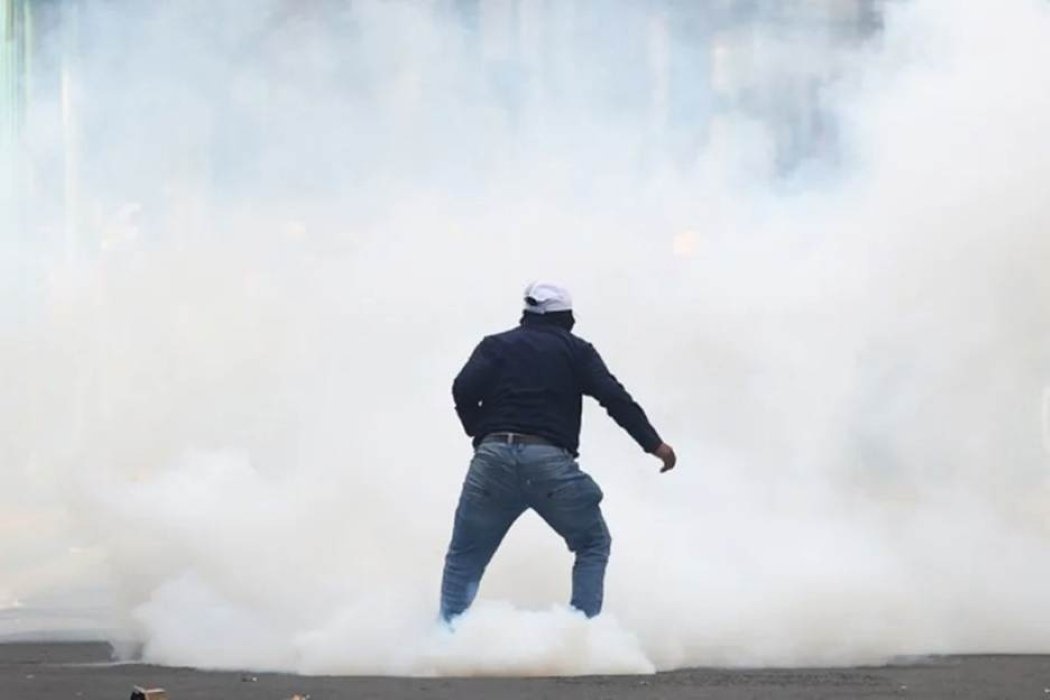
Bolivia’s deepening blockade crisis has pushed President Rodrigo Paz toward emergency powers, exposing a dangerous struggle between social protest, state force, Indigenous memory, food shortages, and Latin America’s old fear that order can quickly turn into repression.
A Country Near the Emergency Line
Bolivia is again standing at the point where a roadblock becomes more than a roadblock. It becomes a question about who controls the country. The elected government in La Paz, or the social movements that can cut its arteries with stones, bodies, and anger.
As protests and blockades enter their fourth week, the possibility that President Rodrigo Paz may declare a state of exception has moved from rumor to legal preparation. Bolivia’s Senate approved a bill to repeal restrictions in force since 2020, clearing the way, if the lower house follows, for the government to deploy security forces with fewer parliamentary limits amid a crisis that has left La Paz and El Alto struggling with shortages of food and fuel.
The debate comes as demonstrators, especially in the Andean region, demand Paz’s resignation. The geography matters. Bolivia’s highlands are not just territory. They are political memory. They are the places where Indigenous organizations, labor unions, and rural power have repeatedly shown that the state can be challenged not only at the ballot box but also on the highway.
The bill approved Sunday in the Senate would repeal the current State of Exception Law and must now be debated by the Chamber of Deputies. Its purpose is to give Paz legal backing to invoke an emergency measure allowed under the 2009 Constitution, promulgated during the government of Evo Morales. The irony is sharp. A constitutional tool born under Morales may now be used by a government facing pressure from the Aymara campesino community, the Central Obrera Boliviana, and sectors loyal to Morales himself.
Carlos Alarcón, a lawmaker from the Unidad alliance and the measure’s promoter, told EFE that the bill seeks to abolish the 2020 law approved under Eva Copa, then the interim head of the Legislative Assembly. That law required parliamentary regulation of executive decisions involving security forces in internal conflicts. Alarcón argues that the current framework ties the government’s hands, preventing it from using the state’s legitimate and legal force through a state of exception.
That is the language of authority. But Bolivia’s streets hear another language too: the memory of 2019.

The Ghost of 2019 Returns
The so-called Eva Copa law was passed during the transitional government of Jeanine Añez to limit the use of security forces after the crisis that followed Morales’s resignation in 2019, when deaths during unrest left a deep scar in national memory. The Vice Presidency, led by Edmand Lara, who has declared himself opposed to the measure, said the 2020 law was designed to prevent the state from again responding to social conflicts with lethal weapons after those painful events.
That warning cannot be dismissed as procedural caution. In Latin America, emergency powers often arrive wrapped in legal language, but they are remembered through bodies. The state may speak of restoring order. Families remember those who did not return. Bolivia knows this more than most countries because its modern politics has been repeatedly shaped by the collision between security forces and mobilized communities.
The current law states that under a state of exception, any restriction on liberty as punishment is prohibited, and that the Armed Forces may be used to control civil disturbances only when police have been overwhelmed. There is no other effective means to restore order. To Alarcón, this gives the legislature too much capacity to “make and unmake” a government decree. He called that absurd, arguing that lawmakers lack the security knowledge needed during internal upheaval.
Yet the Constitution itself, in Article 137, already sets limits. It allows a state of exception in all or part of the country during internal commotion. Still, it says fundamental rights and guarantees cannot be suspended. It does not automatically require military deployment. That would depend on the government’s specific assessment of the conflict. Alarcón suggested the measure could be applied gradually, first with police deployment and then with military involvement in certain regions.
That word, gradually, is supposed to reassure. It may do the opposite. Gradual escalation is still escalation. And in a country where social protest is one of the central languages of political life, the line between restoring circulation and criminalizing dissent can blur very quickly.

Latin America’s Dangerous Bargain
The Central Obrera Boliviana, which is helping drive protests demanding Paz’s resignation, rejected the Senate decision. So did the Vice Presidency. Their resistance signals that this is not only a conflict between the government and the roadblockers. It is also a conflict within the state, in terms of authority, and in Bolivia’s unresolved debate over how much force a democracy may use against social mobilization.
The government’s problem is real. La Paz and El Alto cannot remain hostages to shortages indefinitely. Hospitals need supplies. Families need food. Fuel cannot be treated as an optional luxury in cities built around difficult geography and fragile distribution chains. A state that cannot guarantee basic movement begins to look weak. Weakness invites more pressure.
But the protesters’ anger also comes from real social grounds. Bolivia’s blockades do not emerge from nowhere. They often grow from wage demands, distrust of reforms, fuel problems, Indigenous grievance, labor pressure, and the belief that national decisions are being made above the heads of the people who pay the cost first. Roadblocks are disruptive because they are designed to be disruptive. They are also one of the few tools that rural and labor movements believe can force governments to listen.
For Latin America, Bolivia’s crisis offers a warning at a tense regional moment. Across the continent, states are facing organized crime, fiscal pressure, social exhaustion, distrust in parties, and rising demands for order. Emergency powers are becoming politically tempting. Presidents can argue that normal tools are too slow for abnormal crises. Citizens suffering shortages or violence may agree.
The danger is that the emergency becomes a habit. Once the state learns to govern through exception, democratic limits can begin to look like obstacles rather than safeguards. Latin America’s history is full of governments that promised temporary force and left permanent wounds.
Bolivia’s case is especially important because it sits at the crossroads of Indigenous mobilization, resource politics, labor power, and fragile executive authority. If Paz invokes a state of exception and uses force heavily, he may reopen roads while losing legitimacy in the highlands. If he does nothing, shortages may erode confidence in his government. If he negotiates without leverage, protesters may smell retreat. Every path carries risk.
That is why the question is not only whether the state of exception is legal. It is whether it is politically wise, socially sustainable, and human rights-compliant.
Bolivia’s roads have become the stage for a national trial. On one side stands the state, arguing that order must be restored before scarcity breaks the cities. On the other hand, movements that see emergency powers as the first step toward repression. Between them are ordinary Bolivians counting the price of food, the fuel left in the tank, and the country’s long memory of what happens when the state decides it has reached its limit.
Also Read:
Bolivian Roads Become Battleground as Blockades Test Rodrigo Paz’s Presidency