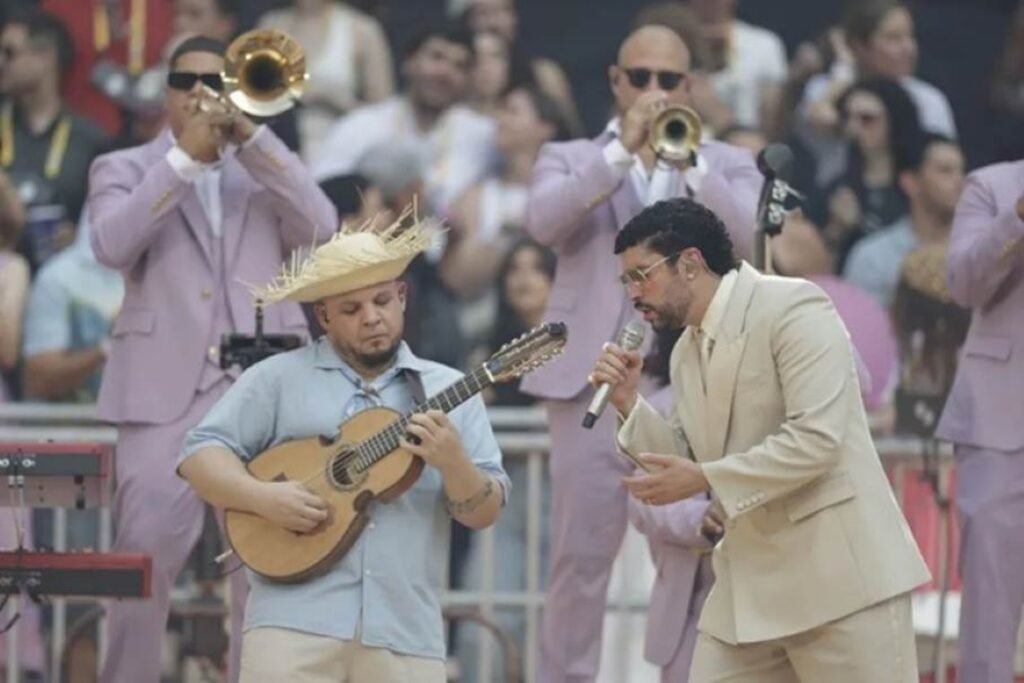
Bad Bunny’s historic Madrid residency opened with 64,000 fans, Myke Towers, and a Puerto Rican homecoming disguised as a stadium show, proving that Spanish-language pop is no longer crossing over. It is the center, sweaty, Caribbean, political, and global right now.
Madrid Learns to Perrear
The present speaks Spanish, sweats under stadium lights, and knows the chorus before the artist opens his mouth. On Saturday night in Madrid, Bad Bunny began what already feels less like a concert run than a cultural occupation: ten nights at the Metropolitano, 640,000 people in total, the first 64,000 packed into the stadium for the opening chapter of his “Debí Tirar Más Fotos” tour, with Myke Towers arriving as the inaugural guest.
Six years had passed since the Puerto Rican superstar last performed in Madrid, according to EFE’s reporting, and the gap showed. Not as absence, exactly. More like growth rings. The artist who returned was no longer just Benito from Vega Baja, no longer only the mischievous “conejo malo” of trap, reggaeton, and wounded love songs. He came back as the sound of an era, the sort of figure people will use later to timestamp the 2020s, the way they use Michael Jackson for the 1980s or Nirvana for the 1990s.
“My first night in Madrid in a long time and I want to enjoy it to the fullest with you,” he told the crowd, in remarks reported by EFE. Then came the command, half-invitation and half-test of belonging: nobody could claim to have attended a Bad Bunny concert, he said, without perreando. He wanted to see Madrid perreando.
It was funny. It was also precise. Perreo in Madrid is not neutral. It carries the Caribbean into the old imperial capital and shifts the city onto a different axis. It turns the Metropolitano into a plaza where Puerto Rico, Spain, Venezuela, Cuba, Colombia, the Dominican Republic, and the Latin American diaspora do not politely coexist. They rub shoulders, shout lyrics, and rewrite the room with hips.
The show began at 8 P.M., still in daylight, with the audience joining the invocation from “La Mudanza.” Then he appeared in a clean beige suit in the middle of the floor, eyes hidden behind translucent glasses, face still, until the chant rose around him. “Benito, Benito.” He opened his eyes and smiled. Nearly three hours and more than 30 songs followed.

A Little House With a Big Flag
The night’s emotional center was not only the main stage. It was the already iconic “casita,” the alternate set that has become the true home of this tour. There, celebrity guests Ana de Armas and Ester Expósito appeared alongside members of Rawayana and Rayo Vallecano players Isi Palazón and Sergio Camello. But the house mattered less because of who entered it than because of what it represented.
Bad Bunny has built “Debí Tirar Más Fotos” as an argument against cultural amnesia. The album draws on Puerto Rican roots, plena, salsa, jíbaro memory, and the music of working people, then places those sounds within the global machinery of streaming pop. That contradiction is the point. He uses the scale of capitalism to criticize what capitalism erases.
In Madrid, the evidence was visible before the show even began. Many fans wore pavas, the straw hats associated with Puerto Rican rural workers that Bad Bunny helped popularize again after his Super Bowl appearance. In another artist’s hands, the hat could become merchandise. In his, it reads closer to a portable homeland, a rural symbol carried into a European stadium where young fans may know the island first through rhythm, slang, and family stories.
The numbers make the cultural shift impossible to dismiss. Ten stadium concerts in one European capital. 640,000 attendees. A Spanish-language album promoted not as a niche export but as global pop’s main event. The notes say “Debí Tirar Más Fotos” has already marked unique records, including the first Grammy for album of the year for a Spanish-language album. Whether viewed as music history, market data, or soft power, the message is the same: the Latin present no longer needs permission to be legible.
Traditional Puerto Rican groups such as Chuwi, Los Sobrinos, and Los Pleneros de la Cresta gave the concert its deeper architecture. During “Baile Inolvidable,” Bad Bunny stood backed by roughly 15 musicians armed with tropical force, then pushed into “Nuevayol” with dancers filling the floor. The moment did not feel like nostalgia. It felt like recovery.
“This show is about enjoying the small things in life like singing, dancing, sweating, laughing, and having a good time,” he said, according to EFE. Then the line that could serve as the tour’s civic slogan: “Madrid, sing and love without fear.”

Latin Pop Becomes Geopolitics
Bad Bunny’s Madrid residency matters beyond music because culture is one of Latin America’s most powerful forms of expression. The region has often lacked financial leverage in global institutions. Still, it has exported sound, bodies, style, language, humor, migration stories, and spiritual weather. Salsa did this. Reggaeton did this. Now Bad Bunny is doing it with a sharper historical consciousness.
Spain is a particularly loaded stage. Madrid is not just another European city. It is the former imperial center, now dependent on Latin American capital, labor, tourism, and culture to renew its own cosmopolitan identity. When 64,000 people chant Puerto Rican lyrics there, the old map flickers. The colony speaks back, not in a parliamentary chamber, but through bass, plena, and a crowd that knows every word.
There is economics in that, too. Spanish-language music has become a global industry with Latin artists driving streaming numbers, touring revenue, fashion, and platform visibility. But Bad Bunny’s move is more specific. He is not sanding down Puerto Ricanness for export. He is intensifying it. The local becomes the product, the politics, and the prestige.
That is why Myke Towers’ appearance on “Adivino” mattered. Two Puerto Rican artists meeting inside a Madrid stadium is not simply a guest slot. It is a reminder that Puerto Rico, despite its colonial limbo under the United States, projects enormous cultural sovereignty. The island may lack a seat at the United Nations, but its music travels with diplomatic weight.
Not everything was perfect. EFE noted the muddy sound that often troubles the Metropolitano, making Bad Bunny’s already tight phrasing harder to decipher for anyone outside the faithful. There were also long pauses, including fan interactions that slowed the pulse. Yet even those interruptions produced one of the night’s softest scenes: a young fan, overwhelmed and crying, embraced by the singer, then chosen to shout the familiar cry, “Acho, PR es otra cosa.”
That phrase is the thesis. Puerto Rico is something else. And in Madrid, for one opening night, it was not small, distant, or dependent. It was the house, the flag, the drumline, the market, the memory, the joke, the kiss, the sweat, the export, and the future.
Also Read:
Colombian Caribbean Voice Totó Kept Ancestral Fire Burning Across Borders