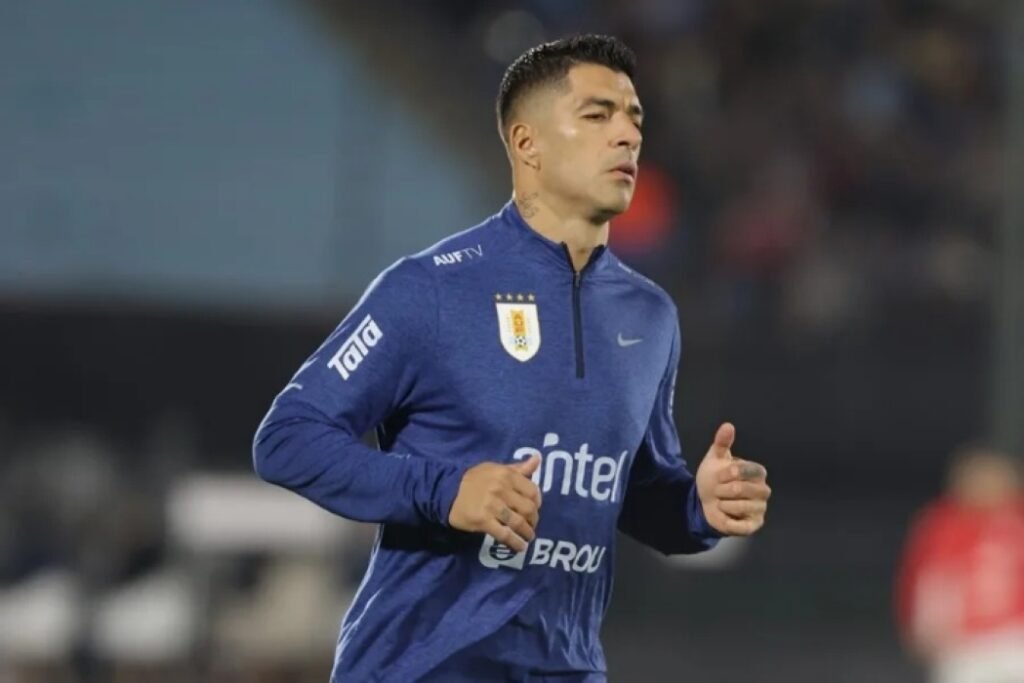
Luis Suárez will not play the 2026 World Cup, leaving Uruguay without its record scorer and most combustible icon as Marcelo Bielsa turns toward younger forwards, a colder future, and a Latin American soccer map shaped by memory and power.
The Door That Stayed Closed
For a few weeks, the door seemed cracked open. Not wide, not theatrically. Just enough for Uruguayans to imagine the old No. 9 appearing one last time, shoulders hunched, jaw set, trouble in his boots. On April 1, after training with Inter Miami, Luis Suárez told reporters he would never refuse the national team if it needed him, especially with a World Cup so near, according to EFE. It sounded less like a campaign than a confession.
He had stepped aside in 2024, he said, because he believed it was time to let younger players pass through. He also admitted he had said something he should not have, adding that he had apologized to those who deserved it. In Uruguay, where soccer apologies are never only about soccer, the words hung there. Personal, political, unfinished.
Then came Sunday. The Uruguayan Football Association released Marcelo Bielsa’s squad for the 2026 World Cup, and Suárez was not on it. The Celeste will go to the tournament without the country’s all-time leading scorer, a man with 69 goals in 143 appearances, four previous World Cups under his belt, and enough mythology to fill a stadium before kickoff.
The decision was not shocking in sporting terms. Suárez left the national team in September 2024 after a 0-0 World Cup qualifying draw against Paraguay. Soon after, he publicly criticized Bielsa, blaming him for creating tension inside the squad. But the official absence still carries weight. It turns a rumor into an ending. It confirms that Uruguay’s next World Cup will be played without the player who, for better or worse, defined its modern competitive identity as feral, stubborn, and dangerous.

A Squad Without Its Old Fire
Bielsa did not leave the center-forward position vacant. He called Darwin Núñez, Rodrigo Aguirre, and Federico Viñas, three strikers who offer different versions of the future. Núñez brings pace, chaos, and an elite European pedigree. Aguirre brings maturity and penalty-box instincts. Viñas brings mobility and hunger. None carries Suárez’s national burden. That may be exactly the point.
Uruguay shares Group H with Spain, Saudi Arabia, and Cape Verde. It is not a decorative group. Spain represents the old colonial and footballing mirror, a possession-heavy power with institutional depth. Saudi Arabia represents money, projection, and a changing soccer economy in which Gulf influence has become a global instrument. Cape Verde, smaller and proud, brings the kind of diasporic confidence that often unsettles traditional powers. Uruguay enters as a country that cannot simply lean on its past.
For Bielsa, this is a political choice in sporting clothes. He has never been a coach who treats selection as nostalgia management. He prefers systems, movement, obedience to a collective rhythm, and a kind of moral intensity that can look beautiful when it works and suffocating when it does not. Suárez, by contrast, has always been excess. Improvisation. Appetite. A player who solved games by refusing the normal rules of proportion.
That clash matters. Uruguay’s soccer culture has long celebrated garra charrúa, the stubborn refusal to surrender, often against richer and larger nations. Suárez embodied that spirit in its brightest and darkest forms. In the 2010 World Cup in South Africa, he scored three goals. He became globally infamous for using his hands to stop Ghana’s winning shot in the 120th minute of the quarterfinal. Uruguay survived the penalty shootout and advanced. To some, it was cynical. To many Uruguayans, it was a sacrifice.
In the 2014 World Cup, he delivered one of his greatest performances, scoring twice as Uruguay beat England 2-1. Then came the bite on Giorgio Chiellini against Italy, the ban, the moral trial by television. In the 2018 World Cup, he scored against Saudi Arabia and Russia. He assisted Edinson Cavani against Portugal in the round of 16. At the 2022 Qatar World Cup, he played all three group matches, but Uruguay went out early. The fire was still visible. The legs, less so.

A Farewell Larger Than Soccer
Suárez’s absence is not just the end of a player’s World Cup story. It is a small geopolitical signal from a small country that has always used soccer as a form of diplomatic language. Uruguay has barely more than three million people. Yet, its football history gives it a voice wildly larger than its population. Two World Cup titles, Olympic glory, historic clubs, and exported stars. In Latin America, where states often struggle to project power through industry or armies, soccer becomes soft power with mud on its knees.
That is why this omission speaks beyond Montevideo. Latin American soccer is changing from the age of sacred veterans to the age of globalized assets. Messi’s Argentina stretched one era to its most romantic limit. Neymar’s Brazil showed the fragility of another. Uruguay is choosing something colder: institutional continuity over emotional debt. Bielsa’s list says the shirt belongs to tomorrow, not to the player who made yesterday unforgettable.
There is also a class and cultural reading. Suárez came from Salto, from the interior, from a life story that Latin Americans recognize: talent sharpened by scarcity, migration, family pressure, the need to fight for a place before anyone grants one. His rise made him beloved because he did not look polished by privilege. He looked like a survivor. His flaws were not incidental to his legend. They were part of the same combustible engine.
Now Uruguay asks whether it can keep the edge without the man who personified it. That question is familiar across Latin America. Can nations modernize without erasing their old emotional codes? Can institutions become more disciplined without becoming sterile? Can a region famous for heroic individuals build collective projects that survive them?
Fernando Muslera, also known as Bielsa, will now stand alone among Uruguayans with the most World Cup appearances once the tournament begins. That detail is tender and severe. Goalkeepers often become witnesses. Strikers become myths. Suárez, with 16 World Cup matches across South Africa, Brazil, Russia, and Qatar, leaves behind both.
There may be no clean goodbye. There rarely is with Suárez. His national team story ends not with a final goal, but with a closed squad list, a public apology still echoing, and a country turning toward June without its most famous snarl. Uruguay will still sing. It will still believe. But in 2026, when the ball enters the box and danger gathers, something ancient will be missing.
Also Read:
Mexico World Cup Faces Carbon Hangover Before First Whistle Blows