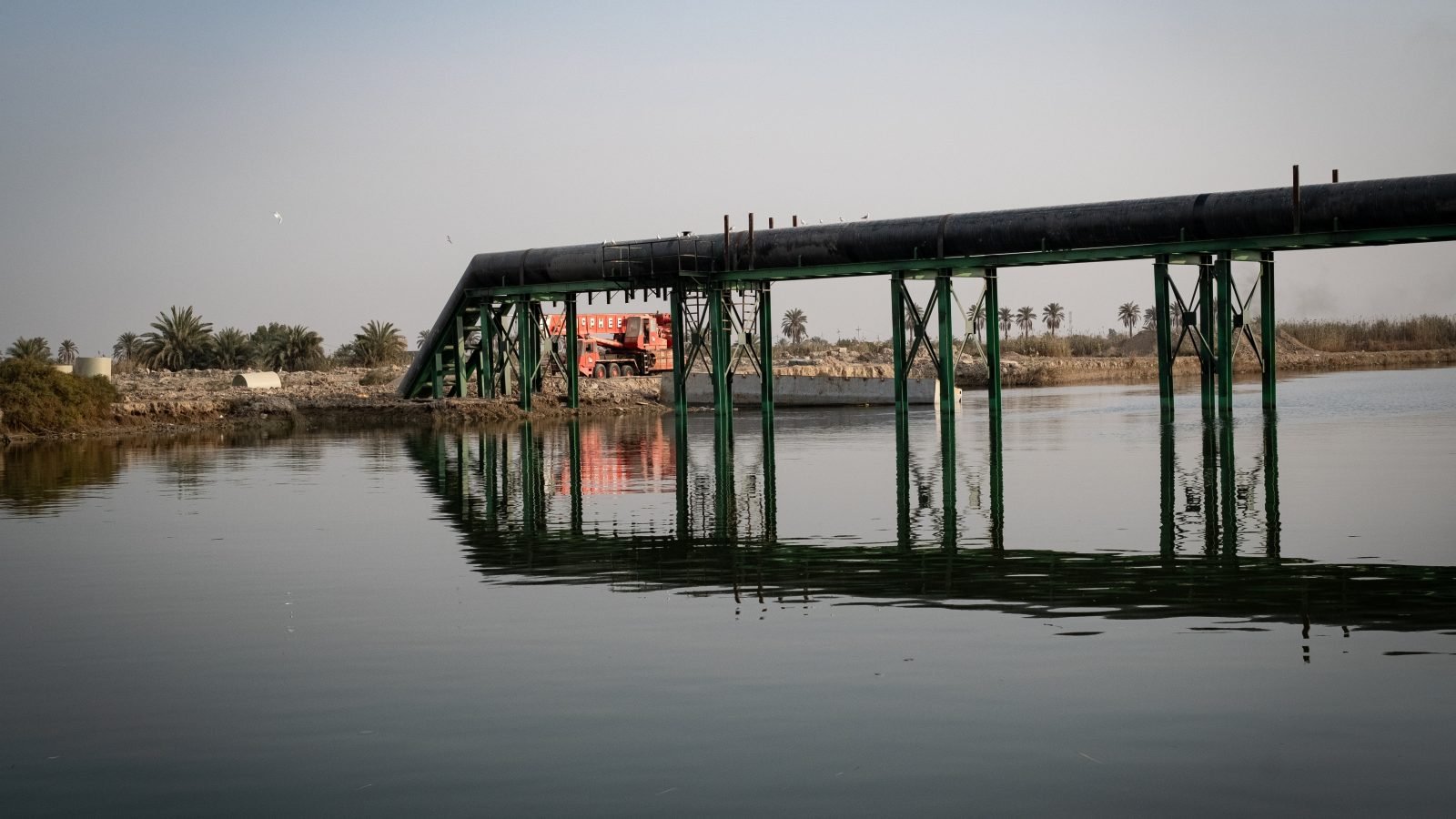
Major U.S. hyperscalers running data centers in the Gulf to power apps and online services for millions of users are channeling data out of the war zone through fiber-optic cables that an Iraqi telecom has strung alongside crude-oil pipelines.
“Most if not all the hyperscalers” have bought capacity on the Iraqi route, Martin Frank, strategic adviser at IQ Networks, the company that built the network, told Rest of World.
The demand for diverse fiber routes out of the Gulf is “ultimately driven by hyperscalers such as Google.”Paul Brodsky, TeleGeography
“Hyperscalers” is the industry term for the companies — led by Amazon, Google, Meta, and Microsoft — which run data centers in almost 40 countries.
The data centers serve customers in more than 190 countries, processing transactions, storing files, and running applications for businesses and individuals from Latin America to South Asia. When Iranian drones struck Amazon’s facilities in the United Arab Emirates and Bahrain on March 1, the effects spread across the region.
“Stressful, frustrating, and time-consuming”
Apps of major banks in the UAE, including Abu Dhabi Commercial Bank, stopped working. Payment and delivery platforms went offline. Snowflake, a U.S. enterprise software company used by thousands of businesses globally, reported Middle East service disruptions tied directly to the Amazon Web Services outage. Amazon told its customers to migrate their workloads out of the Middle East.
Kareem Arshad, an independent financial adviser in the UAE, was trying to transfer money that day through Abu Dhabi Commercial Bank, when its mobile app stopped working.
“It was stressful, frustrating, and time-consuming because I went to an exchange center to transfer,” he told Rest of World. “I was thinking the problem was only from my account.”
The data from these banking, payment, and enterprise platforms normally travels to Europe through cables running under the Red Sea and the Strait of Hormuz, then connects onward to users across the world. The war has put those cables at risk. The overland route through Iraq is meant to serve as a backup if the sea cables are disabled. It is already carrying live traffic, Frank said.
The demand for diverse fiber routes out of the Gulf is “ultimately driven by hyperscalers such as Google,” Paul Brodsky, a senior research manager at TeleGeography, which tracks telecommunications infrastructure worldwide, told Rest of World.
Unbroken land-based route to Europe
IQ Networks began building the route in 2010 as an alternative to the submarine cables that carry almost all Gulf data to Europe. The company, based in Iraq’s Kurdistan region, runs fiber from the southern tip of Iraq to the Turkish border. It is now extending the network through gas-pipeline corridors across Turkey to the European border, with the first link expected early next year, Frank said.
When that extension is complete, cloud providers will — for the first time — have the option of an unbroken land-based fiber path from the Gulf into the European network, connecting onward to Frankfurt, Amsterdam, London, and Marseille, from where their data connects back to U.S. users.
The advantage of this alternative route is that oil and gas pipelines come with their own security perimeters, access roads, and maintenance corridors already built around them, allowing a telecom company to lay fiber without digging new trenches through difficult terrain.
Iraq avoided the fate of earlier overland routes that collapsed because of a sustained period of stability, and because existing pipeline infrastructure provided ready-made corridors for laying fiber, Doug Madory, director of internet analysis at network intelligence firm Kentik, told Rest of World.
“Iraqi pipeline infrastructure provides established long-distance right-of-way paths along which fiber optic cables can be run,” Madory said.
Companies that move large volumes of data will need several independent routes through the Middle East, not just one, Bertrand Clesca, a partner at infrastructure advisory firm Pioneer Consulting, told Rest of World.
“Dark fiber” and a greater degree of control
Cloud providers increasingly want to buy raw fiber strands on this route, known in the industry as dark fiber. The buyer installs equipment at each end, sends laser light through the strands to carry data, and controls everything from security to how much traffic they push through.
IQ Networks maintains the physical cable but cannot see what travels through it. That level of control matters to companies such as Amazon and Google because no government or third party sits between them and their data.
IQ Networks’ route, called the Silk Route Transit, has been running since November 2023. The network currently carries enough data to stream about 400,000 high-definition videos simultaneously, Frank said.
The land route is faster. Data traveling through submarine cables from the Gulf to Europe takes about 150 milliseconds. The Iraqi terrestrial route cuts that to roughly 70 milliseconds — a difference that matters for video calls, financial transactions, and applications that run on artificial intelligence, according to IQ Networks.