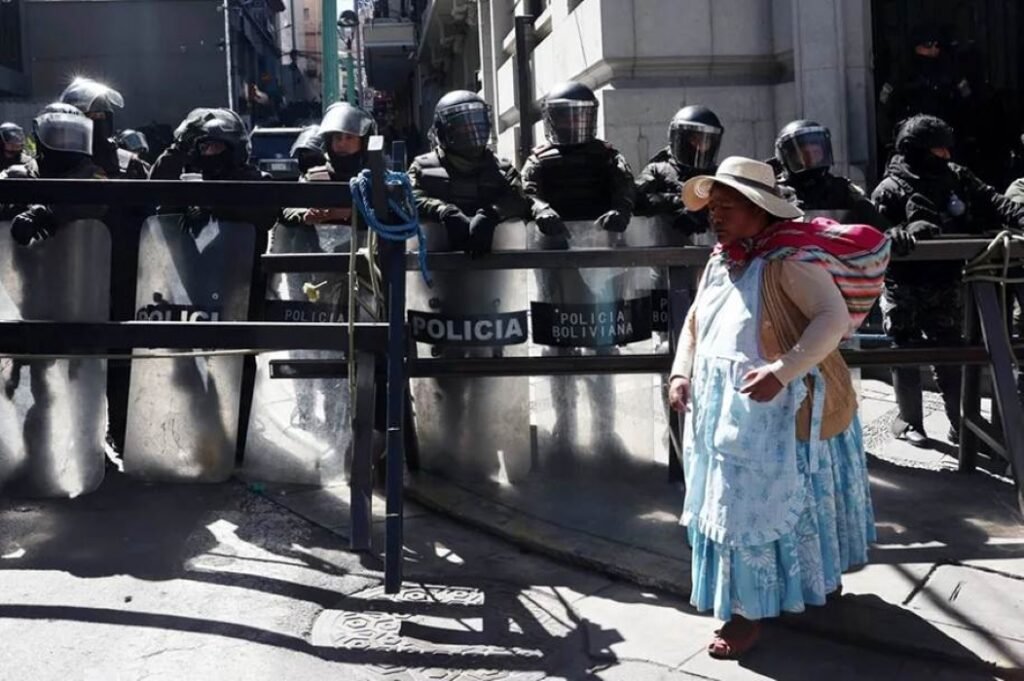
Bolivia’s roadblocks have trapped cities, inflated food prices, and shaken President Rodrigo Paz’s fragile coalition, exposing a deeper Latin American problem: governments win elections promising relief, then lose the street when austerity arrives without trust, fuel, or bread at home.
A Country Waiting Behind Barricades
In La Paz, scarcity has a sound. It is the thin argument over the last tray of eggs, the stalled engine at a fuel line, the phone call asking whether medicine made it through from another city. In nearby El Alto, where politics often begins at street level and ends in national consequence, the roadblocks have become more than a protest tactic. They are a daily weather system.
According to an EFE report, President Rodrigo Paz said Monday in Cochabamba that “the violent cannot win”. He promised that “in the coming days” the suffering of cities most affected by five weeks of blockades and protests would end. He called for “democratic maturity,” a truce, and national pacification, while acknowledging that some sectors have legitimate grievances and others, in his view, seek to damage democracy.
That distinction is politically convenient, but not entirely wrong. Bolivia’s unrest is not one thing. It is a pileup.
The Central Obrera Boliviana, the Tupac Katari campesino federation of La Paz, and groups loyal to former President Evo Morales have helped push demands that began as sectoral complaints into a call for Paz’s resignation. The accusations are familiar in a country where privatization is not merely a policy word but a memory of dispossession. Protesters say Paz broke promises and is preparing to privatize companies and services. His government denies it.
Yet the roadblocks tell another story, too. They map a country where representation is splintering faster than the political class can name it. Paz has been in office for a little more than six months. He campaigned as a centrist exit ramp from the long shadow of the Movement for Socialism, promising economic order without the hard-right turn many voters feared under former President Jorge Tuto Quiroga. He won with a broad, awkward coalition, helped by Vice President Edman Lara, a former police officer whose anti-corruption message traveled through social media and poorer neighborhoods with unusual force.
Now, some of the very zones that lifted Paz and Lara are blocking their paths.

The Price of a Broken Mandate
The numbers are blunt because they belong to households. La Paz and El Alto have faced shortages of food, fuel, medicine, and medical oxygen. Chicken and eggs have climbed beyond the reach of many families. Losses to the national economy are already described as massive. Roadblocks have spread from La Paz into Oruro, Potosí, Cochabamba, Chuquisaca, and Santa Cruz, turning a political crisis into a logistics crisis.
Bolivia knows roadblocks. They are part of the grammar of power, especially for groups historically kept outside the palace. In the Andes, the highway has long been both infrastructure and bargaining table. When institutions do not listen, the road does. But duration changes the moral temperature. A blockade on day one can look like pressure. A blockade after five weeks begins to look like a siege to the mother searching for oxygen, the vendor with rotting produce, and the taxi driver whose income depends on gasoline.
EFE reported that government attempts on May 16 and May 23 to open humanitarian corridors for food and supplies ended in clashes involving police, soldiers, and demonstrators. Since then, there have been no new efforts to clear the roads. Dialogue attempts by a legislative commission, the Catholic Church, the Ombudsman’s Office, and human rights activists have not prospered because protesters insist that Paz must resign.
That is the dangerous corner. When a demand reaches its peak, negotiation loses oxygen too.
Paz’s bigger problem is not only the street. It is credibility. His administration moved quickly toward alliances with conservative political and business actors, especially agro-industrial sectors in Santa Cruz. That may have seemed economically rational in a country strained by fiscal deficits, fuel problems, and pressure to attract investment. But in Bolivia, economic modernization without consultation is politically radioactive. The state may be broke, but voters still remember being told that sacrifice would someday become prosperity.
This is where Latin America should pay attention. From Argentina to Ecuador, from Peru to Panama, governments are rediscovering the same hard equation. Fiscal adjustment may please markets. It may even be necessary. But in societies built on informal labor, regional inequality, and historical distrust, adjustment without a narrative of shared burden becomes humiliation.
Paz failed, or has so far failed, to explain who pays, who benefits, and who gets protected. Lara’s public apology to voters for campaign promises left unmet, including pensions, police reform, and judicial reform, sharpened the perception that the government’s moral contract has frayed from within.

Latin America’s Street Still Votes
The easiest way to do outside reading is to make this about Evo Morales. He remains influential, loud, and politically useful to his enemies. His supporters are present in the crisis. But treating Morales as the hidden hand behind everything flatters yesterday’s map. Bolivia’s post-MAS landscape is more fragmented now, less obedient to a single caudillo, less containable by old labels.
That fragmentation is not only Bolivian. Latin America has entered an era of brittle mandates. Presidents win because voters are exhausted, not because they are trusted. Coalitions form against the past, then collapse over the price of the future. The street becomes a second legislature, messy, wounded, sometimes democratic, sometimes coercive.
Quiroga, now an opposition voice, said Monday there is a “state vacuum” and that the country has been “blocked” for a month. His critique lands because paralysis is visible. But calls to “govern” carry their own risk in Bolivia, where force can turn a solvable conflict into a generational grievance. The memory of state violence is never far from the plaza.
Paz’s phrase, “the violent cannot win,” is a warning. It is also a test of restraint. If he means that democracy cannot be overthrown by siege, many Bolivians will agree. If it becomes a license to flatten all protest into criminality, he will deepen the very rupture he says he wants to heal.
The crisis is asking Bolivia for something harder than order. It is asking for political repair. Humanitarian corridors must be negotiated and protected. Shortages must be treated as national emergencies, not propaganda props. The government must bring Lara’s constituency, labor groups, campesino organizations, and urban consumers to a real table where the costs of reform are visible.
For Latin America, Bolivia is not an oddity at altitude. It is a mirror. Democracy in the region is not dying only in coups or presidential palaces. It is thinning out in the space between promises and prices, between campaign poetry and the empty market stall. In that space, people do not first ask for ideology. They ask whether the road is open, whether the chicken arrived, and whether the oxygen tank will last the night.
Also Read:
Sheinbaum’s Election Warning Tests Latin American Democracy and Foreign Influence