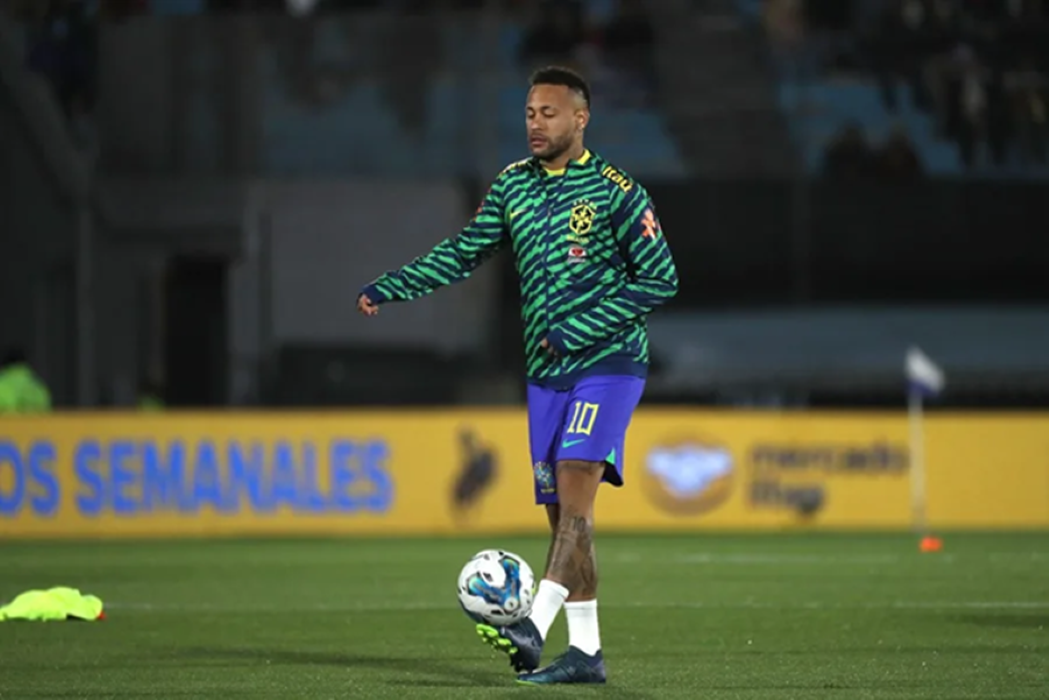
Neymar’s return to Brazil’s number ten shirt, despite injury doubts, turns Carlo Ancelotti’s World Cup gamble into a national drama about legacy, Pelé’s shadow, Vinícius Júnior’s patience, and Latin America’s obsession with wounded genius.
A Shirt Heavier Than Muscle
The number ten shirt in Brazil has never been just a piece of cloth. It is an inheritance. It is a burden. It is a theater. It carries Pelé’s smile, Zico’s elegance, Rivaldo’s left foot, Ronaldinho’s mischief, Kaká’s glide, and the impossible expectation that Brazilian football should not merely win, but enchant.
Now, once again, it belongs to Neymar.
A source from the Brazilian Football Confederation told EFE that Neymar will wear Brazil’s number ten shirt at the World Cup in the United States, Mexico, and Canada, which begins on June 11. Carlo Ancelotti surprised many by including the Santos forward in his squad, even though Neymar arrived at Brazil’s training camp in Teresópolis with a grade two injury in his right calf that is expected to keep him out for two to three weeks.
That makes his return both emotional and risky. Neymar is expected to remain with the Seleção in the mountains of Rio de Janeiro state, undergoing intensive treatment in hopes of being ready for Brazil’s debut against Morocco on June 13 in New Jersey. He is doubtful for that opener and will miss Brazil’s two pre-tournament friendlies against Panama in Rio and Egypt in Cleveland.
Ancelotti has until June 12, one day before Brazil’s first World Cup match, to make changes to his 26-man list. Brazil’s team doctor, Rodrigo Lasmar, said Thursday that he expects the country’s all-time leading scorer to be cleared in two or three weeks and available during the group stage.
That timeline is the tension. Brazil is not merely waiting for a player to heal. It is waiting for a symbol to become usable again.

The Number Ten Has an Owner
The Brazilian press had speculated about a possible dispute between Neymar and Vinícius Júnior for the number made sacred by Pelé. But Vinícius, the Real Madrid star who has carried Brazil’s attack during Neymar’s long absence, recently told CazéTV that the ten has an owner, and that owner is Neymar.
It was a generous statement, but also a revealing one. Vinícius is now the most explosive Brazilian player in world football, the face of Real Madrid’s left wing, a Ballon d’Or-level figure, and the natural heir to the Seleção’s attacking stage. Yet he stepped aside from the country’s most mythic number. That says something about hierarchy in Brazil’s football imagination. Form matters. But myth still outranks form.
Neymar has not played for the senior national team since suffering a serious knee injury in October 2023. He returned to Santos at the beginning of 2025, the club where he first became a global obsession, in an attempt to recover the level that made him electric in his early years in Europe. Injuries interrupted that comeback, too. But in 2026, he improved physically, found some continuity, and convinced Ancelotti that there was still enough magic left to justify the call.
That decision will define part of Ancelotti’s tournament before a ball is kicked. If Neymar recovers and shapes matches, the Italian coach will look brave, almost prophetic. If Neymar cannot run, press, absorb contact, or survive the pace of World Cup football, the selection may be remembered as nostalgia dressed up as strategy.
Brazil has lived through this before. The country loves the returning genius, the wounded artist, the player whose body is questioned but whose name still rearranges rooms. In Latin America, football memory often forgives what medical reports do not. Fans want one more dribble. One more free kick. One more proof that history is not finished.
But World Cups are cruel to sentiment. They do not wait for calves, knees, or legends.

Latin America’s Wounded Genius Problem
Neymar’s case speaks to a wider Latin American pattern. The region’s football culture has always been drawn to the damaged genius. This player carries technical beauty and national contradiction in the same body. Maradona played through pain and chaos. Ronaldo entered 2002 with questions about his knees and left as a champion. Messi carried years of Argentine heartbreak before Qatar turned him into a complete myth.
Neymar’s unfinished story is different. He already became Brazil’s all-time leading scorer, surpassing Pelé’s official national-team mark. Yet many still place him below the country’s greatest figures because he has not delivered the World Cup. In Brazil, statistics are never enough. The altar is built in June and July.
That is why the number ten matters. Pelé remains the standard by which every Brazilian attacking genius is measured, fairly or unfairly. He won the World Cup as a teenager in 1958, added two more titles, and turned Brazil into football’s dream language. Zico never won the trophy, but his artistry made him immortal. Rivaldo and Ronaldinho helped deliver Brazil’s fifth star in 2002. Kaká became the last classic Brazilian playmaker to win the Ballon d’Or before the Messi-Cristiano Ronaldo era consumed the award.
Neymar belongs in that lineage, but also sits apart from it. He is a product of Santos and social media, street football and brand culture, dazzling improvisation and constant scrutiny. His genius has always been public, monetized, debated, defended, mocked, and replayed. He has carried Brazil in eras when the country’s midfield produced fewer artists and its fans demanded miracles from the left channel.
His return to Santos adds another layer. In Latin America, the return to the first club often feels like a pilgrimage. It suggests roots, humility, repair, and a search for lost rhythm. But Neymar’s body has made the pilgrimage uncertain. Every injury now becomes a referendum on whether brilliance can survive time.
For Brazil, the geopolitical meaning lies in soft power. No country exports football identity like Brazil. The Seleção is a cultural embassy in yellow, a national brand older and more persuasive than many diplomatic campaigns. When Brazil is beautiful, the world watches differently. When its number ten limps, the world senses fragility in the myth.
For Latin America, Neymar’s gamble is familiar. The region often enters global stages with undeniable talent, uneven institutions, overburdened bodies, and hope placed on individuals asked to solve collective problems. One player becomes an economy of emotion.
Ancelotti may be betting that even a half-fit Neymar changes how opponents defend, how teammates believe, and how the world reads Brazil. He may be right. But the World Cup will not honor the shirt unless the legs beneath it answer.
The ten is his. The question is whether the tournament still is.
Also Read:
El Salvador Still Owns World Cup’s Harshest Scoreline and Warning