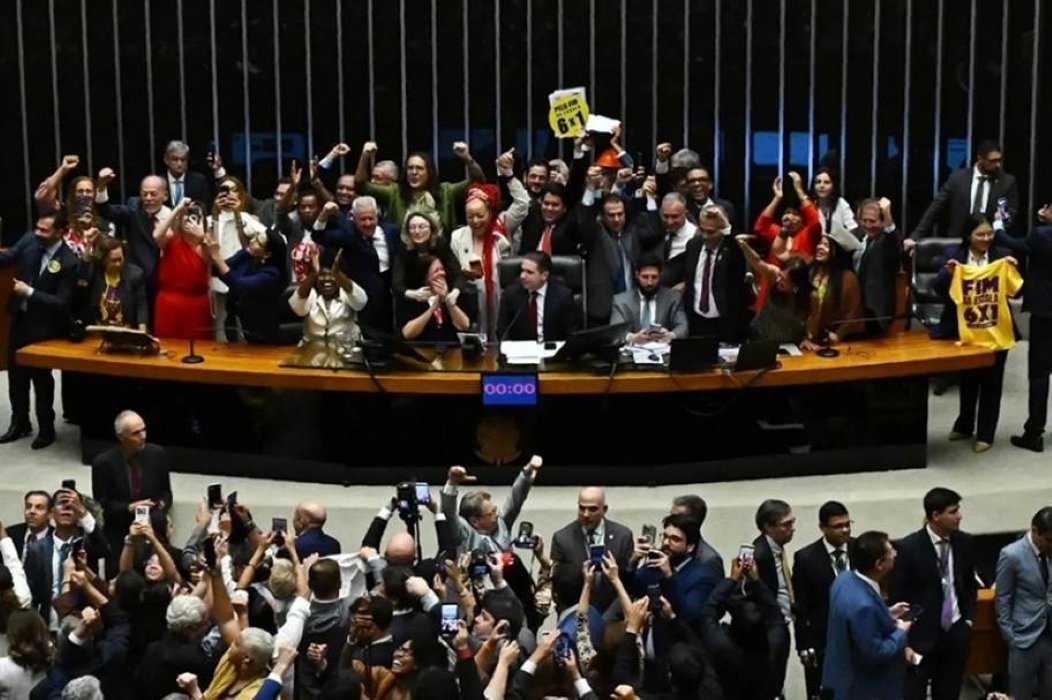
Brazil’s push to cut the workweek from 44 to 40 hours puts Lula’s labor agenda, industrial anxiety, productivity gap, and election-year coalition-building into one fight over whether workers deserve more time without breaking the economy.
The Weekend Becomes Political
In Brazil, Saturday has become more than a day on the calendar. It is now a labor battlefield, an election-year promise, and a symbol of what kind of country the world’s largest Portuguese-speaking democracy wants to become.
The Chamber of Deputies approved a constitutional amendment proposal on Wednesday to reduce Brazil’s legal workweek from 44 to 40 hours, a reform that now moves to the Senate. It passed in two consecutive votes with broad support from nearly the entire congressional spectrum, including most deputies from the Liberal Party of former President Jair Bolsonaro, which initially opposed the measure but shifted as October’s presidential and legislative elections drew near.
That political turn says almost as much as the vote itself. Few lawmakers want to appear against time off when voters are tired, wages feel stretched, urban commutes eat into family life, and the meaning of work has changed across Latin America since the pandemic. Brazil’s lower chamber read the room.
After the first vote, Chamber President Hugo Motta framed the project in almost civilizational terms. He said the reform defends the “right to live, not to survive” and promotes workers’ health. Then he reached into Brazil’s long social memory, saying that advances such as the work card and the abolition of slavery also faced resistance from those who claimed the country could not bear them, yet Brazil moved forward.
The comparison is politically powerful, and deliberately so. Brazil is a country where labor questions are never only technical. They sit on a history of slavery, late formalization, inequality, domestic work, informality, industrialization, union struggle, and a republic that has often treated the worker’s body as disposable. Reducing the workweek is not abolition. But Motta’s language tries to place the measure inside a national story of delayed dignity.
The proposal, agreed by President Luiz Inácio Lula da Silva with Motta, aims to eliminate regular Saturday work by gradually reducing the weekly limit. Sixty days after final promulgation, the maximum workweek would fall to 42 hours, establishing two paid weekly rest days by law, one preferably on Sunday. After 12 months, the permanent limit would become 40 hours.
That gradual path is designed to calm business fears. But it has not erased them.

Industry Fears the Cost
The strongest opposition comes from productive sectors, especially the National Confederation of Industry, which warned that the reform could raise formal labor costs by up to 7 percent annually. That figure is the heart of the economic objection. For employers already dealing with taxes, credit costs, global competition, logistics bottlenecks, and Brazil’s famously complex bureaucracy, a shorter legal workweek looks like another pressure on formal hiring.
The reform’s defenders answer that better rest can improve health, productivity, retention, and quality of life. They also argue that the transition gives sectors time to adapt and preserves the validity of existing collective agreements and special arrangements for essential sectors such as health, security, transportation, and urban cleaning. These areas could keep their own schedules as long as they respect the broader limit of eight hours per day and two rest days.
The proposal also calls for a complementary law to define differentiated rules for individual microentrepreneurs, microbusinesses, and small firms, in theory, to protect jobs. That caveat is crucial because Brazil’s economy is not made only of large factories and formal offices. It is also made of small shops, family enterprises, delivery workers, informal services, and fragile businesses that survive one payroll at a time.
Here lies the reform’s central challenge. A shorter workweek can be socially progressive and economically risky at the same time if badly implemented. Brazil must avoid designing a labor reform for formal middle-class workers while leaving informal and small-business workers outside its benefits or burdened by unintended costs.
The productivity data complicates the debate. According to the International Labor Organization, Brazilians work an average of 38.9 hours per week and have low productivity, at $21.2 per hour, placing the country 94th in the world. The numbers seem paradoxical because the legal limit is 44 hours, yet the actual average hours are lower. That reflects the diversity of labor arrangements, informality, underemployment, sector differences, and the gap between law and lived work.
Low productivity is Brazil’s deeper economic wound. The country does not simply need fewer hours. It needs better hours. Better infrastructure, better education, more technology, less bureaucracy, safer transport, stronger management, less informality, and investment that raises output without squeezing bodies. A 40-hour week will not magically solve that. But it can force the country to confront an old truth: productivity cannot be built forever on exhaustion.

Latin America Watches the Clock
For Latin America, Brazil’s vote matters because the region is again debating the social contract. Workers are asking what growth is for if it does not return time, health, and dignity. Employers are asking who will pay when reforms raise costs. Politicians are asking how to turn labor demands into electoral strength. The old twentieth-century question has returned with a new face: can development mean more than survival?
Lula clearly believes this issue can help carry him toward a fourth nonconsecutive term. The workweek reduction has become one of the pillars of his election-year agenda, tied to his identity as a former metalworker and labor leader. In political terms, it lets him speak to unions and popular sectors without needing a new slogan. Time off is a tangible promise. It is easier to understand than tax reform and more intimate than GDP growth.
But the Senate fight will be harder. Constitutional reforms require a qualified majority in two rounds. Industry will lobby. Conservatives will calculate. Governors will watch. Small-business groups will demand exceptions. The presidential campaign will turn every argument into a test of economic responsibility or social justice.
The regional implications are larger than Brazil’s campaign. If Latin America’s biggest economy reduces the workweek successfully, it could create pressure on neighbors to revisit labor standards, especially in countries where informality and burnout coexist. If it produces layoffs, higher costs, or evasion, opponents across the region will use Brazil as a warning against ambitious labor policy.
The reform also fits a broader global discussion about work after the pandemic, automation, artificial intelligence, and the demand for more humane schedules. But Brazil brings its own history to the conversation. In a society still marked by racial inequality, class hierarchy, and the afterlife of slave labor, the right to rest carries a particular moral weight.
A 40-hour week will not by itself remake Brazil. It will not close the productivity gap, modernize factories, solve informality, or guarantee that domestic workers, delivery riders, rural laborers, and precarious employees experience equal dignity. But it can redraw the legal horizon of what the country says a worker’s life is worth.
That is why the debate is so charged. It is not only about Saturday. It is about whether Brazil’s economy exists to use people until they are tired, or whether productivity, democracy, and social life can be arranged around the idea that workers deserve time to live.
Also Read:
Mexico Pays Corruption’s Hidden Tax While Trust Falls Through Cracks