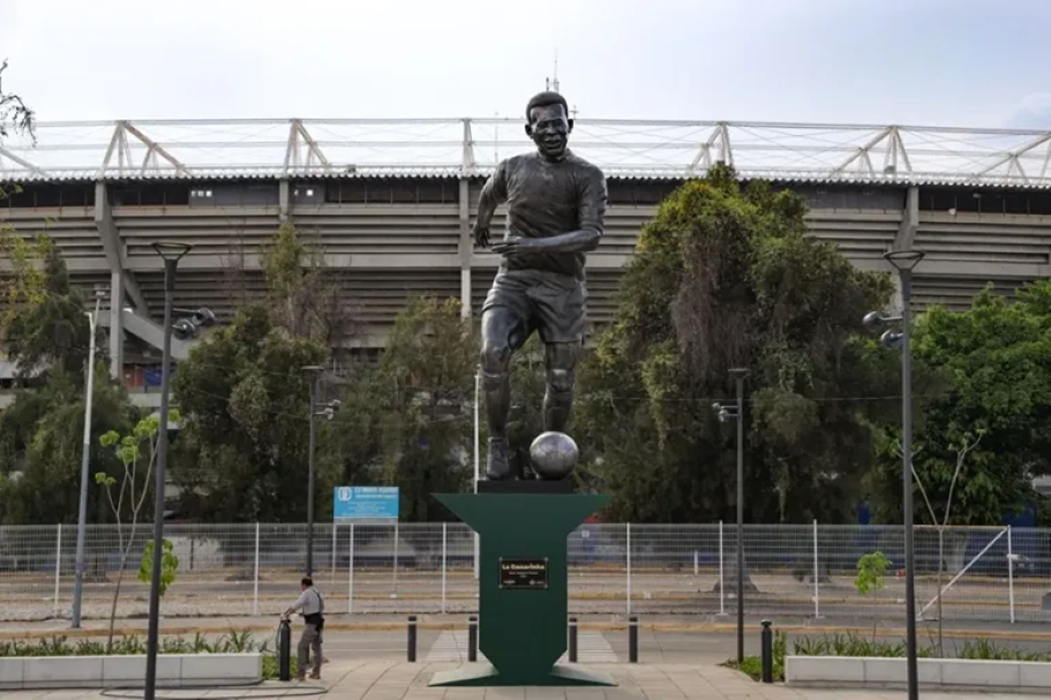
A towering Pelé sculpture outside Estadio Jalisco turns Mexico’s 2026 World Cup countdown into a tribute to Brazil’s 1970 glory, reminding Latin America that football memory is tourism, diplomacy, mythmaking, and cultural power cast in bronze.
A King Reappears in Bronze
Three weeks before the 2026 World Cup begins, Pelé has returned to Guadalajara, not in flesh, not in the yellow shirt that once bent stadiums toward wonder, but in bronze, almost 10 meters high with its base, facing Estadio Jalisco like a memory too large to stay inside an archive.
Authorities and organizers inaugurated the large-scale sculpture outside the stadium where the Brazilian legend played during the 1970 World Cup, the tournament that fixed him forever in the imagination of football. The plaza beside the Jalisco now holds his face above a base that simulates the silhouette of the Jules Rimet Cup, the trophy Brazil kept after winning the World Cup for the third time. Mexican artist Alejandro Velasco said the scale was studied according to the plaza so the work could carry “true cultural weight” for the people of Jalisco, according to the provided notes.
The sculpture has been named “La Canarinha,” the nickname of Brazil’s national team, because organizers could not use Pelé’s name due to trademark rights held by NR Sports, the company linked to Neymar Jr.’s family. That detail is almost too modern, and somehow perfect. The twentieth century’s most mythic footballer returns in the twenty-first century under the grammar of brand rights. Even memory now has licensing rules.
Still, no trademark can erase what Guadalajara remembers. Pelé built a sporting and personal bond with the city across two World Cups and later visits. He returned in 1975 for a quadrangular tournament between local teams, invited by his friend Nei Blanco de Oliveira. In 1976, he returned during a promotional tour for a soft drink brand, held football clinics, and met fans. The city did not merely host Brazil. It absorbed part of Brazil’s football soul.

The Stadium That Saw Audacity
To understand why a Pelé sculpture in Guadalajara matters, one has to return to June 1970, when the World Cup was still becoming television’s great global ritual. Mexico gave that tournament heat, altitude, color, sound, and theatrical light. Brazil gave it immortality.
The opening match for Brazil against Czechoslovakia did not begin as legend. Pelé missed an early chance in front of the goal, and the Czechs scored first after 11 minutes. Then Brazil steadied itself. Rivellino thundered in a free kick. Pelé later scored. Jairzinho shone. Brazil won 4-1.
But the remembered moment was a miss. Near halftime, Pelé received the ball inside Brazil’s half, looked up, noticed goalkeeper Ivo Viktor straying from his line, and launched an audacious shot from near the halfway line. It went just wide. The Brazilian commentator’s rising cry captured the spell: “Pelé, Pelé, Pelé… almost.”
Almost became part of the myth. This was not a showboat attempt in a meaningless match. It was an opening World Cup game, still level, under pressure. Pelé risked the ridiculous because genius often begins where caution ends. Only a few players in football history have made failure feel like evidence of greatness.
Then came England. At noon, under the punishing Mexican sun, Brazil faced the reigning world champions. Carlos Alberto fed Jairzinho, who beat Terry Cooper and crossed to the far post. Pelé rose and drove a header downward with terrible force. Gordon Banks somehow crossed the goal and scooped it over the bar. The save became immortal partly because the header was so perfect. Pelé created greatness even when denied.
After the match, another image entered football memory: Pelé and Bobby Moore exchanging shirts, touching, smiling, exhausted by mutual respect. In an age when football nations still carried hard postwar myths, the photograph suggested something softer and rarer. Two captains understood that they had shared not just a match, but a standard.

Brazil later beat Peru in the quarterfinals and faced Uruguay in the semifinal, a match haunted by 1950, when Uruguay broke Brazilian hearts at the Maracanã. The old trauma returned when Uruguay scored first. Brazil equalized before halftime, then Jairzinho gave them relief. Near the end, Pelé set up Rivellino to seal the result.
Then came another almost-goal that became legend. Tostão sent Pelé through. Goalkeeper Ladislao Mazurkiewicz rushed out. Instead of touching the ball around him, Pelé stepped over it at full speed, letting it roll past the keeper, then spun around to chase it. His shot rolled just wide. Again, the miss survived because imagination had outrun the scoreboard.
In the final against Italy, Pelé scored with a header. Later, with Brazil ahead, the team produced perhaps the most famous goal in World Cup final history. Clodoaldo dribbled past Italian pressure; Rivellino and Jairzinho moved the ball; Pelé received it near the area, paused, and rolled a no-look pass into the path of Carlos Alberto, who struck it perfectly. Brazil were champions again.
That 1970 side set a benchmark that still haunts every Seleção. Pelé scored four goals, including one in the final, but his greatness in Mexico was never only numerical. It lived in decisions made under global pressure: the halfway-line lob, the header that summoned the greatest save, the dummy against Uruguay, the pass to Carlos Alberto. Football remembers him not merely for what he did, but for when and where he dared to do it.
For Latin America, the sculpture in Guadalajara is more than a tourist attraction ahead of 2026. It is a reminder that the region helped write football’s global language. Uruguay hosted the World Cup’s first stage. Brazil gave it its most luminous team. Mexico gave 1970 the color broadcast era and the stadiums where that brilliance became planetary memory.
The geopolitical meaning is subtle but real. World Cups are no longer just tournaments. They are soft-power machines, urban branding projects, tourism engines, and cultural diplomacy platforms. Jalisco Governor Pablo Lemus said the new space will attract residents and tourists attending matches at Estadio Guadalajara in 2026. That is the modern calculation. Bronze becomes a destination. Memory becomes economy.
But the deeper value cannot be priced only in hotel rooms or visitor flow. Pelé in Guadalajara binds Mexico and Brazil through a shared Latin American football mythology that survives the commercialization surrounding it. The statue stands near Plaza Brasil, itself created to honor the bond between the city and the Brazilian team.
In 2026, crowds will come for new matches. Many will stop before the bronze face of the King. They may not know every story. But they will feel the old message. Before football became a global industry, it was a daring body under a Mexican sun, deciding that even a miss could become eternal.
Also Read:
From Uruguay to Qatar, World Cup History Keeps Expanding South