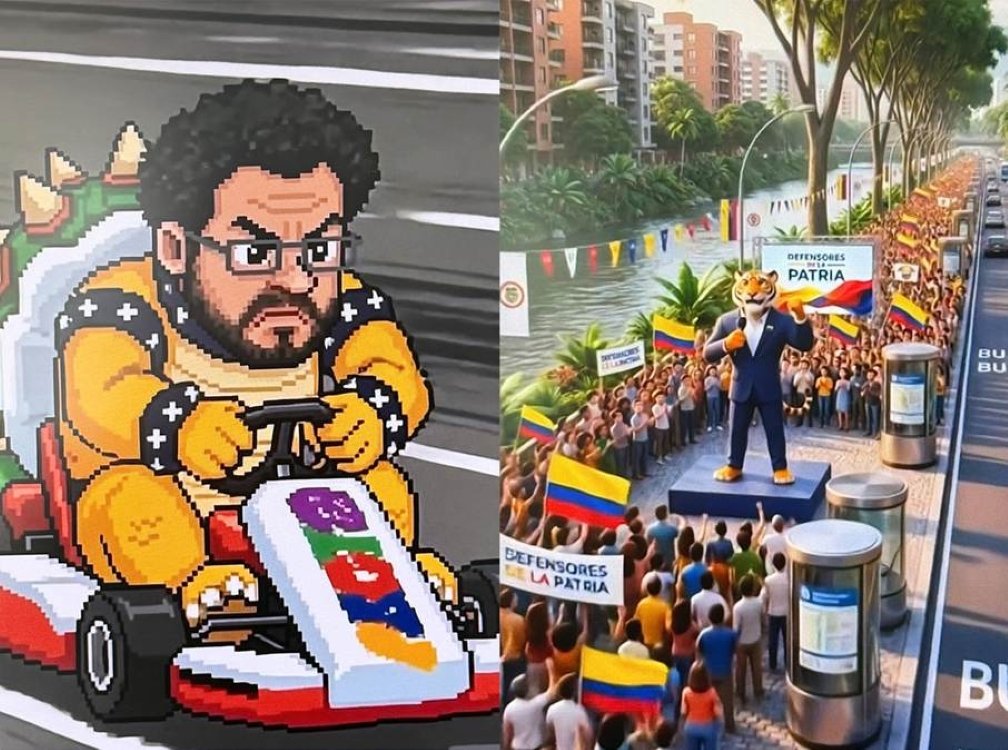
As Colombia’s May 31 presidential campaign shifts into artificial intelligence memes, fruit melodramas, football fantasies, and superhero security videos, analysts warn that viral humor is replacing debate, shrinking politics into algorithmic theater at a moment when democracy urgently needs depth.
The Campaign Becomes a Screen
Colombia’s presidential campaign is no longer unfolding only in plazas, televised debates, radio interviews, or neighborhood meetings. It is happening inside the fast, slippery language of social media, where candidates become fruits, tigers, football stars, fantasy characters, and digital avatars built to travel faster than any policy proposal.
According to reporting and interviews credited to EFE, the campaign for the May 31 election is increasingly being fought through artificial intelligence content, with humor and parody replacing traditional formats for communicating political ideas and attracting voters. Almost all candidates have used AI-generated videos, from caricatures placed inside “frutinovelas” to Harry Potter-style recreations and montages showing candidates playing football with Colombia’s national team during World Cup season.
At first glance, it can feel harmless, even funny. Politics has always used theater. Latin America knows this better than most regions. Campaign songs, nicknames, dances, radio jingles, murals, slogans, saints, villains, and animals have long been part of electoral language. The difference now is velocity. AI does not just decorate politics. It multiplies it, segments it, and sends it into small emotional chambers where voters may see entertainment long before they see scrutiny.
The most aggressive use of the format has come from ultraright candidate Abelardo de la Espriella, known as “the Tiger,” whose campaign and allied accounts have circulated images of him turned into a feline or surrounded by dancing animals at political rallies. One widely shared video places him in Jamundí, one of Colombia’s municipalities most affected by conflict, in the country’s southwest, as he captures Néstor Gregorio Vera, alias Iván Mordisco, head of the Estado Mayor Central, the largest FARC dissident group.
With epic music and phrases such as “I protect you,” the montage borrows from the digital language of U.S. President Donald Trump’s AI propaganda and echoes the security aesthetics of Salvadoran President Nayib Bukele. That is not accidental. Across the Americas, strongman imagery has learned to speak in memes. It does not argue. It rescues. It does not explain institutions. It shows a savior entering chaos.

The Algorithm Loves a Strongman
The Colombian danger is not that voters cannot tell a tiger from a candidate. The danger is that the emotional structure of these videos may be more powerful than their obvious fiction. A candidate who appears as a heroic predator in a conflict-torn town need not be believable to work. It only has to make insecurity feel simple.
Colombia’s armed conflict has never been simple. Jamundí, dissident groups, rural fear, extortion, state absence, coca economies, peace failures, and the unfinished aftermath of the FARC agreement cannot be solved by cinematic capture fantasies. Yet AI allows campaigns to compress complexity into a short emotional scene: danger appears, the candidate arrives, order returns. The voter is not invited to evaluate a security plan. The voter is invited to feel protected.
That is why the warning from political analyst Yann Basset, professor at the School of International Studies at Universidad del Rosario, matters. Speaking to EFE, he described the phenomenon as evidence of a profound transformation in electoral campaigns, but also a “considerable impoverishment” of political debate. Campaigns, he said, are focusing more on segmented social media content and less on spaces of confrontation between candidates. “The campaign is the moment to confront one another, to exchange ideas, and that is not being seen,” he noted.
This is the heart of the issue. Democracy requires friction. Candidates must be placed under pressure. Their numbers must be tested. Their contradictions must be exposed. Their slogans must collide with opponents, journalists, citizens, and reality. AI campaign content does the opposite. It protects candidates inside curated universes where they always look witty, heroic, youthful, persecuted, or beloved.
Other candidates have joined the same logic. Paloma Valencia, candidate for the right-wing Democratic Center, appears in a video playing football for Colombia’s national team. She wears the team’s colors and plays alongside her running mate, Juan Daniel Oviedo, against a team led by Iván Cepeda, of the leftist Pacto Histórico, the coalition of President Gustavo Petro.
The symbolism is obvious. Football is the closest thing Colombia has to a national secular ritual. To wear the jersey is to borrow from belonging. During World Cup season, that image is even stronger. But the substitution is revealing: a campaign no longer needs to explain what it will do with taxes, pensions, security, peace, health care, corruption, or the rural state. It can kick a ball in the colors of the nation and hope affection does the work.

Fruit Novelas and Fragile Democracy
The most surreal trend may be the “frutinovelas,” TikTok-inspired videos where cartoon fruits star in melodramas narrated like soap operas. Sergio Fajardo, of the centrist Dignity & Commitment party, published one in which he becomes “Fajarduyá,” Abelardo de la Espriella becomes “Ajisardo.” Iván Cepeda becomes “Cepera,” all involved in romantic triangles, betrayals, and disputes to win “Manzalombia.”
It is funny, yes. It is also a perfect image of the campaign’s risk. Colombia, a country still wrestling with inequality, violence, institutional distrust, illegal economies, migration pressure, regional polarization, and a fragile peace, is being turned into an apple in a melodrama. The joke works because it is absurd. The problem is that absurdity may now be the main language voters receive.
Even Cepeda, initially more cautious with AI, released a video this week featuring a refrigerator saying it is happy because the Petro government’s minimum wage increase has filled it with groceries. That clip shows another side of the trend: AI can make policy feel domestic and emotional. A wage debate becomes a talking fridge. Inflation, labor markets, household debt, food prices, and informal work disappear behind a friendly appliance.
Basset told EFE that the use of AI in electoral propaganda is, to some extent, a natural evolution of digital tools long used in politics. But he warned that clear ethical limits are needed, especially for fake or manipulated videos. He also argued that the emotional turn in campaigns did not begin with AI, but with social networks, and that candidates risk building campaigns designed only to maximize virality and please the algorithm.
That warning should echo beyond Colombia. Latin America is entering an electoral era where artificial intelligence can intensify old weaknesses: caudillo worship, misinformation, polarization, spectacle politics, and distrust of institutions. In countries already marked by inequality and low confidence in parties, AI can give campaigns cheap magic and voters expensive confusion.
Colombia’s May 31 election is therefore not only about who wins. It is about whether democratic debate can survive the conversion of politics into a shareable mood. Viral support can create a false sense of popular strength, Basset warned, one that does not always become real votes. But the bigger risk is worse: that even when the votes are real, the deliberation behind them has been hollowed out.
A meme can open the door to politics. It should not become the whole house.
Also Read:
Central and South American Vipers Turn Speed Into Survival Power