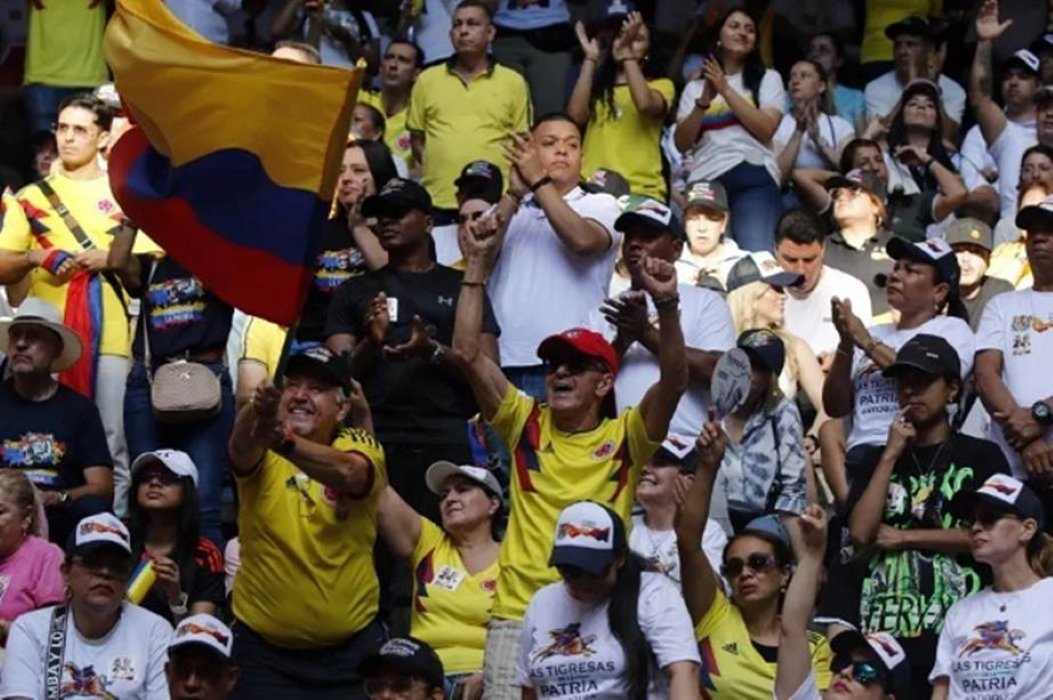
As Colombia enters its final week before the presidential vote, absent debates, fractured conservatives, OAS observers, and last-minute alliances reveal a campaign where silence has become strategy and polarization may decide who survives the nationwide Sunday, June runoff battle ahead.
A Campaign Without the Argument
Colombia has entered its week of electoral reflection with an odd sound hanging over the race: the silence of candidates who never truly faced one another. The presidential campaigns have closed before Sunday’s first round. Still, unlike other years, the country did not witness the major contenders collide in sustained public debates. The result is an unusually evasive campaign, loud on rallies and social media, yet thin on direct confrontation.
According to reporting and interviews credited to EFE, the three candidates leading most polls, leftist Senator Iván Cepeda, ultraright lawyer Abelardo De la Espriella, and right-wing Senator Paloma Valencia, avoided the debate stage during the campaign that formally began after the March 9 legislative elections. That absence matters because Colombia is not voting in calm weather. It is voting amid insecurity, political distrust, digital aggression, ideological fatigue, and a right-wing split at the very moment it needs unity most.
Polls suggest no candidate will surpass 50 percent on Sunday, meaning Colombia is likely headed to a second round on June 21. That makes this first vote less a final verdict than a sorting mechanism. It will decide who has the right to challenge Cepeda, who leads the polls as the candidate of the governing Pacto Histórico, but whose ceiling remains the central mystery of the election.
The last-minute alliance dance has already begun. Former Magdalena governor Carlos Caicedo, who polled below 1 percent, dropped out of the presidential race and endorsed Cepeda. Former senator Roy Barreras, also marginal in the polls, called on other left-wing currents to unite “to avoid the return of the extreme right to government.” However, he did not withdraw his candidacy. In a race where fractions can shape a runoff, even minor endorsements carry symbolic weight.
But Colombia’s deeper problem is not only fragmentation. It is avoidance. Cepeda said weeks ago that he would debate only “extreme-right candidates,” referring to De la Espriella and Valencia, if the discussion centered on the social reforms advanced by the current government. That posture drew criticism from centrist candidates such as former mayors Sergio Fajardo and Claudia López, who accused him of refusing to engage in idea-based contrast. De la Espriella, for his part, rejected Valencia’s debate invitation in early May, saying he would focus on being “in the street with the people,” not locked in a television studio.
In other words, every camp has a justification. Colombia is left with fewer answers.

The Right Splits Its Own Mirror
The most consequential drama may be unfolding inside the right. De la Espriella and Valencia are competing not only against Cepeda but also against each other’s version of conservative identity. Valencia emerged from La Gran Consulta por Colombia with more than 3 million votes, carrying the institutional weight of Centro Democrático, the party founded by former President Álvaro Uribe. De la Espriella refused from the start to enter that interparty consultation, building his campaign as a hardline outsider under Defensores de la Patria.
The contrast is almost theatrical. Valencia is the party candidate, tied to Uribe’s legacy, congressional politics, and the language of conservative governance. De la Espriella is the insurgent from the right, presenting himself as a voice of those who have never “lived off the state” or stolen public money. He calls his camp “the never,” set against what he describes as “the usual ones.”
The attacks have sharpened. On May 16, Valencia said at a campaign event that she did not need “a bulletproof vest or glass ballot boxes,” a clear reference to De la Espriella giving speeches behind bulletproof glass because of death threats. De la Espriella has accused Valencia of being allied with traditional political forces and questioned her independence. The online war escalated when influencer Vincenth Ramos, one of De la Espriella’s major digital boosters, accused Valencia of wanting the ultraright candidate assassinated. Valencia rejected the claim as false, reckless, and gravely damaging.
This is not normal intraparty rivalry. It is a struggle over fear, purity, and legitimacy. Colombia’s right is trying to decide whether its future lies in institutional uribismo or a more aggressive, anti-establishment security politics. The fight is strategically dangerous because Cepeda benefits from division. If conservative voters split too evenly, the left enters the runoff stronger. At the same time, the right spends precious weeks repairing wounds it inflicted on itself.
The irony is that both Valencia and De la Espriella are campaigning in a country where security is perhaps the dominant public concern. Yet their fight risks turning the security debate into a personal branding exercise. Who is tougher? Who is less established? Who is more threatened? Who is more authentic? Beneath those questions sit the harder ones Colombians need answered: how to confront armed groups, coca expansion, urban crime, extortion, weak local governance, and the unfinished promises of peace without returning to a politics of permanent war.

Observers Arrive, Trust Remains Fragile
International observers are arriving in this tense atmosphere. The Organization of American States Electoral Observation Mission will deploy 96 observers and political specialists from 24 nationalities, led by former Dominican President Leonel Fernández. The mission will be present in 26 departments, Bogotá, and five cities abroad: Madrid, Barcelona, New York, Miami, and Washington. It will monitor election organization, overseas voting, technology, campaign finance, electoral justice, violence, media, and digital communication.
The OAS mission joins a European Union mission that deployed 40 experts in early May. Colombia’s National Electoral Council has accredited 1,188 national and international auditors and observers for the presidential elections. The numbers show institutional seriousness. They also show anxiety. Colombia wants eyes on the vote because the political climate is too charged for trust to be assumed.
For Latin America, this election matters beyond Colombia’s borders. The region is watching whether a left-wing governing coalition can reproduce power after years of backlash against incumbents, whether a fragmented right can reorganize around security, and whether democratic competition can survive without becoming a theater of delegitimization.
Colombia has often been a hinge country in Latin America: Pacific and Caribbean, Andean and Amazonian, U.S.-aligned yet increasingly regionally assertive, scarred by armed conflict yet central to debates over peace. Its election will influence drug policy, migration, relations with Venezuela, regional security cooperation, climate and Amazon policy, and the broader ideological balance between left and right.
The absence of debates, therefore, feels larger than a campaign tactic. It suggests a democracy in which candidates prefer controlled spaces, friendly crowds, and segmented messaging to the risk of public contradiction. That may be rational politics. It is a poor democratic culture.
Sunday will likely not end the election. It will narrow the confrontation. If Cepeda advances, the question becomes whether he faces Valencia’s institutional right or De la Espriella’s insurgent hard right. Either path leads to a polarized runoff. Either path will test whether Colombia can argue without breaking.
For now, the campaign has left voters with speeches, endorsements, insults, observers, and a strange missing scene: the candidates standing together, forced to answer each other in front of the country they want to govern.
Also Read:
Mexico Drowns in Trash as Circular Economy Test Begins Now