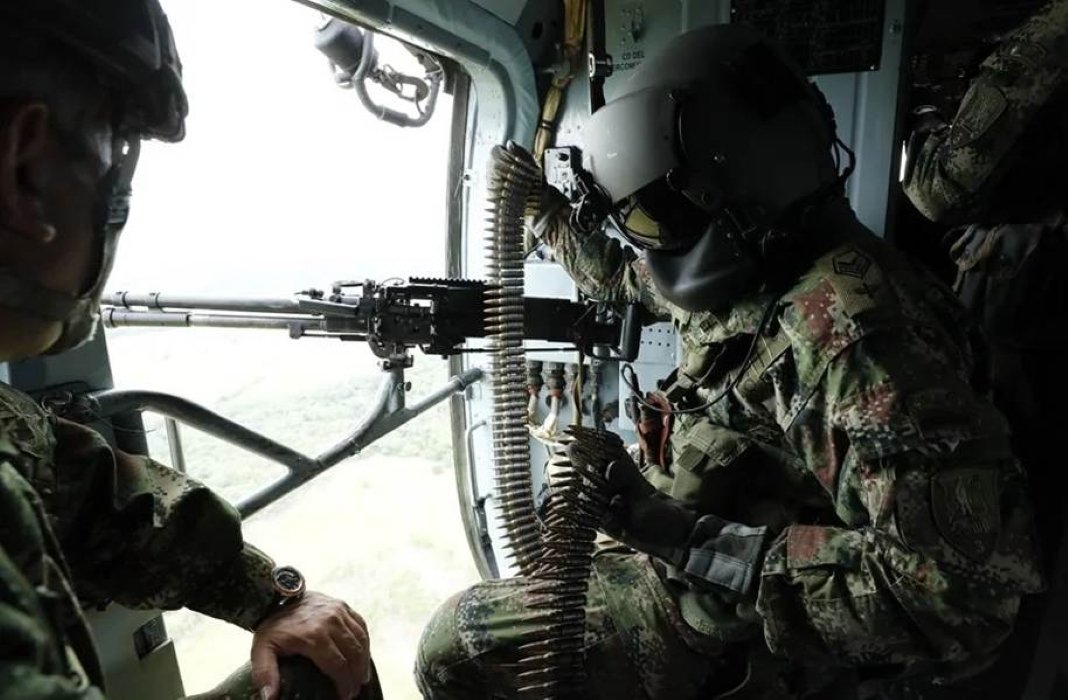
A reported deadly clash in Guaviare between rival FARC dissident factions lands three days before Colombia’s presidential vote, exposing how armed territorial disputes, narcotrafficking, illegal mining, and unfinished peace still stalk democracy from the Amazonian edge at election time again.
The War Inside the Peace
In Colombia, elections never happen far from the echo of the jungle. Even when the ballot boxes are clean, even when observers arrive, even when candidates speak of programs and alliances, another country is often moving underneath the official one. A country of rivers, illegal trails, armed orders, coca routes, mining pits, and rural communities that hear the war before Bogotá names it.
That hidden country surfaced again in Guaviare, where Colombian authorities are investigating a confrontation between two illegal armed groups tied to FARC dissident factions. Local media have reported between twenty and fifty dead, though officials have not confirmed a toll. Sources from Colombia’s Defense Ministry told EFE that Minister Pedro Sánchez Suárez is expected to address the incident. Still, for now, the government has not validated the figures circulating in local reports.
The Army said troops from Brigade Twenty-Two are maintaining a strategic presence in rural San José del Guaviare, where clashes between armed groups have been reported, to protect civilians, strengthen security, preserve territorial control, and ensure respect for human rights and international humanitarian law. Soldiers are present in sectors including Resbalón, Boquerón, Filo de Hambre, Caño Negro, Charras, and Puerto Alvira.
That official language is cautious. It has to be. Guaviare is not only a crime scene. It is a political warning, arriving three days before the first round of Colombia’s presidential election. The timing makes the clash more than another violent episode in a remote department. It becomes a reminder that whoever wins the presidency will inherit not a post-conflict country, but a country where the conflict mutated.
The 2016 peace agreement demobilized the old FARC as a national guerrilla army. Still, it did not erase the economies, territorial voids, weapons, distrust, and routes that had sustained decades of war. In places like Guaviare, the vacuum was not empty for long. Dissident structures moved in, claiming control through narcotrafficking, illegal mining, extortion, recruitment, and armed governance.

Guaviare’s Territorial Ledger
According to local media cited in the notes, the fighting involves factions of the Estado Mayor Central, led by Néstor Gregorio Vera, alias Iván Mordisco, Colombia’s most wanted man, and the Estado Mayor de Bloques y Frentes, led by Alexander Díaz Mendoza, alias Calarcá. Their dispute centers on territorial control in this strategic center-south zone, where the Orinoquía meets the Amazon.
The geography is crucial. Guaviare has always been a hinge: a frontier, a refuge, a corridor, a laboratory. For decades, armed actors operated there because the terrain offered concealment and connection. Rivers and forests linked coca economies to wider trafficking networks. Weak state presence allowed parallel authorities to take root. After the FARC’s demobilization, those who rejected the peace deal, or profited more from war than from politics, found space to reorganize.
This is not ideology in its old form. Some dissident leaders still use insurgent language, but the material struggle is about power over territory and illegal income. In Guaviare, the gun protects the route, the route protects the business, and the business finances the gun. Civilians are left living between armed names that shift, split, merge, and fight, while the state tries to arrive as a protector after years of arriving too late.
The reported death toll, whether closer to twenty or fifty, points to a serious confrontation. It also follows a pattern. In January, the same Guaviare region saw another clash among FARC dissidents that left twenty-six dead. That repetition matters. It suggests not isolated combat but sustained competition among armed structures for zones where criminal revenue and political control overlap.
For communities, these battles are not abstract. They mean confinement, threats, forced silence, recruitment pressure, blocked movement, school disruptions, fear of retaliation, and the old necessity of pretending not to see too much. Colombia’s conflict has always been measured in national figures, but it is lived in local instructions: do not go that way, do not speak that name, do not answer that question.

A Ballot Under Armed Shadow
The electoral meaning is unavoidable. Colombians are preparing to vote in a campaign already marked by tension, insecurity, and sharp debate over the government’s “total peace” policy. Any large armed confrontation days before the vote strengthens the argument of candidates who say the state has lost control and weakens those who defend negotiation as the central path to ending violence.
But the lesson should not be reduced to campaign ammunition. Colombia’s security dilemma is deeper than a slogan. A purely military approach can kill commanders and disperse groups, but if illegal economies remain profitable and rural institutions remain weak, new leaders emerge. A purely negotiated approach can open doors to demobilization, but if groups use talks to buy time, recruit, and expand, peace becomes a cover for consolidation. The country needs the difficult middle ground it has often promised and rarely sustained: strong state presence, credible justice, rural investment, civilian protection, environmental enforcement, and negotiations conditioned by real territorial change.
For Latin America, Guaviare is a regional mirror. Across the continent, armed groups are less interested in taking capitals than in controlling corridors. Ecuador has seen gangs reshape ports and prisons. Brazil fights illegal mining and criminal expansion in Amazonian territories. Mexico’s cartels govern through fear in strategic zones. Peru, Bolivia, and Venezuela face versions of the same question: what happens when the state is present on paper but negotiated on the ground?
Guaviare also links Colombia’s election to the Amazon’s future. Illegal mining and narcotrafficking are not only security problems. They are environmental and geopolitical problems. The Amazon is now a climate, criminal, and sovereignty frontier at once. Whoever controls the forest edge can move drugs, gold, weapons, people, and influence. Whoever fails to protect it loses more than trees.
That is why this clash matters beyond the immediate death toll. It shows that Colombia’s democratic ritual is functioning in one sphere while armed territorial politics continue in another. Voters will choose a president. Dissident factions are choosing routes, alliances, enemies, and zones of command.
The Army’s presence in rural San José del Guaviare may calm the immediate fear. It may also mark only another temporary return of the state to a place where permanent presence remains the harder promise.
Three days before the election, Guaviare reminds Colombia that peace is not signed once. It must be defended every day, on roads, rivers, ballots, and in the communities that still know the sound of war before the rest of the country does.
Also Read: Colombia’s Debate-Free Election Turns Silence Into a Democratic Stress Test