Hiring talent in Latin America has never been more attractive for international companies. But actually managing that talent – contracts, payroll, compliance, benefits, culture – remains genuinely hard.
Bogotá-based Remoti is betting that the solution is infrastructure, not just recruitment. The company unveiled its “Workforce-as-a-Service” (WaaS) model and a new app today at a private event in the Colombian capital, framing itself less as a staffing firm and more as the operational backbone for companies building distributed teams in the region.
It is a meaningful repositioning for a nearly decade-old business, and it arrives at a moment when the underlying market has shifted considerably in its favor.
Why now
The macro case for Latin American talent has become hard to dispute. According to projects by the World Economic Forum (WEF), the IT market in Latin America will reach $140 billion USD by 2027, with high demand for developers, cybersecurity experts, and data specialists as digital adoption continues to accelerate.
Meanwhile, Deloitte estimates that over 60% of U.S. companies are considering moving their operations closer to home – with Colombia among the leading destinations.
Colombia has especially become a focal point: the country’s IT outsourcing market reached $803 million USD in 2025, and is projected to hit $1.15 billion USD by the end of the decade.
The cost argument is well-worn, but still potent. Senior software developers in Colombia earn approximately $57,000 USD a year, while the same role in San Francisco pays $223,000, according to Glassdoor salary data – a 74% gap, in which Colombian professionals still earn well beyond the $6,688 USD minimum annual wage.
Executives, however, cite operational factors as equally pressing. Colombia operates on the U.S. Eastern time zone, which enables real-time collaboration that is near-impossible to replicate with teams in Asia or Eastern Europe.
The WEF’s Future of Jobs Report points to a deeper structural shift: demand for big data analysts, AI and machine learning specialists is expected to surge across the wider Latin American and Caribbean markets, with 84% of employers in the region planning to upskill their workforces themselves within the next five years.
The talent is there – the question is whether the infrastructure to access and manage it is.
The model
Remoti’s WaaS proposition covers the full employment lifecycle – sourcing, contracting, payroll, benefits, compliance, and what the company describes as workforce “experience”. Its new app organizes this into three modules: Global Opportunities for talent matching, Workforce Operation for the administrative and legal layer, and Marketplace & Financial Products offering financial tools directly to workers.
That third component is the most distinctive element. Most employer-of-record and recruitment platforms focus on solving the hiring company’s problems, while Remoti is explicitly building for the worker – a difference that may matter in a market where outdated and inflexible regulatory frameworks are cited as a barrier to business transformation by 61% of Colombian firms surveyed.
The competitive landscape is real, however, Platforms like Deel, Rippling, and Oyster have built substantial global businesses on similar premises. Remoti’s argument is that nearly ten years of operating specifically in Latin America – and a managed-service model that takes operational ownership rather than merely providing software tools – set it apart.
That claim will be ultimately tested by the market over time.
The policy dimension
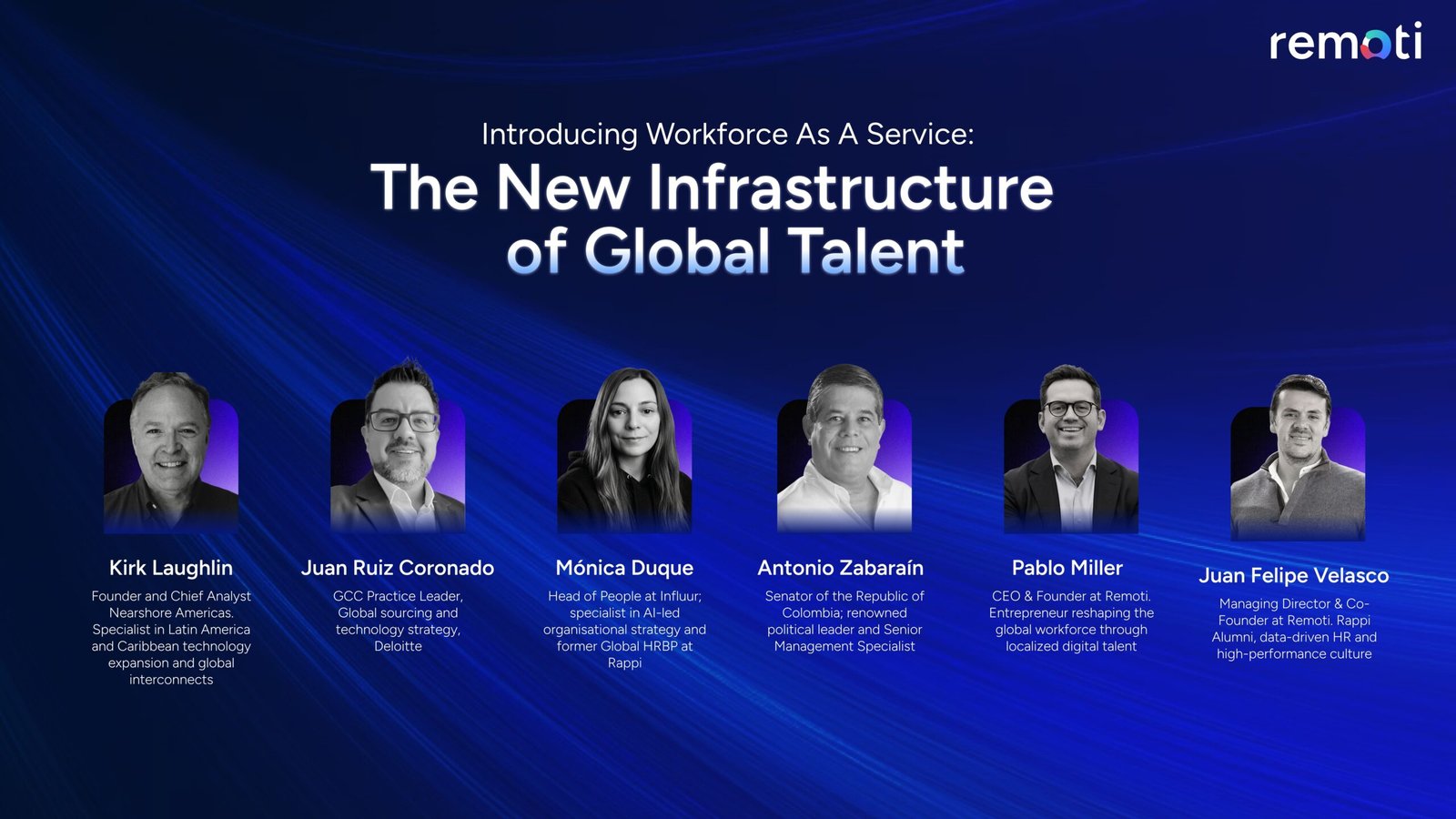
Remoti’s launch event included Dr. Antonio Zabarain, a member of Congress who championed legislation to promote Colombia’s technology sector, alongside executives from Deloitte, Cast and Crew, and the HR platform Influur.
The combination signals that what the startup is attempting isn’t purely a private sector story, but rather sitting within a national ambition to position Colombia as a global talent hub, backed by government investment in digital infrastructure and skills training.
Whether that ambition, and companies like Remoti building atop it, will translate into the kind of durable employment the region needs is a more complicated question.
Regardless, the demand is clearly there; building the infrastructure to meet it at scale and without the operational failures that have plagued earlier models is the harder part.
Featured image: Courtesy of Remoti

Disclosure: This article mentions clients of an Espacio portfolio company.