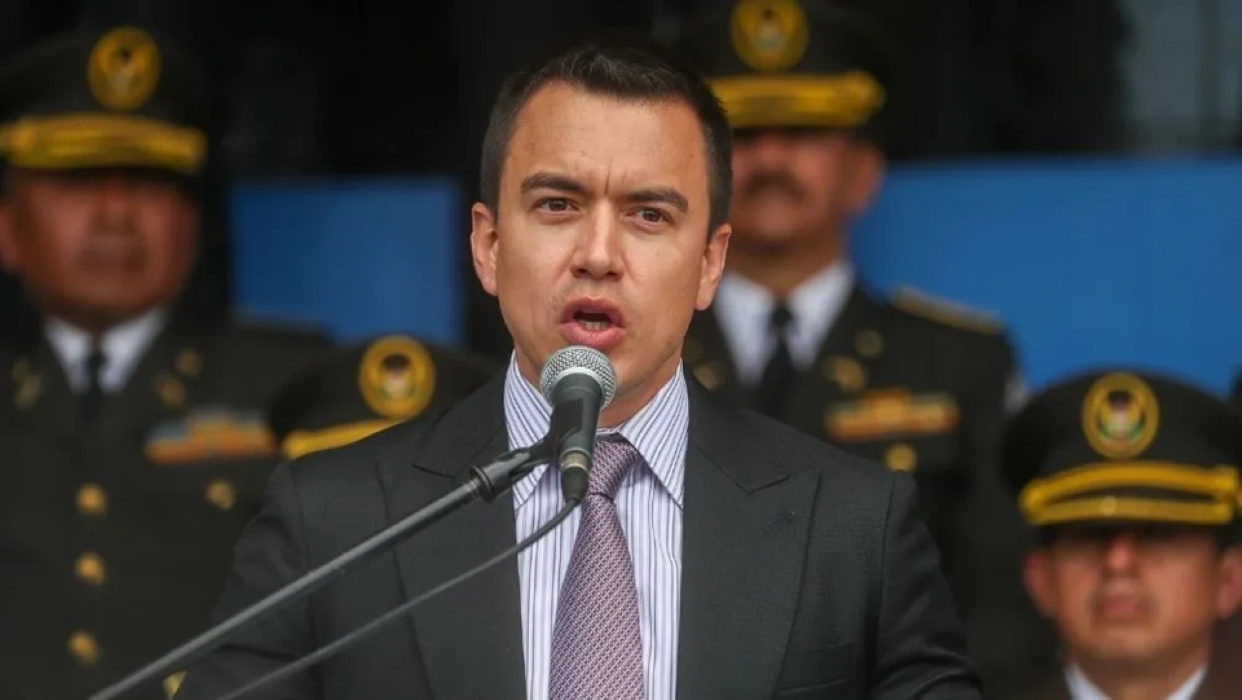
Daniel Noboa’s first full year exposes Ecuador’s harsh bargain: a militarized crime war, a rejected constitutional gamble, deadly Indigenous protests, and a tariff clash with Colombia that turns one small Andean nation into a regional warning for Latin America.
A Presidency Built on Emergency
Daniel Noboa’s first year in his new mandate has felt less like a presidency settling into power than a country learning to breathe inside a permanent alarm. The Ecuadorean leader, who first took office in November 2023 to complete conservative Guillermo Lasso’s term and then won reelection in 2025 for a full four-year mandate, entered this stage with momentum. He wanted to deepen his reforms. He wanted to turn victory into authority. He wanted to show that Ecuador, battered by violence and institutional fatigue, could be governed through speed, discipline, and force.
Instead, his first year became a test of limits. The Constitutional Court pushed back. Voters rejected his referendum. Indigenous protesters filled the roads after the diesel subsidy was eliminated. Colombia became a trade enemy. And the criminal violence that justified his hardline posture kept burning through the country.
The contradiction is stark. Noboa has built his image around the “war” he declared against organized crime, a war formalized in 2024 when he placed Ecuador under “internal armed conflict” and labeled criminal gangs as “terrorists.” The groups, tied mainly to drug trafficking and illegal mining, are blamed by the government for homicide levels that have pushed Ecuador to the top of Latin America’s violence rankings.
Yet despite major blows, including the capture of José Adolfo Macías Villamar, known as Fito, in Ecuador, and Wilmer Chavarría, known as Pipo, in Spain, the alleged top leaders of Los Choneros and Los Lobos, Ecuador’s two largest criminal gangs, 2025 ended with a record of about 9,300 homicides, according to the notes and reporting credited to EFE.
That number does not simply question the success of the security strategy. It raises a deeper regional problem. Across Latin America, governments increasingly borrow the language of war to confront organized crime. But war language can win elections faster than it rebuilds courts, prisons, ports, intelligence networks, police discipline, border control, and local trust. Ecuador is showing how difficult it is to convert emergency into durable security.

The Ballot Said No
Noboa’s hardest political defeat came not from an opposition speech, but from voters. In November, Ecuadoreans rejected all four questions in the referendum and popular consultation. They said no to installing a Constituent Assembly to draft a new constitution, with 61.81 percent rejecting the proposal. They said no to reducing the number of lawmakers, with 53.72 percent opposed. They also rejected eliminating public financing for political parties, with 58.31 percent voting against it, and refused to restore foreign military bases, with 60.83 percent opposed.
The referendum defeat matters because it punctured the idea that Noboa’s security mandate was a blank check. Ecuadoreans may want order. They may fear gangs. They may support strong action against armed groups. But they did not give the president permission to rewrite the constitutional architecture or reopen the door to foreign bases.
That is a crucial distinction for Latin America. The region knows the seduction of strong executives during crises. Violence makes people tired. Fear makes shortcuts attractive. Constitutional change can be packaged as efficiency. Foreign military cooperation can be sold as realism. But the referendum showed that even a frightened society may still draw lines around sovereignty and institutional balance.
The failed foreign bases proposal is especially significant. Noboa has reinforced his closeness to Donald Trump’s government in the United States. Even with foreign bases prohibited, U.S. and Ecuadorean forces have carried out joint military operations on Ecuadorean territory against what they call “narcoterrorist” targets. That relationship gives Noboa international backing, equipment, and symbolic muscle, but it also places Ecuador inside a broader hemispheric security map shaped by Washington’s priorities.
For smaller Latin American states, that is always a delicate bargain. U.S. support can help confront transnational crime, but it can also pull domestic security into geopolitical dependency. Ecuador’s voters, by rejecting foreign bases, appeared to say that cooperation has limits. The country may need help, but it does not want to become someone else’s platform.
Noboa also faces attacks from correísmo, the main opposition force, which accuses him, without proof, of maneuvering to block its participation in local elections after prosecutors investigating Revolución Ciudadana, the movement led by former President Rafael Correa, requested a suspension. The accusation may be unproven, but the political atmosphere is combustible. In Ecuador, legal decisions are rarely read as merely legal. They become part of a wider struggle over whether institutions are referees or weapons.

A Border War With Costs
The most socially painful episode of Noboa’s first year came after he eliminated the diesel subsidy. Indigenous protests, concentrated in Imbabura province, began on September 22 and lasted a month. Two demonstrators died, and about 300 people were injured. Noboa rejected all the Indigenous demands. Protesters attributed his decision to pressure from the International Monetary Fund.
In April, the IMF approved the fifth review of Ecuador’s $5 billion credit agreement, signed in May 2024 for a four-year term. The Fund highlighted that real GDP rebounded strongly in 2025 amid low inflation and projected 2.5 percent growth in 2026. Those numbers matter. But Latin America has learned to read IMF praise with caution. Macroeconomic stability can look clean in a report. At the same time, its social costs are borne by truck drivers, farmers, Indigenous communities, and low-income families who pay more for fuel and transport.
The diesel protests revealed the old fracture between fiscal adjustment and territorial legitimacy. A subsidy can be inefficient, expensive, and environmentally harmful. But removing it without enough political negotiation can detonate historic grievances in a country where Indigenous movements have repeatedly shown they can paralyze national life. Noboa’s refusal to concede may reinforce his image of firmness. It may also deepen the sense that reform is being imposed from above.
Then came Colombia. Since February, Noboa has imposed tariffs of up to 100 percent on Colombian imports to pressure President Gustavo Petro to strengthen border security. Colombia responded with tariffs of its own, though at lower levels. There are no clear signs that the dispute will be resolved soon.
This tariff war is more than a bilateral quarrel. Ecuador and Colombia share a border shaped by trade, migration, armed groups, smuggling routes, and rural economies that do not respect diplomatic speeches. Punishing imports may send a message, but it also risks hurting businesses, consumers, and communities whose lives depend on cross-border movement.
For Latin America, Noboa’s first year is a warning about the new politics of insecurity. Crime is pushing presidents toward militarization, trade pressure, constitutional gambits, and alignment with the U.S. But security without social legitimacy can become brittle. Growth without dialogue can produce revolt. Border pressure without cooperation can turn neighbors into adversaries.
Ecuador is small compared with Brazil or Mexico, but its crisis is continental in meaning. It shows a region trying to govern fear without losing democracy, sovereignty, or social peace. Noboa still has time. But his first year suggests that force can seize the agenda, while consent remains much harder to win.
Also Read:
Colombia Campaign Violence Turns Right-Wing Split Into Democracy’s Hardest Test