El Salvador’s mass trial of 486 alleged gang leaders promises swift punishment for years of terror. Yet, it forces Latin America to confront a question: whether justice remains justice when hundreds are judged together under emergency powers and suspended guarantees.
A State That Wants Speed
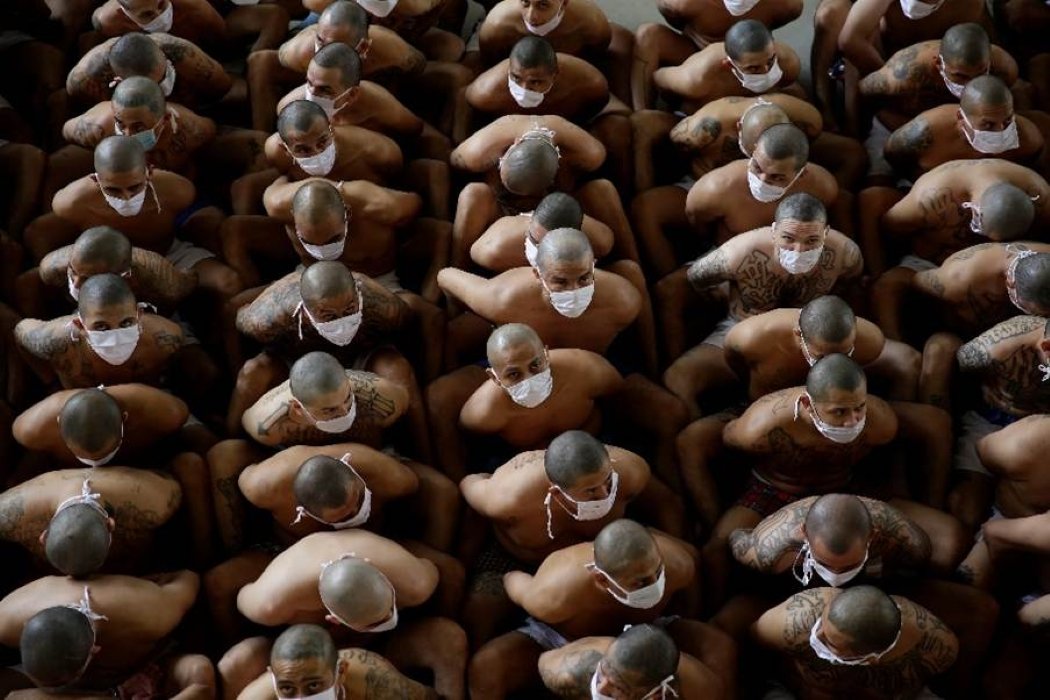
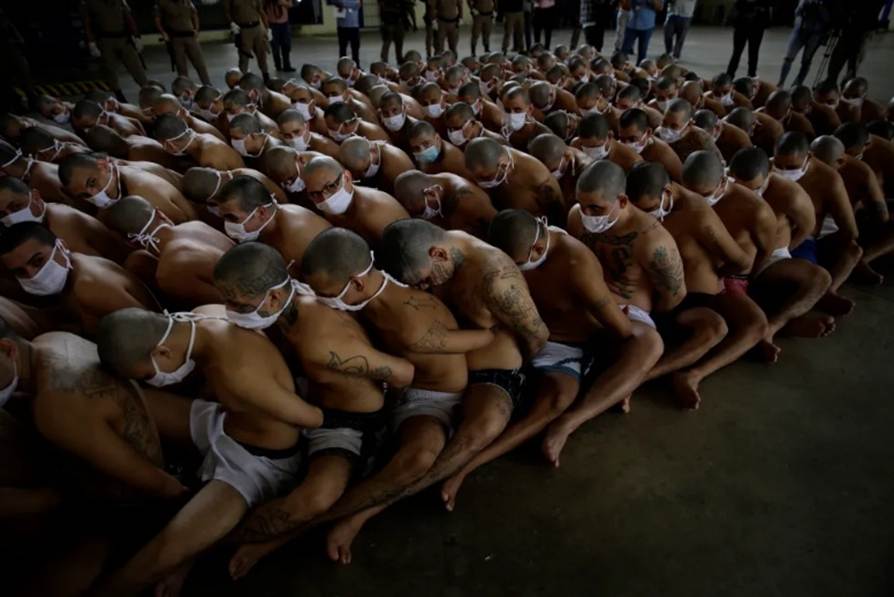
El Salvador has opened one of the most revealing trials in the region, not only because of who is in the dock, but because of how many people are there at once. A mass trial of 486 suspected MS-13 leaders has begun, with the attorney general’s office accusing the group collectively of committing more than 47,000 crimes between 2012 and 2022, including murder, extortion, drug trafficking, arms trafficking, femicide, and disappearances. Among the accused are people allegedly linked to the wave of gang violence in March 2022 that left 87 people dead in one weekend and pushed President Nayib Bukele to declare his war on gangs. The attorney general’s office says it has compelling evidence and is seeking maximum penalties.
It is not hard to understand why many Salvadorans would welcome a scene like this. The state is trying to project something that has long been scarce in much of Latin America: forceful control. The accusation is vast. The numbers are staggering. The symbolism is unmistakable. The government wants to show that the men it says helped instill fear and grief in Salvadoran families are now enclosed within one judicial frame, their territorial power broken, their violence named, their punishment approaching.
The charges themselves are designed to tell a political story as much as a criminal one. Prosecutors say the defendants are not only responsible for individual crimes but also for rebellion and for attempting to maintain territorial control to establish a parallel state. That phrase matters. It casts the trial not simply as a prosecution of murders and trafficking, but as a confrontation between sovereignty and its rival. In that reading, MS-13 is not just a gang. It is an enemy authority that once governed neighborhoods through fear and informal rule. The state is now insisting that it alone will rule.
That is why this case will resonate beyond El Salvador. Across Latin America, governments facing organized crime often promise to restore public authority not through slow judicial repair but through spectacle, exceptional force, and the language of emergency. The message is always emotionally powerful because the wound is real. Citizens living under extortion and threats do not first ask for elegant legal theory. They ask for relief. The temptation for any government is to answer that pain with concentrated power and procedural compression. El Salvador has taken that logic further than most.
The state of emergency imposed in March 2022 remains central to the story. It expanded powers to arrest people suspected of gang affiliation or support and suspended some constitutional rights. It has also produced tens of thousands of arrests. Human rights groups have argued that it has led to arbitrary detentions. Legal changes then allowed for mass trials. This is the crucial sequence. First comes terror. Then the emergency. Then a new judicial architecture was built to handle the scale of the crackdown. In that progression, the courtroom starts to look less like a place of individualized moral judgment and more like an extension of war by other means.

Can Collective Guilt Be Just
From a legal philosophy standpoint, this is where the trouble begins.
Justice in the deepest sense usually rests on individual responsibility. It asks what this person did, what this person intended, what evidence links this person to a crime, and what punishment fits that person’s acts. A mass trial strains that tradition by asking the court and the public to think in aggregates. Four hundred eighty-six people are processed together. Forty-seven thousand crimes are presented as the collective work of one structure. Four hundred thirteen are already in custody, while 73 more are being prosecuted in absentia. The moral intuition behind such a proceeding is understandable: when a criminal organization operates as a system, perhaps only a systemic trial can meet it at scale. But the danger is equally obvious. The larger the group, the easier it becomes for individual guilt to blur into organizational guilt.
That does not automatically make the trial unjust. Criminal organizations do act collectively. Leadership structures matter. Patterns matter. Long-running conspiracies are real. A court does not need to pretend that organized violence is merely a pile of isolated acts. But justice begins to wobble when procedural efficiency becomes more valuable than individual differentiation. Once that happens, the question silently changes from “What did this defendant do?” to “How do we process this whole universe of accused people fast enough to satisfy the emergency?” Those are not the same question.
There is also the matter of trials in absentia. In some legal traditions, trying people who are not physically present can be defended under limited conditions. Yet from the standpoint of legitimacy, absence always creates a shadow. It weakens the public drama of accountability and makes the proceeding feel less like a contest of proof than a mechanism for closure. Add a continuing state of emergency and suspended constitutional rights, and the atmosphere becomes harder still. The law may remain operational. But is it operating freely, or under the pressure of political necessity?
This is the paradox El Salvador now embodies for the region. A mass trial can feel morally satisfying because it mirrors the scale of the harm. It says the state has finally grasped the enormity of the criminal structure it is facing. But law is not only about scale. It is also about distinction. A justice system that loses the ability to distinguish carefully between actors may still punish, may still incapacitate, may still terrify potential offenders. What it may no longer do, at least fully, is judge.
That matters because mass trials are not only legal instruments. They are moral theater. They teach a society what counts as proof, what kind of defendant deserves nuance, and how much procedural patience can survive under fear. If the lesson becomes that emergency dissolves individuality, then the victory over gangs may also normalize a thinner idea of justice.
Why Latin America Keeps Returning Here
Latin America returns to this problem again and again because the region has long carried two truths at once. One is that criminal violence can become so organized, territorial, and socially invasive that ordinary legal rhythms appear weak, even naive. The other is that states in the region have a long history of using emergency as a shortcut, expanding powers, narrowing safeguards, and promising that exceptional measures will remain temporary. Often they do not remain temporary. They become the new grammar of rules.
El Salvador’s current trial sits squarely inside that history. The accused belong to a transnational gang founded in Los Angeles during the 1980s by immigrants who had fled El Salvador’s civil war. However, its presence is now larger in Central America. That origin story alone says much about why the problem persists. Latin American gang violence is rarely purely local. It is shaped by war, displacement, migration, deportation, exclusion, and fragile institutions. Criminal organizations grow where the social fabric has already been torn. Governments then inherit not just a public security challenge, but a deep historical failure.
That helps explain why legal philosophy so often loses ground to political urgency. When families have buried too many people, when extortion has ruled too many neighborhoods, when fear has become ordinary, a mass trial can look like moral clarity. It feels decisive. It feels proportional to the scale of the terror. And yet history across Latin America suggests that emergency justice rarely stays neatly inside its original target. Powers expanded for the worst offenders often linger. Standards lowered for the most hated defendants can later be used more broadly. The region knows this pattern because it has lived with states that become accustomed to acting first and sorting carefully later.
None of this means the Salvadoran state should have done nothing. It means the harder question is not whether gang leadership should face justice, but what form of justice preserves enough fairness to remain worthy of the name. A state can dismantle a violent structure and still hollow out legal principle in the process. It can win control of territory while losing something inside the courtroom.
That is why this trial will matter far beyond El Salvador. It offers Latin America a stark test case in the old argument between order and law. If the defendants are guilty, a society brutalized by MS-13 will understandably want punishment and permanence. But if mass trials become the accepted answer whenever fear is large enough, then the region may find itself solving one form of parallel power by quietly building another. The courtroom will still function. The sentences will still fall. Yet justice, compressed into one enormous proceeding, may begin to resemble the emergency that called it into being.
Also Read:
Mexico Watches Families Dig for Truth Where the State Falters