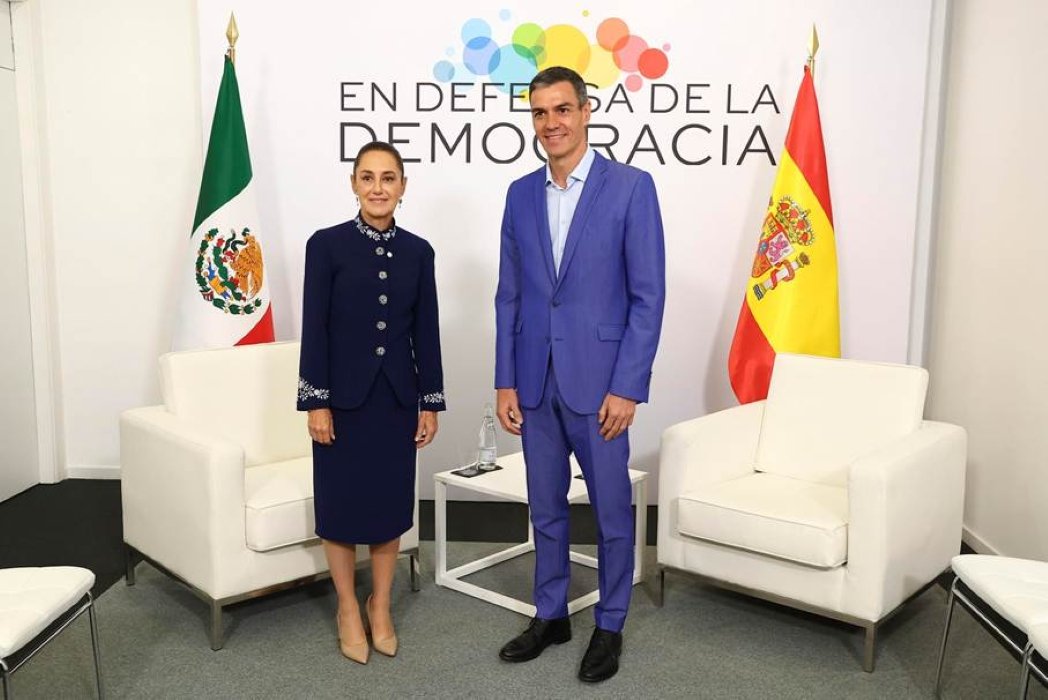
Claudia Sheinbaum’s visit to Spain signals a careful thaw between two countries bound by trade, language, and old wounds, showing how Mexico is trying to reopen a useful relationship without surrendering the colonial memory that still shapes Latin American politics today.
A Thaw With Conditions
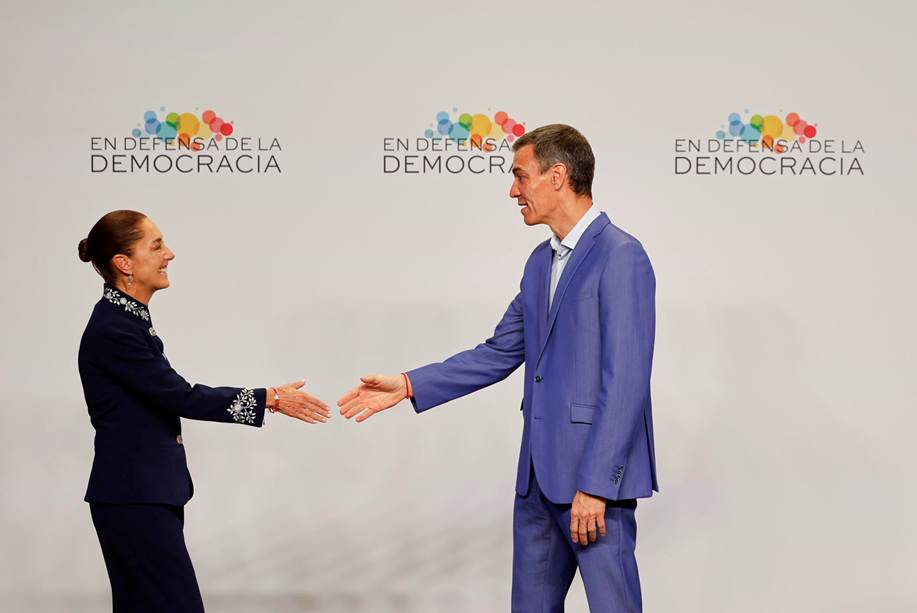
When Mexican President Claudia Sheinbaum met Spain’s Pedro Sanchez in Barcelona after the summit called “In defense of democracy,” the scene carried more weight than the usual photo of leaders shaking hands after a forum. It was Mexico’s first presidential visit to Spain in eight years, and the first by a Mexican president since Morena came to power in 2018. That alone made it a diplomatic signal. But what gave it meaning was not just the trip itself. It was the tone.
The visit marked a softening after years of strained ties. Under Sheinbaum’s predecessor and political mentor, Andres Manuel Lopez Obrador, relations with Spain deteriorated after his 2019 demand that Spain apologize for abuses committed during colonial rule in Mexico. That apology did not come at the time. The standoff lingered as yet another reminder that, in Latin America, history is never only history. It keeps leaking into protocol, trade, ceremony, and national pride.
Now the language has shifted. Sheinbaum said there had already been a rapprochement from both the Spanish prime minister and the king, something she said Mexico acknowledges. But she also made clear that the reopening is not built on forgetting. She said she again laid out Mexico’s position on the importance of acknowledging abuses committed during the colonization of Latin America during her meeting with Sanchez. That is what makes this moment politically interesting. Mexico is not backing away from historical memory. It is changing the diplomatic method around it.
That matters because Sheinbaum appears to understand that a relationship can thaw without becoming amnesiac. She thanked Sanchez for the invitation, said there is no diplomatic crisis and there never has been one, and invited him to the next edition of the summit in Mexico next year. This is a gentler style than the public confrontation that marked the previous phase. But it is not surrender. It is a recalibration.
The Empire in the Room
To understand why the meeting matters, it helps to remember what exactly sits behind the diplomatic awkwardness. Spain ruled one of the largest empires in the world between the 16th and 18th centuries, extending across five continents, including much of Latin America. In the notes, colonial rule is described plainly through forced labor, land expropriation, and violence against Indigenous peoples. That is not rhetorical excess. It is the historical foundation of the argument.
For Mexico, asking Spain to acknowledge those abuses has never been a side issue. It has been part of a broader Latin American effort to push colonial violence out of the polite fog of heritage and into the harder language of power and damage. What Lopez Obrador did in 2019 was not unusual in spirit, even if it was unusually frontal in diplomatic form. Across the region, governments, intellectuals, and social movements have repeatedly insisted that the colonial period cannot remain wrapped in nostalgia, monuments, and selective schoolbook memory. The demand is not only for an apology. It is for clarity.
That is why this new phase with Spain carries a certain tension. Any rapprochement risks being read, especially by skeptics, as a retreat from historical truth in exchange for smoother statecraft. But the facts provided here suggest something subtler. King Felipe VI last month acknowledged abuses in Spain’s colonial past, softening an earlier refusal to apologize. That does not erase the prior resistance, nor does it satisfy every historical demand. But it changes the atmosphere. It offers the beginnings of recognition without fully entering the language of repentance.
In Latin America, gestures like that matter because symbolism has always done heavy political work. This is a region where official memory can wound or heal, where the refusal to name past violence often feels like an extension of the violence itself. So Felipe’s acknowledgment, and Sheinbaum’s willingness to note it, suggests a new diplomatic grammar may be emerging. Less theatrical than the clash of 2019, perhaps. More incremental. But still rooted in the idea that modern relations between Spain and Latin America cannot be built on the old fiction that the empire was merely a civilizing exchange.
There is also a domestic angle. Morena came to power partly by speaking in a language of historical repair, national dignity, and resistance to elite consensus. For Sheinbaum, then, improving ties with Spain without appearing to abandon that moral terrain is not just a matter of foreign policy. It is a political balance. She has to show that Mexico can reopen doors abroad while remaining faithful to the historical claims that helped define her movement at home.
Trade, Democracy, and the Latin American Future
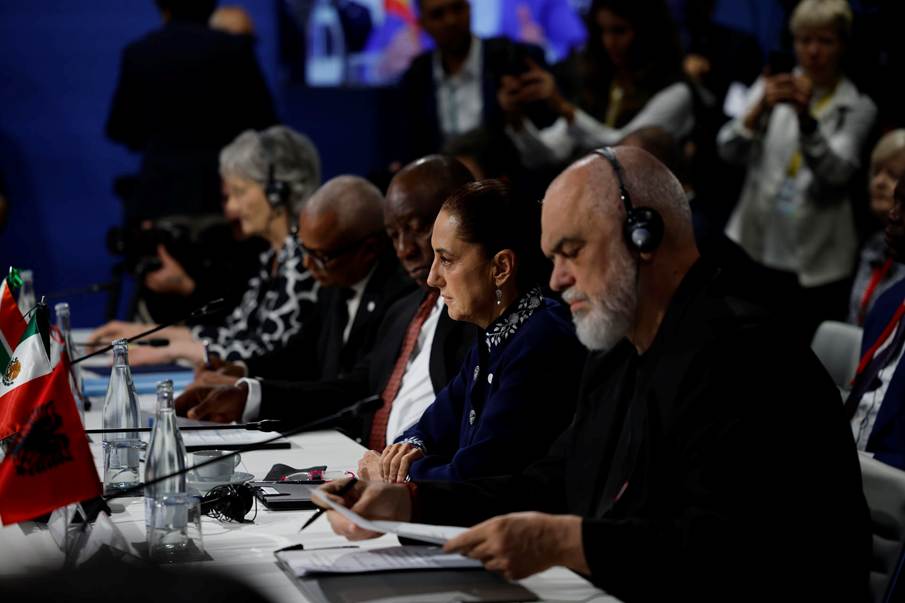
The other reason this visit matters is that it happened not at a trade expo or royal ceremony, but at a summit of progressive leaders organized to mobilize forces against the far right. That setting tells its own story. The meeting between Sheinbaum and Sanchez was not simply bilateral diplomacy. It took place within an ideological landscape in which the Latin American left and parts of Europe’s center-left are trying to present themselves as defenders of democracy under pressure.
That gives the thaw strategic meaning. Spain’s economy minister said Sheinbaum’s presence was a very important and positive sign of rapprochement and highlighted the need to boost trade and investment ties, especially in energy, infrastructure, and finance. Those are not minor sectors. They are the kinds of sectors through which modern influence is exercised, and long-term alignment is built. If relations improve, the benefits will not be confined to protocol. They may move through ports, grids, credit, and construction.
Still, this is where Mexico’s balancing act becomes especially delicate. Latin America has a long history of reopening relationships with former imperial powers in the language of modernization, only to discover that the old asymmetries return dressed in contracts and investment flows. Sheinbaum’s challenge will be to deepen ties without letting economic cooperation flatten the historical and political questions that gave the rupture meaning in the first place.
Her invitation to King Felipe VI to attend the World Cup opening ceremony next year is one sign of this new stage. So is the fact that she did not invite him to her inauguration last year, while now extending a gesture after his public acknowledgment of colonial abuses. Diplomacy here is being used almost like choreography. Distance, then recognition, then invitation. Not warmth for its own sake, but warmth after a signal.
What this means for Mexico, and perhaps for Latin America more broadly, is that the region may be entering a more mature phase in how it handles colonial memory with Europe. Less dependent on grand rupture. Less willing to let history be shelved for convenience. More interested in extracting recognition while reopening practical ties.
That is not a perfect formula. It may frustrate those who want fuller accountability and those who want history removed from diplomacy altogether. But it reflects a truth Latin America knows well. The past does not disappear because presidents decide to smile again. It sits there, in the room, in the handshake, in the invitation, in the phrasing. Sheinbaum’s trip to Barcelona suggests Mexico is trying to do something difficult but necessary: move forward with Spain while keeping the empire visible enough that nobody can pretend the road was ever clean.
Also Read:
Colombian Informant Escapes Prison and Exposes Justice’s Crooked Moral Theater