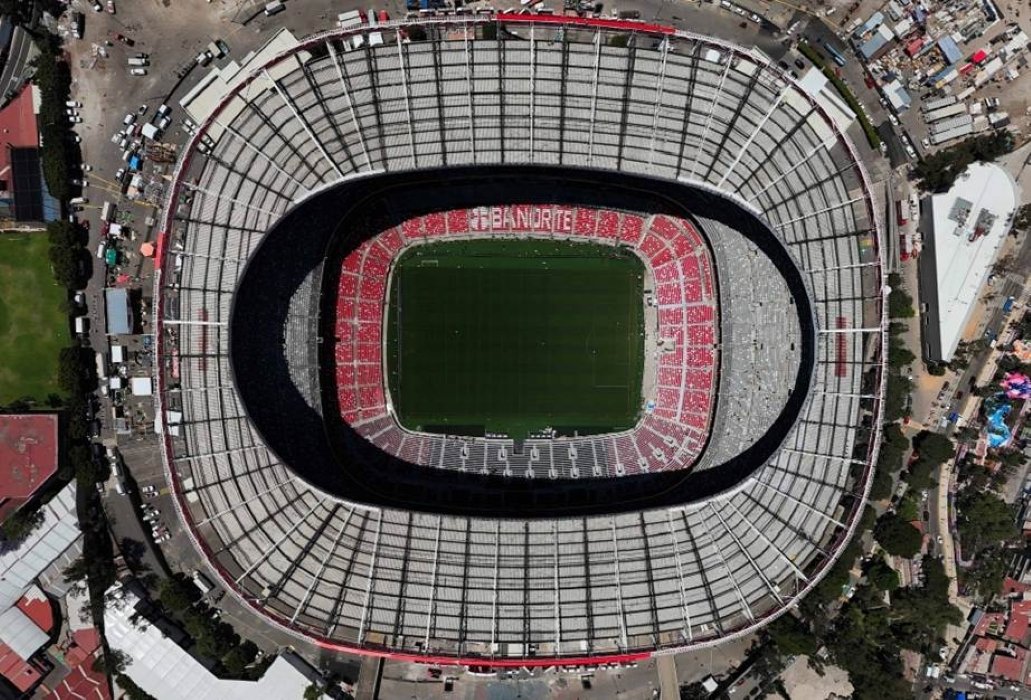
The 2026 World Cup promises spectacle across North America, but a New Weather Institute report warns its vast distances, expanded format, and heavy air travel could make it the most carbon-intensive tournament in football history, with Mexico at the center.
The Biggest Cup Gets Heavier
Football likes to speak in dreams. Flags, anthems, children in painted faces, strangers hugging in plazas, the old illusion that for one month the world can argue with a ball instead of a weapon. But the 2026 World Cup arrives with a shadow that cannot be waved away by fireworks or opening ceremonies. According to the New Weather Institute, the tournament hosted by the United States, Mexico, and Canada could generate more than nine million tons of carbon dioxide, potentially making it the competition with the largest carbon footprint in World Cup history.
That figure is not decorative. Nine million tons of CO2 would double the historical average of previous World Cups, according to the report. The main driver is movement. The study estimates that greenhouse gas emissions from air travel will rise between 160 percent and 325 percent compared with earlier editions. In plain terms, the tournament is growing faster than its climate conscience.
The reason is built into the map. The 2026 World Cup will be the tournament of immense distances: three countries, 16 host cities, four time zones, and nearly 5,600 kilometers between Vancouver and Miami, the two most distant venues. Unlike the Olympic Games, which usually concentrate competition in one city, the World Cup is already a traveling machine. In 2026, that machine becomes continental.
The expansion to 48 national teams and 104 matches adds another layer. More teams mean more flights, more hotels, more buses, more training bases, more staff, more fans, more security operations, more energy use, and more pressure on urban systems. The format promises inclusion, and inclusion matters. But the climate bill will also grow.
Sergi Simón, academic adviser at EALDE Business School, put the contradiction sharply in comments included in EFE reporting: bigger also means more vulnerable. More teams mean more flights, logistics, energy consumption, and operational exposure. His warning cuts through the event’s promotional language. While sport tries to move toward more sustainable models, mega-events are expanding at a pace that strains climate and urban limits.

Distances Become the Hidden Opponent
Mexico’s role in this equation is complex. It will host fewer matches than the United States, yet its venues, fan routes, tourism corridors, and national symbolism place it squarely inside the tournament’s environmental question. Mexico City, Guadalajara, and Monterrey will not merely stage games. They will absorb travelers, infrastructure demand, heat exposure, security operations, and the contradiction of celebrating a global event amid a regional climate crisis.
For Mexico, the World Cup is an opportunity for tourism, investment, international visibility, and soft power. It can project urban energy, football devotion, cultural depth, and logistical capacity. But it will also expose the country’s environmental vulnerabilities. Cities already dealing with air pollution, water stress, heat islands, traffic congestion, and uneven public transport will be asked to perform global hospitality under extreme scrutiny.
That is where the carbon issue becomes more than an abstract planet problem. In Latin America, climate change is not a future theory. It is already present in droughts, hurricanes, floods, crop failures, wildfires, heat waves, water shortages, and migration pressure. A tournament that celebrates global unity while generating record emissions risks sounding like a party held on a cracked floor.
The New Weather Institute report points to aviation as the central challenge. Fans crossing North America for group-stage matches, knockout games, or team followings will likely rely heavily on flights because the tournament’s geography almost requires it. Teams and workers will move too. The logistical footprint of a 104-match calendar spread across a continent is not comparable to a compact tournament.
This matters geopolitically because mega-events increasingly function as statements of national and regional competence. North America wants to show capacity. Mexico wants to show itself as a modern, safe, culturally magnetic host. But climate governance is now part of that competence. A country or region cannot claim global leadership while treating emissions as an afterthought.
For Latin America, the issue is especially delicate. The region has historically contributed less to global emissions than industrialized powers, yet it suffers disproportionately from climate impacts. Mexico, by co-hosting with the United States and Canada, stands within a North American framework where responsibility is uneven. The richest country in the trio carries enormous climate responsibility, but Mexico may still face the reputational and local environmental consequences of a sprawling event.

Heat Changes the Rules
Carbon is not the only challenge. Heat may become the more immediate danger. Recent warnings from EALDE indicate that several venues could face dangerous thermal stress, including Miami, Dallas, Houston, and Monterrey. That matters for players, fans, workers, police, vendors, medical personnel, and stadium infrastructure.
The old football calendar was designed for tradition, television, and league schedules, not a warming planet. June and July once felt like the natural home of the World Cup. Now, in parts of North America, they may become a physical risk. The debate over when these competitions should be held is no longer theoretical. More people are arguing for milder months or later kickoff times closer to night, when temperatures fall.
Simón’s EFE-cited warning is blunt: sport is beginning to realize that climate change is no longer a future problem but a direct economic and operational risk. That sentence should be written on every organizing committee wall. Climate is not merely a moral concern. It is a business, health, scheduling, and credibility risk.
For Latin America, the lesson extends far beyond football. The region’s economies depend heavily on climate-sensitive sectors: agriculture, tourism, fisheries, energy, mining, and urban services. If even FIFA, with its enormous budgets and planning capacity, struggles to reconcile spectacle with climate reality, what does that say about smaller governments trying to manage heat, drought, and infrastructure pressure with fewer resources?
The 2026 World Cup could still be remembered for great matches, new heroes, and the strange beauty of football across three countries. But it also risks becoming a warning about the age of oversized spectacle. The bigger the event, the harder it is to pretend sustainability can be handled with slogans, offsets, or recycling bins alone.
A serious response would require aggressive public transit planning, lower-emission travel options, smarter scheduling, transparent carbon accounting, renewable energy use, fan education, and honest reporting after the tournament. It would also require admitting that a continental World Cup has climate costs built into its design.
Mexico, as co-host, has a chance to push the conversation beyond celebration. It can treat the tournament as a test of climate-aware urban planning, not just football hospitality. Because the future of sport in Latin America will depend not only on talent, stadiums, and passion, but on whether games can still be played safely in the heat and whether the joy of one month is worth the emissions left behind.
The first whistle has not blown, but the climate scoreboard is already lit.
Also Read:
Brazil Hands Neymar Number Ten as World Cup Hope Turns Fragile