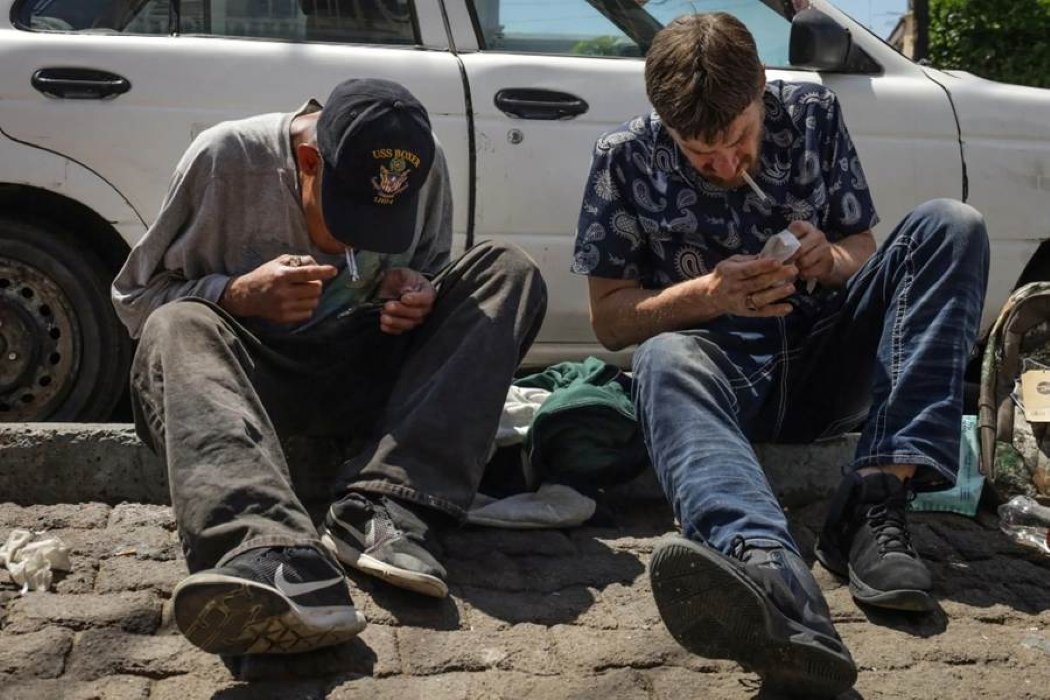
Fentanyl in Tijuana is no longer only a trafficking story. It is a binational public health rupture, where U.S. overdose deaths, Mexican border poverty, deportation, cheap access, and daily cross-border movement have made addiction a shared wound.
The Border’s Crisis Runs Both Ways
For years, the dominant story has moved in one direction: drugs cross north, death follows in the United States, and Mexico is left framed as the supplier of poison. But in Tijuana, the border tells a more uncomfortable truth. The crisis also moves south. People cross with hunger, dependency, deportation papers, U.S. benefit cards, trauma, and the unbearable arithmetic of cheaper survival.
Fentanyl trafficking and consumption along Mexico’s northern border have created a binational emergency, one that reveals not only the flow of drugs into the United States but also the displacement of U.S. drug users into cities such as Tijuana. According to interviews credited to EFE, the reasons are brutally practical: lower costs, easier access to substances, cheaper food, cheaper housing, and a border that many people cross so often it becomes less a line than a daily routine.
Alfonso Chávez, coordinator of the Prevencasa AC program, told EFE that the northern border concentrates specific problems of injectable drug and opioid use that are different from Mexico’s national panorama. National surveys point to methamphetamine as the main substance consumed in the country. But Tijuana belongs to another system. Its drug crisis is shaped by U.S. opioid demand, deportation, homelessness, migration enforcement, cross-border commuting, and the economic gap between San Diego and northern Mexico.
That distinction matters because national policy can fail when it pretends the border is just another region. Chávez warned that centralizing public policy and failing to design differentiated strategies for northern Mexico risks minimizing a phenomenon with its own characteristics. In other words, a plan made for the country as a whole may arrive too late, too generic, and too blind to the geography where fentanyl, migration, and poverty meet.
The U.S. records more than 70,000 opioid-related deaths annually, Chávez noted, a number that helps explain the severity of the problem in a region where people constantly cross between the two countries. That death toll is often treated as an American tragedy. It is. But Tijuana shows that the tragedy does not stop at the border fence. It spills into Mexican clinics, shelters, streets, emergency services, and neighborhoods that were already carrying the weight of deportation, violence, precarious work, and urban neglect.

Tijuana’s Cheap Survival Economy
Prevencasa staff have assisted multiple people who overdosed after crossing from the United States, Chávez said. They include deportees and U.S. citizens who regularly travel between cities like San Diego and Tijuana. Some are not permanently living on the street. Some move back and forth, coexisting in both cities every day.
That detail breaks the stereotype. This is not only the story of abandoned people sleeping under bridges, although many do. It is also a story of border mobility, economic inequality, and a form of survival that is legal, illegal, medical, informal, and desperate all at once. A person can wake up in Tijuana, cross into the United States to remain enrolled in aid programs, return south, and spend the money in an economy where substances are cheaper, and the cost of living is lower.
Mike, originally from California, told EFE that the high cost of living in the United States has pushed many Americans to settle temporarily in Tijuana. He said he crosses daily into the U.S. to register for and maintain government economic support, using those resources to sustain his stay in Mexico and cover expenses related to drug consumption.
This is the hidden underside of North American integration. Goods, workers, tourists, money, weapons, and drugs move across the border. So do illnesses. So do addictions. So do the failures of housing policy, healthcare access, and social protection. The border economy does not simply connect two nations. It exposes the inequality between them.
Mario Alberto Bustillo Chávez, an American who has lived in California, Utah, and North Carolina, warned EFE about how easily drugs can be obtained in Tijuana because of their low cost and wide availability. He said this deepens the city’s addiction problem. His words about life on the street were stark: “Living on the street is not an easy path for anyone. You have to be really strong.” He also noted that people in this situation are often stigmatized and treated as “black sheep.”
That stigma is not incidental. It is part of the machinery that keeps the crisis alive. When people who use drugs are treated only as moral failures, governments avoid building the systems that reduce death: outreach, treatment, safe supply strategies, overdose reversal access, shelters, mental health care, and cross-border coordination. Condemnation is cheaper than care, until the ambulance bill arrives.
From January 1 to May 13, 2026, the Tijuana Red Cross delegation provided 152 overdose-related services. That figure is not massive compared with the U.S. national death toll, but it is a local alarm bell. It reflects direct pressure on emergency responders in a city marked by constant transit between Mexico and the United States. Each call is a point where geopolitics becomes breath, pulse, panic, and the effort to keep someone alive.

A Binational Problem Needs Binational Honesty
The geopolitical meaning for Latin America begins with a reversal of blame. For too long, U.S. political discourse has treated drug crises as foreign invasions rather than shared systems. Mexico is blamed for trafficking. Central America is blamed for migration. South America is blamed for coca. But demand, guns, money laundering, pharmaceutical failures, untreated addiction, and housing collapse are also part of the circuit. Tijuana makes that circuit visible.
Northern Mexico is not merely a corridor for substances headed north. It is absorbing the human consequences of the U.S. social breakdown. When Americans cross into Tijuana because San Diego is too expensive, because drugs are easier to obtain, or because they can stretch their benefits further south, the border becomes a mirror. The United States is not only receiving drugs. It is exporting vulnerability.
For Mexico, this creates a difficult policy dilemma. The country must protect its own population from expanding fentanyl use while avoiding a purely punitive approach that repeats the failures of the drug war. Militarization may intercept some supplies, but it does not treat addiction. Deportation may move people, but it does not cure dependency. Border crackdowns may satisfy politics, but they often push the most vulnerable deeper into danger.
For Latin America, the lesson is broader. Drug policy cannot be separated from migration policy, housing policy, healthcare, and labor markets. The same region that has been told for decades to police supply is now seeing how consumption, poverty, and displacement travel across borders in complex ways. The fentanyl era is not the old cocaine script. It is faster, deadlier, more synthetic, and less geographically contained.
A serious response would require coordinated overdose prevention, shared public health data, treatment access on both sides of the border, and policies designed specifically for cities like Tijuana, where people live in two countries even when their bodies sleep in one. It would require Washington to stop scapegoating Mexico and recognize its own role in creating demand and exporting despair. It would require Mexico City to understand that northern Mexico needs border-specific tools, not distant abstractions.
The border has always been sold as a line of control. In Tijuana’s fentanyl crisis, it looks more like a wound that both countries keep reopening. The drugs cross. The people cross. The money crosses. The suffering crosses. The only thing that has not crossed with enough urgency is responsibility.
Also Read:
Chile Turns Schools and Hospitals into Migration’s New Political Border