
By Staff Reporter | NewsAmericasNow.com
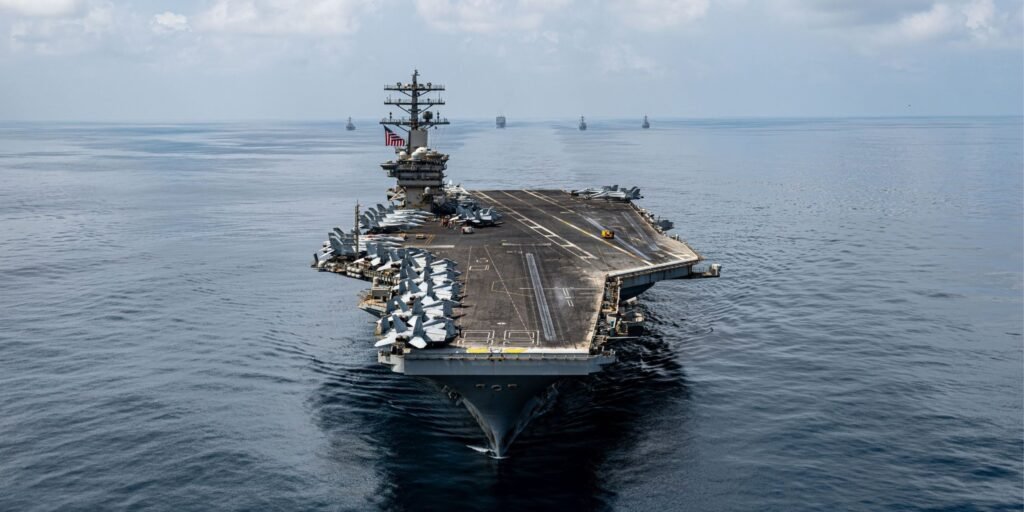
News Americas, WASHINGTON, D.C., Sun. May 30, 2026: On Monday June 1st, the USS Nimitz – one of the largest and most powerful naval vessels on the planet – will drop anchor at the Port of Kingston, Jamaica. Ninety miles away, Cuba is watching. The nuclear-powered aircraft carrier’s arrival in Kingston Harbor marks the final stop of Southern Seas 2026 – an 11th iteration multinational goodwill deployment announced by US Naval Forces Southern Command that has taken the carrier throughout South America and the Caribbean. The United States Embassy in Jamaica has framed the June 1 to June 5 visit as an exercise in maritime cooperation and people-to-people connections.
But the timing, the context, and the fractures it has exposed within the Caribbean Community tell a far more complicated story.
A Goodwill Visit – Or Something More?
The USS Nimitz is not a goodwill vessel in the conventional sense. It is a Nimitz-class nuclear-powered supercarrier – one of the largest warships ever built, capable of carrying dozens of combat aircraft and projecting overwhelming military force across an entire ocean. Its arrival in Kingston comes at a moment of extraordinary tension between the United States and Cuba – the most dangerous escalation in US-Cuba relations since the Cuban Missile Crisis of 1962, according to analysts tracking the situation.
In the weeks leading up to the Jamaica port call, the Trump administration unsealed a superseding federal indictment charging former Cuban President Raul Castro with the alleged murders of four Americans in the 1996 shoot-down of unarmed civilian aircraft. Secretary of State Marco Rubio publicly described Cuba as “a failed state 90 miles from our shores run by friends of our adversaries” — while standing at Homestead Air Reserve Base in Florida, approximately 180 miles from Havana. The administration expanded secondary sanctions targeting foreign entities doing business with Cuba. And US Southern Command confirmed the Nimitz carrier strike group’s deployment to the southern Caribbean.
The carrier is now coming to Jamaica, and Cuba, which sits between Florida and Kingston, is watching every move.
Jamaica: Partner, Not Launchpad – For Now
The United States Embassy in Jamaica was careful in its framing of the visit. Chargé d’Affaires Scott Renner described it as underscoring “the depth of the US-Jamaica bilateral relationship and the importance the United States places on its enduring partnership with Jamaica.”
“The visit of a US aircraft carrier to Jamaica marks an important milestone in the longstanding partnership between our countries,” Renner said, as quoted in the Embassy announcement. “Beyond strengthening maritime cooperation and regional security, this visit creates opportunities for meaningful people-to-people connections and economic benefits for local communities.”
The language is deliberate. Diplomatic. Carefully calibrated to frame a nuclear-powered supercarrier docking in the Caribbean’s third-largest island as a routine partnership exercise. Whether Jamaica – and the broader Caribbean – accepts that framing without question is another matter entirely.
Jamaica Government Moves Quickly To Frame The Visit
As questions swirled about the timing and implications of the USS Nimitz’s arrival, Jamaica House – the Office of the Prime Minister -moved swiftly on May 29th to frame the visit in decidedly civilian terms.
In an official press release, the government noted that the Nimitz had previously visited Panama, Chile, Argentina, and Brazil as part of its Southern Seas regional tour – and had hosted government officials from Guyana and Suriname while in South America. The statement emphasized people-to-people activities during the Jamaica visit – including the beautification of four schools in collaboration with the Jamaica Defence Force, youth sporting activities on June 4, and opportunities for Jamaican students to be exposed to world-class maritime operations and infrastructure.
“Jamaica and the United States have long shared common interests in regional stability, maritime cooperation, disaster response, trade, education, and security,” the statement read, as quoted in the Jamaica House press release. “The visit of the USS Nimitz provides a further opportunity to reaffirm these bonds and to strengthen mutual understanding between both nations.”
The carefully calibrated statement made no mention of Cuba, the escalating US-Cuba crisis, or the broader geopolitical context in which the carrier’s Caribbean deployment has taken place.
CARICOM Fractures – Guyana And Trinidad Break Ranks
The arrival of the USS Nimitz in Caribbean waters has exposed a fault line within the Caribbean Community that had been building quietly for months – and this week it cracked open in public. CARICOM foreign affairs ministers expressed their “profound concern” regarding the ongoing and intensifying economic, commercial, and financial measures imposed upon Cuba by the United States – a statement that reflected the longstanding regional consensus in support of Cuba and against the US embargo.
But two of CARICOM’s most significant members – Guyana and Trinidad and Tobago – reserved their positions from that statement. They did not sign on. The reason is significant. Both Guyana and Trinidad and Tobago are official members of the US-led Shield of the Americas alliance – a security pact signed by 17 Western Hemisphere countries in March 2026, focusing on countering transnational organized crime, drug cartels, and illegal migration through enhanced intelligence sharing and military cooperation.
In practical terms, two of the Caribbean’s most economically powerful nations – one sitting on one of the world’s largest oil discoveries, the other a major natural gas producer – have chosen alignment with Washington over regional solidarity with Havana.
For CARICOM, which has built its diplomatic identity on consensus and the principle of a Zone of Peace in the Caribbean, the public fracture is deeply significant. The regional body that has consistently called for an end to the US embargo on Cuba now cannot speak with one voice on the issue – because two of its most influential members are standing with the country imposing that embargo.
Cuba’s Warning To The Region
Cuban Foreign Minister Bruno Rodriguez Parrilla has not been subtle in his message to Caribbean governments watching this unfold. Addressing the United Nations Security Council last week, Rodriguez warned of an impending humanitarian catastrophe and issued a direct appeal to the region. “I call upon Latin America and the Caribbean to act in order to preserve their condition as a Zone of Peace and to avert adverse consequences that would destabilize the region,” he said, as reported by AFP.
Rodriguez also challenged the logic of the US pressure campaign in terms the Caribbean understands viscerally – the logic of a small island nation facing the full weight of a superpower. “Cuba is a small island – 100,000 square kilometers and 10 million inhabitants,” Rodriguez said, as quoted by Fox News. “Based on what logic, what would be the common sense behind the idea that Cuba could threaten a nuclear superpower?”
The question resonates across a Caribbean made up almost entirely of small island states that have historically understood — from their own colonial experience — exactly what it feels like to be on the wrong side of a great-power confrontation.
The Congresswoman From Jamaica’s Diaspora
As the USS Nimitz prepares to dock in Kingston, one of the most prominent Caribbean-American voices in the US Congress was making herself heard in Washington. Congresswoman Yvette D. Clarke – the daughter of Jamaican immigrants and chair of the Congressional Black Caucus – wrote directly to President Donald Trump and Secretary of State Rubio last week, demanding an immediate end to the oil blockade on Cuba.
“Under the administration’s oil blockade and tightening of sanctions, Cubans are dying,” Clarke wrote, as quoted in her letter. She cited reports that Cuba’s infant mortality rate has more than doubled since 2018 as a result of sanctions – with food shortages leaving pregnant mothers and newborns unable to survive.
“Enough is enough,” Clarke wrote. “The Congressional Black Caucus will not stand by and allow this administration to continue this barbaric policy that generates unimaginable human suffering in Cuba. We are demanding that you end the oil blockade, lift the sanctions on Cuba, and allow the Cuban people access to the most basic resources they need to sustain life on the island.”
The letter came from a congresswoman whose political roots are in the Jamaican diaspora community of Brooklyn – the same community that will be watching the USS Nimitz dock in Kingston Harbor on Monday with deeply mixed emotions.
What Comes Next
The USS Nimitz will be in Kingston from June 1 to June 5. During that time, US sailors will interact with Jamaican communities, maritime cooperation exercises will take place, and the Embassy has promised economic benefits for local businesses. earlier ?
But the questions that the visit raises – about Jamaica’s role in an escalating US-Cuba confrontation, about CARICOM’s fracturing unity, about the Caribbean’s capacity to remain a Zone of Peace when the world’s most powerful military is parking a nuclear carrier in its waters – will not be answered in five days.
The Caribbean has been placed at the center of a geopolitical confrontation it did not choose, between two powers whose conflict has defined the region’s political reality for more than six decades. The USS Nimitz arrives Monday. Cuba is watching. And the Caribbean – fractured, uncertain, and caught in between – is watching too.