Caracas, Venezuela — The minimum wage in Venezuela, which stands at 130 Bolívares (VES) or about $0.28 USD, is one of the population’s main pain points, as people have seen their incomes—and consequently their quality of life—plummet.
Acting President Delcy Rodríguez last week promised a “responsible” increase to the minimum wage by May 1 (Venezuela’s Labor Day), but didn’t elaborate on specifics.
Latin America Reports spoke with economist Aarón Olmos from the Instituto de Estudios Superiores de Administración in Caracas who outlined some of the effects a wage increase could have in the country amid continued political uncertainty following the January 3 capture of Nicolás Maduro by U.S. forces.
“Whatever the amount, it will be welcomed by households in Venezuela because income levels have indeed fallen sharply; they are meager, they are poor. The Bolívar’s purchasing power has been lost. A foreign currency is used as the basis for calculating prices, and that erodes purchasing power,” Olmos said.
The professor noted that it remains unclear whether this will be a direct increase in wages or in the bonuses the government allocates to certain public employees.
Based on data released by the Central Bank of Venezuela, which indicates the country earned $18.2 billion in oil revenues, Olmos believes there is a significant foundation for funding a substantial public payroll.
“We’re talking about nearly nine million people—roughly seven million public sector workers and two million retirees,” he said.

But he cautions that the economic conditions should not be dependent solely on oil sales. “It is essential to recognize that Venezuela would have to diversify, that is, to generate revenue through different channels, not just oil. It has to be oil, mining, raw materials, semi-finished products, and finished goods; in other words, Venezuela would have to activate its entire productive apparatus so as not to depend solely on crude oil sales. The idea is not to depend on the volatility of the energy market but to revive the economy,” he said.
The economist noted that at the production level, some changes would also be necessary, such as revising Venezuela’s Labor Law to ensure that the wage increase works more effectively.
In the case of private companies, Olmos believes there will be adjustments to pay scales, even though this sector has always paid more than the minimum wage.
“If you raise wages, well, you’ll see a price effect where the price-setter wants to appropriate this person’s surplus—this new income. And well, that appropriation of the surplus will affect both those who earn more and those who earn less,” he said.
Companies will be on “high alert” he noted, acknowledging that they will have to adjust their pay scales in response to government sector wage increases. “Perhaps not in the same proportions, but clearly some tax adjustment should follow,” he added.
Wage increases in recent years
The last minimum wage increase in Venezuela was decreed in March 2022, setting it at 130 Bolívars per month. Since then, this nominal amount has remained frozen, although the executive branch has applied adjustments to the “comprehensive minimum income” through non-wage bonuses.
For example, in May 2023, the food voucher (Cestaticket) was increased to the equivalent of $40 USD and the Economic War Bonus to $30 USD (for active workers), resulting in a minimum income of $70 USD per month indexed to the official exchange rate.
Subsequently, in January 2024, a new adjustment to these bonuses was announced to raise the comprehensive income to $100 USD, while still keeping the base salary at the same 130 Bolívars.
A year later, an increase in the total minimum income indexed to $160 USD per month was ordered for active public sector workers.
This amount was achieved by adjusting the two non-wage benefits: the Cestaticket, which remained at the equivalent of $40 USD, and the Economic War Bonus, which was raised to $120 USD.
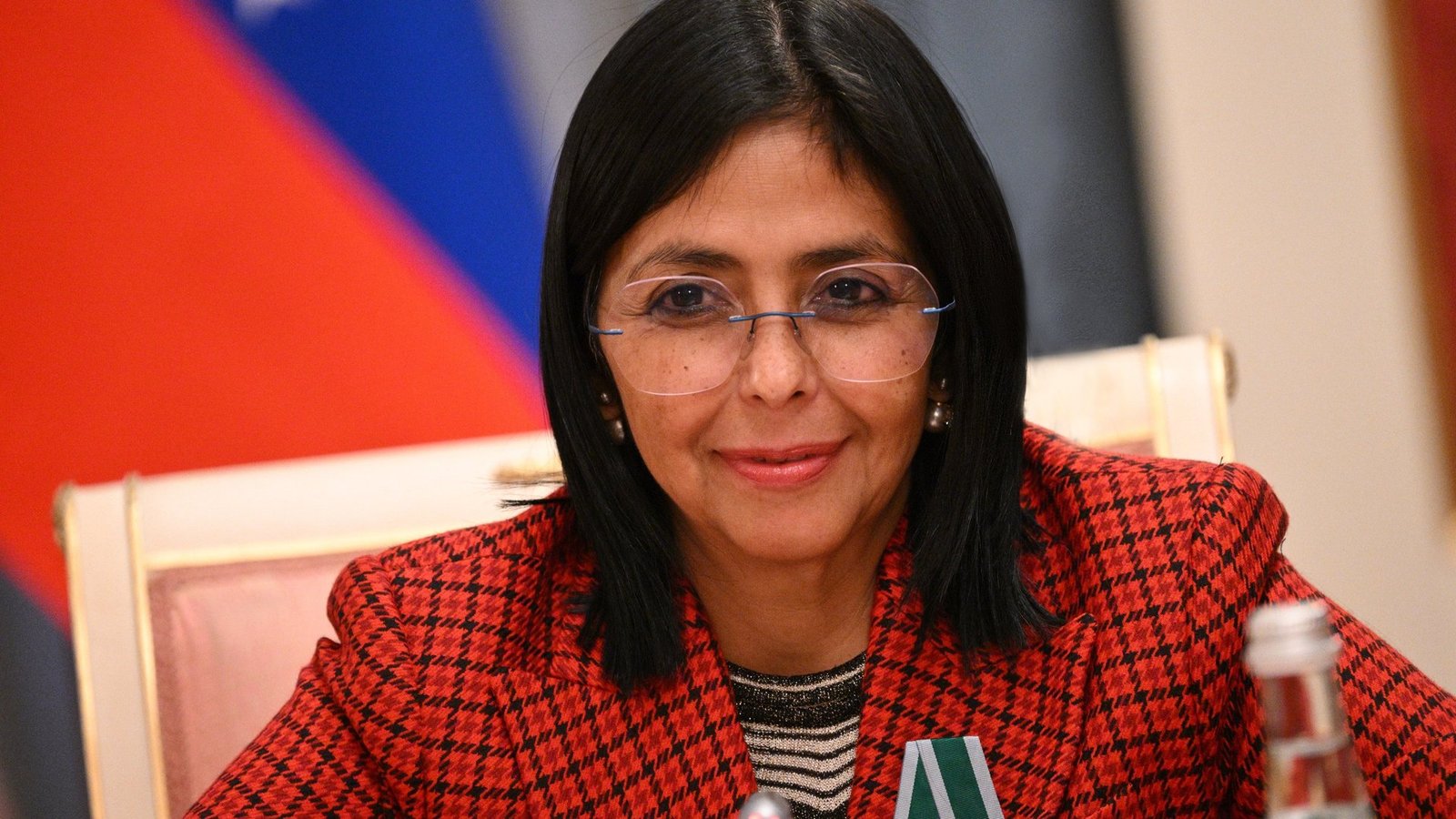
Featured image: Delcy Rodriguez.
Image credit: Government of Russia via Wikimedia Commons