Latin America’s presidential approval map shows a region rewarding order, punishing drift, and measuring democracy less by institutions than by fear, prices, security, and the fragile feeling that someone is finally in control of daily life.
Popularity Is No Longer Innocent
The latest regional survey by CB Consultora Opinión Pública reads like a political thermometer pressed against a feverish continent. At the top are presidents who, in very different ways, have learned how to turn public exhaustion into power. At the bottom are leaders, caretakers, and embattled governments trapped in the old Latin American curse: governing societies that demand miracles while institutions arrive late, weak, divided, or already distrusted.
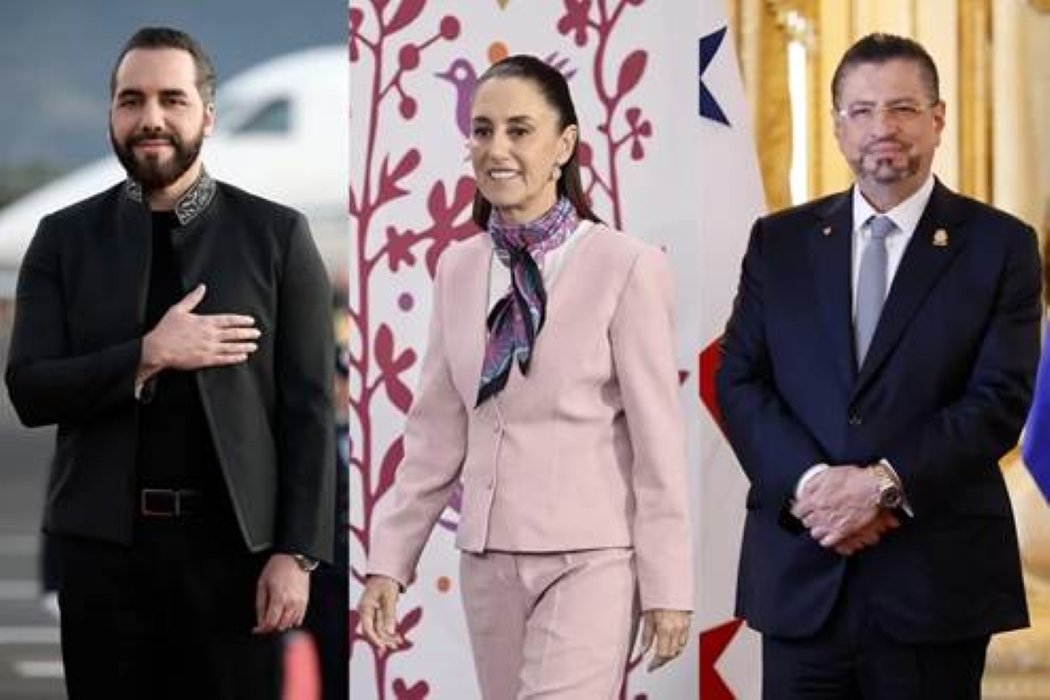
Nayib Bukele leads the ranking with 70.1 percent approval in El Salvador, followed closely by Mexico’s Claudia Sheinbaum at 69.8 percent. Costa Rica’s Rodrigo Chaves stands third, with 59.5 percent. That trio says something uncomfortable about the region. Voters are not only choosing ideology. They are choosing sensation. The sensation of safety. The sensation of continuity. The sensation that the presidency still has a steering wheel.
Bukele’s number is the most revealing. His popularity remains enormous even as his second consecutive mandate is in violation of a constitutional prohibition and his government continues to rule under a state of exception that began in March 2022. For many Salvadorans, the moral calculation appears brutally practical: if the streets feel safer, institutional warnings lose weight. That is the new democratic bargain, and it should worry the region precisely because it is so easy to understand.
Sheinbaum’s standing tells a different story. She governs Mexico as its first female president, even as insecurity still shadows national life, yet her approval rating remains close to Bukele’s. Her support suggests a hunger for stability rather than rupture. In Mexico, continuity can be a political asset when people fear chaos more than fatigue. The danger is that high approval can also soften scrutiny. When a leader begins with trust, institutions must work harder, not less, to remain independent.
Chávez, soon to hand power to Laura Fernández, occupies a curious third place. His rise in favorability from March suggests that, even near the exit, a president can benefit from the public’s desire for directness and political confrontation. Costa Rica, long imagined as the region’s polite democratic exception, is not immune to the same continental mood. Voters there, too, can reward a leader who seems to cut through procedure, even when procedure is part of the democratic inheritance.

Fear, Fatigue, and the Strong Hand
The middle of the table shows a region without a stable ideological script. Luis Abinader in the Dominican Republic remains above water with 57.3 percent favorability. Bolivia’s Rodrigo Paz sits at 52.9 percent as he approaches six months in office. Daniel Ortega, after 19 years of governing Nicaragua and now sharing power with Rosario Murillo, appears with a 51.8 percent positive image. Lula da Silva, who has led the survey several times before, falls to seventh with 48.4 percent approval and 49.1 percent disapproval.
Those numbers resist easy reading. They show that Latin America is not simply turning right or left. It is turning impatient. The region is less moved by doctrine than by results, or by the believable performance of results. Security, inflation, corruption, migration, criminal power, and the cost of food have eaten through old party loyalties. People do not always ask whether a model is liberal, conservative, socialist, or populist. They ask whether the bus route is safe, whether the wage is enough to survive the supermarket, and whether their children can come home alive.
That is why Bukele’s shadow is larger than El Salvador. His political formula has become a regional temptation, even where leaders cannot fully copy it. The idea is simple and dangerous: democracy must prove itself faster than fear spreads. If courts, congresses, and procedures appear slow, the strong hand gains poetry. It begins to sound like protection. It begins to look like dignity restored. But Latin America knows, from a long and bitter archive, that emergency powers rarely remain clean tools once they become habits.
The lower half of the survey is just as telling. Chile’s José Antonio Kast, newly in office, sits at 45.1 percent approval and 49.9 percent rejection. Paraguay’s Santiago Peña has 43.2 percent support and a 52.3 percent negative image. Uruguay’s Yamandú Orsi stands at 41.7 percent positive and 55.4 percent negative. Honduras’s Nasry “Tito” Asfura reaches 40.5 percent approval against 54.3 percent disapproval. Colombia’s Gustavo Petro, nearing the end of his mandate, records 38.2 percent favorability and 57.5 percent rejection.
This is the landscape of punished expectations. New presidents are not given long honeymoons. Old presidents are not forgiven for unfinished promises. Reformers are judged against daily pain. Conservatives are judged against fear and prices. The public mood is sharper, more suspicious, and less patient than the political class wants to admit.

The Region Is Voting With Its Nerves
The bottom tier carries the harshest warning. Bernardo Arévalo, Javier Milei, Daniel Noboa, José Raúl Mulino, Delcy Rodríguez, and Peru’s José María Balcázar sit in a zone where disapproval becomes a governing fact, not just a polling problem. Balcázar’s 17.9 percent positive image and 67.9 percent rejection place Peru at the deepest point of the survey’s crisis line. Venezuela’s Delcy Rodríguez, with 27.5 percent support and 67.6 percent negative image, shows another version of the same democratic exhaustion: power without broad legitimacy becomes administration, not persuasion.
Milei’s 36.2 percent positive image in Argentina is especially important because his project has been sold as a regional shock therapy model. His low approval does not mean that his ideas have disappeared. It means the political cost of pain is real. Latin Americans may accept austerity, confrontation, or disruption for a while, but only if they believe sacrifice is leading somewhere. Without that belief, the theater of rupture becomes another form of fatigue.
The survey’s methodology, conducted among 40,528 people with a national sample and a 95 percent confidence level, provides the ranking weight. But its deeper value is political, not mathematical. It shows a continent where approval has become a language of anxiety. Citizens are not simply applauding leaders. They are sending distress signals.
The lesson for Latin America is not that popular presidents are dangerous or unpopular ones are virtuous. That would be too easy. The lesson is that democracy in the region is judged in the streets before the constitution judges it. When institutions cannot deliver security, dignity, and economic breathing room, voters look for someone who can make power visible.
That is the sharp new price tag. Presidents can still rise high in Latin America, but the ground beneath them is thinner than it looks. The people want order, but they also want respect. They want protection, but they remember abuse. They want change, but they are tired of being used as raw material for experiments. The leaders who forget that may discover that approval, like fear, can move very fast.
Also Read:
Ecuadorian Secrets Follow Petro and Noboa Into a Regional Storm