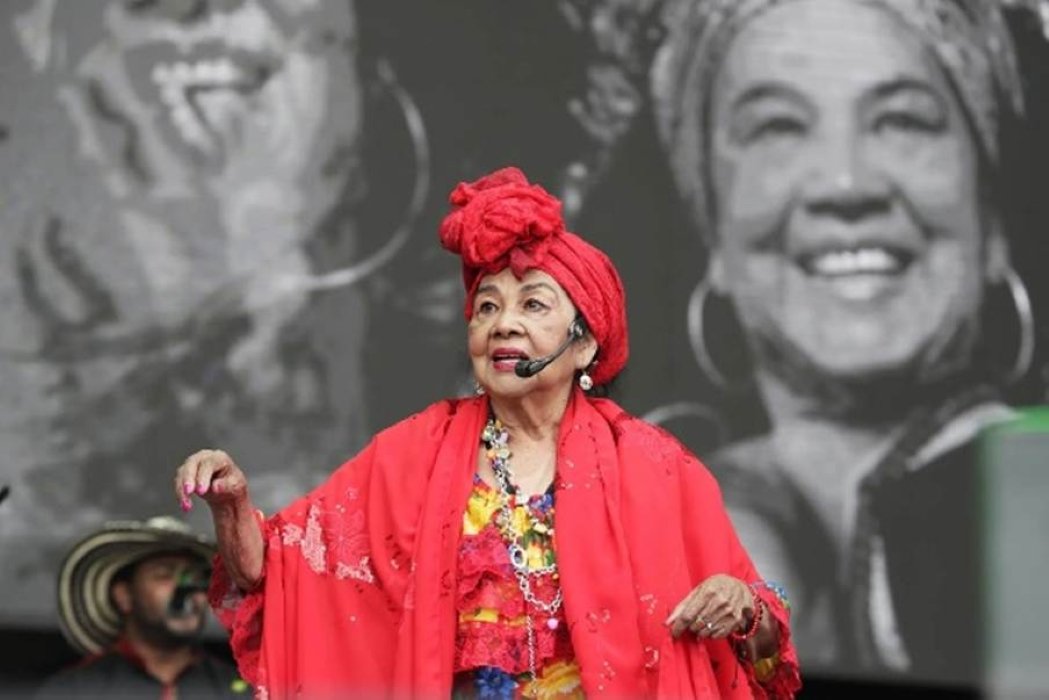
Totó la Momposina’s death at 85 marks the end of a monumental chapter in Colombian music. However, her drums still speak across Latin America, turning cumbia, bullerengue, mapalé, and porro into living memory, resistance, and cultural sovereignty for generations.
The River Sang Through Her
Before the world knew her name, the Magdalena River knew her rhythm. Before the grand theaters, the awards, the collaborations, and the solemn tributes, there was a girl born Sonia Bazanta Vides in Talaigua, Bolívar, less than an hour from Mompox, in the deep Colombian Caribbean. There was a family of musicians. There were drums, gaitas, maracas, village dances, women’s voices, Afro-Indigenous memory, and the stubborn pulse of a region that has always known how to survive through song.
Totó la Momposina, who died Sunday at 85, surrounded by her family in Celaya, Mexico, according to a statement from her children, Marco Vinicio, Angélica María, and Eurídice Salomé, was not simply one of Colombia’s great singers. She was one of Latin America’s great cultural witnesses. For more than six decades, she carried the ancestral music of her homeland across the planet, making cumbia, bullerengue, mapalé, and porro sound not like folklore preserved behind glass, but like a living force with dirt under its nails and fire in its throat.
Gabriel García Márquez understood that force. When he received the Nobel Prize in Literature in Stockholm in 1982, he wanted the world to hear the Caribbean that had shaped his imagination. Totó was part of the artistic delegation that accompanied him, bringing cumbias and vallenatos into one of Europe’s most formal literary ceremonies. It was more than performance. It was a declaration. Latin America would not arrive at the center of global prestige alone, polished into silence. It would arrive with drums.
In a 2018 interview with EFE in Mompox, Totó said, “Ancestral music is the one that gets to heaven.” The phrase sounded like a prayer, but it was also political theory in plain language. For her, traditional music was not backward. It was not decorative. It was not a quaint national costume to be taken out for tourism. It was a path to the sacred, a map of survival, a point of reference for people who had been repeatedly told their history belonged at the margins.

A Voice Against Cultural Amnesia
Totó came from a lineage where music was an inheritance. Her mother, Livia Vides, was a singer and dancer. Her father, Daniel Bazanta, was a percussionist. Her grandfather led a band in Magangué, another Bolívar town rooted in the Magdalena River basin. That matters because Totó did not build her authority from celebrity. She built it from continuity.
During the mid-twentieth-century violence in Colombia, her family fled the Caribbean region for Bogotá. That forced movement belongs to the larger Colombian wound: people leaving land, towns, rivers, and graves because violence made staying impossible. But the Bazanta Vides home in the capital became a refuge for musicians, students, and artists who kept their roots alive. Displacement tried to separate the family from the Caribbean. Music carried the Caribbean into the house.
In the late 1970s, Totó traveled along Magdalena River towns with anthropologist Gloria Triana, learning directly from traditional singers and drummers. That journey shaped her understanding of music as cultural memory and way of life. She did not treat oral tradition as raw material for modern reinvention. She treated it as knowledge held by communities, elders, peasants, Black families, Indigenous memory, and women whose names rarely enter the official archive.
That is why her critique of hollow sounds had such bite. In her 2018 conversation with EFE, Totó described herself as transparent and said she could not be fooled. She criticized reggaeton and other urban genres, saying they were, in her view, “an invention” that spoiled youth’s ears. Many younger listeners may disagree with that judgment, and Latin America’s urban music has its own histories of marginality and resistance. But Totó’s warning should not be dismissed as nostalgia. She feared a market that confuses volume with depth and novelty with memory.
Her own music proved that tradition could travel without surrendering its soul. Albums such as “La Candela Viva,” “Pacantó,” and “La Bodega” carried rural and coastal sounds into international circulation. Songs like “El Pescador,” “Yo Me Llamo Cumbia,” and “Aguacero de Mayo” became popular anthems because they felt both old and present, like something a grandmother knew and a child could still dance to.
Her stage presence was part of the lesson. At 78, in a 2018 Mompox concert, she still danced with startling vitality, telling the audience, “I’m giving a lesson,” then taking a sip from a bottle and clarifying with a laugh, “It’s water, not rum.” That moment captured her perfectly: mischievous, commanding, earthly, luminous.

Folklore as Latin American Power
Totó’s death matters geopolitically because culture is one of Latin America’s most underestimated forms of power. The region is too often described from outside through crisis: drugs, debt, corruption, migration, violence, coups, hunger, and extraction. Those realities exist, but they are not the whole map. Totó offered another geography, one drawn through rhythm, ancestry, and dignity.
Her global career showed that the Colombian Caribbean was not peripheral. It was central. It was a source of language, movement, and philosophy. When she performed in the Americas, Europe, and Asia, she was not asking audiences to pity a region marked by poverty and violence. She was demanding they recognize its authority.
Her collaborations with Carlos Vives, Gilberto Gil, and Calle 13 widened that continental reach. With Calle 13, she contributed to “Latinoamérica,” a song that became an anthem of resistance and identity for millions. The collaboration mattered because it placed Totó’s ancestral voice inside a modern protest language. It connected river music to anti-imperial feeling, peasant memory to urban youth, Colombian Caribbean sound to a broader Latin American refusal to be reduced to market statistics or foreign stereotypes.
In 2013, she received the Latin Grammy Lifetime Achievement Award for her career and her defense of folk music. Yet recognition never led her to abandon the popular language that shaped her. She said her mission was to support the folklore of Colombia and everywhere else, so those sounds would endure forever as points of reference.
That phrase carries the weight of her legacy. A region without points of reference becomes easy to sell back to itself at a lower price. It forgets the difference between culture and branding. It mistakes foreign validation for worth. Totó resisted that erasure with every drumbeat.
Her farewell to the stage came in 2022 at Bogotá’s Cordillera Festival, where she performed with Adriana Lucía and Nidia Góngora in a collective tribute. Her remains are expected to arrive at Colombia’s National Capitol in Bogotá on May 27 for a posthumous tribute with her body present, her family reported.
The Capitol is a fitting place, and also an ironic one. The state will receive a woman whose deepest authority came from beyond the state: from rivers, patios, drums, family memory, African roots, Indigenous breath, peasant labor, and Caribbean laughter. Totó sang until God wished. Now the ember she guarded belongs to the continent.
Also Read:
Mexican Ghosts Sing Frida and Diego Back Into Global Memory