Peru’s missing recruits expose a hidden pipeline from Andean hardship to Russia’s trenches, where false job promises, vanished passports, silent embassies, and grieving mothers turn Ukraine’s war into a Latin American diplomatic crisis that Lima can no longer ignore.
The War Arrives at the Embassy Gate
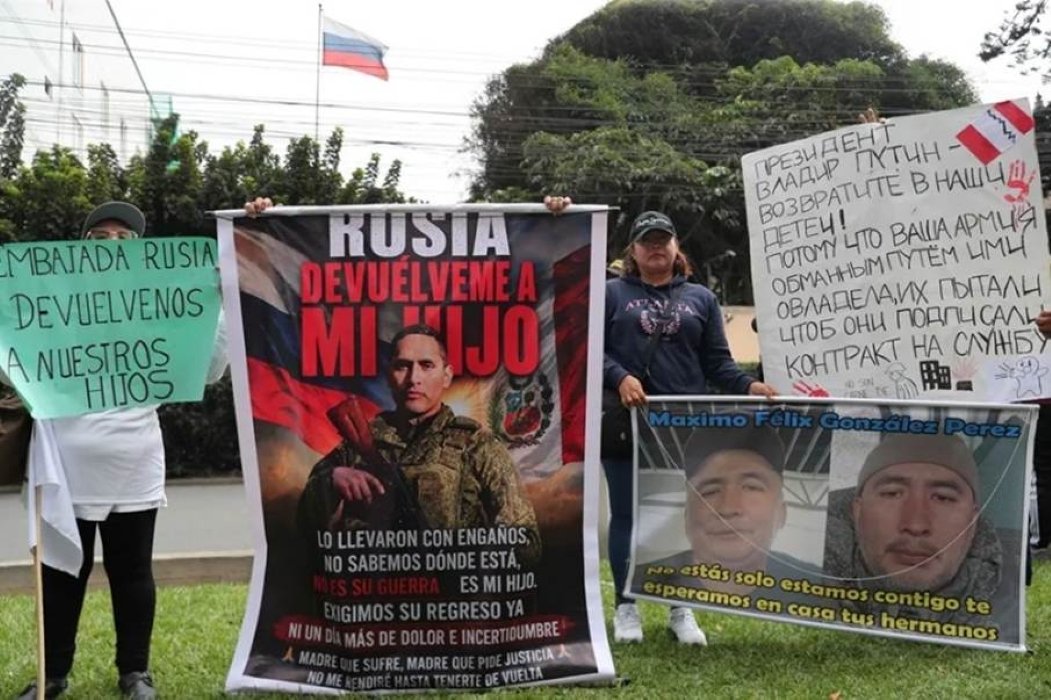
The women arrived with photographs, signs, prayers, and the kind of exhaustion that no government office knows how to measure. Outside the Russian Embassy in Lima’s financial district of San Isidro, they kept vigil from Monday night into Tuesday morning, waiting for answers about sons, husbands, brothers, and fathers recruited in Russia to fight in the war against Ukraine.
Many had not heard from their relatives in weeks. Some had received rumors of death. Others had only silence. The silence may be the cruelest part, because it keeps a family trapped between mourning and hope, between checking a phone and fearing what the next message might say.
According to the families’ legal defense, 214 Peruvians recruited in Russia have been formally registered. But the number may be far higher. Around 600 affected people have not yet completed the official registry or complaint process, and at least 20 have died in battle, based on information gathered so far. The figures, reported through interviews credited to EFE, suggest something more organized than scattered bad luck: a recruitment pipeline reaching into Peru’s economic vulnerability and feeding men into a foreign war.
Peru’s Foreign Ministry has sent diplomatic notes to Russia for each of the 214 registered Peruvians. However, the families say they have still received no response from the Russian authorities. Over the weekend, the Peruvian government requested assistance from the International Committee of the Red Cross delegation to search for affected citizens.
That request matters. It shows that the case has moved beyond family anguish into international humanitarian territory. When a state must ask the Red Cross to locate its citizens in a foreign army’s war zone, the problem is no longer just consular. It is geopolitical.

False Jobs and Vanishing Phones
Yovana has not spoken to her son in almost a month. He used to work in a mine in Peru. According to what she told EFE, he was deceived with the promise of a security job in Russia and an initial payment of $20,000 that never arrived. Now she has heard unofficial information that he died on the front line. She does not want to believe it. She also fears that people are trying to profit from the tragedy by selling false information to desperate families.
Her story captures the machinery of exploitation. A man leaves a mining job, likely already part of the hard economy that pushes Peruvians into risky labor, and follows a promise abroad. Security work. A large payment. A chance to change the family’s fortunes. Then the contract becomes something else. The phone goes dead. The family waits.
The vigil lasted about 15 hours. Most of those outside the embassy were women. They cried, prayed, held signs, and demanded that Russia explain whether their relatives are wounded, dead, detained, deployed, or alive somewhere without documents. One poster read, “They are not war meat.” Another, written in Russian, denounced conditions described as inhuman: no passport, no phone, no money, no food, no rest.
Narma, whose son reportedly traveled to Russia believing he would work as a cook, told EFE that the families want answers. Peru’s Foreign Ministry has already sent documents to the Russian Embassy, she said, and the relatives need to know the conditions of their loved ones, whether they are wounded, dead, or in danger zones.
The details are painfully consistent. Men were recruited under labor promises. Families cut off. Phones taken or lost. Passports inaccessible. Weeks without communication. Lawyer Marcelo Tataje told EFE that many recruited Peruvians experience up to six weeks of complete silence when they are moved from a training base to the war front. Sometimes they later recover their phones. For that reason, the legal team tells families to keep hope alive, even when there is no news.
Hope, in this context, becomes both medicine and torture.

A Latin American War by Proxy
The Peruvian cases do not stand alone. Tataje said the defense is in contact with similar cases involving Ecuadorians and Colombians recruited by Russia. He also said they are seeking pressure so the Andean Community, made up of Bolivia, Colombia, Ecuador, and Peru, intervenes.
That regional angle is crucial. The war in Ukraine may be fought in Eastern Europe, but its labor market has become global. Russia’s need for manpower appears to be reaching into poorer, unequal societies far from the battlefield, where a promise of dollars can outweigh fear, especially among men who already know the precariousness of labor, migration, and state abandonment.
For Latin America, this is a warning about sovereignty in the age of distant wars. A country does not need to send troops officially for its citizens to become combatants. They can be pulled through informal networks, false contracts, poverty, deception, and the weakness of consular protection. The battlefield expands quietly, not by invasion, but by recruitment.
Peru is especially vulnerable to this kind of promise. The country has endured years of political instability, deep regional inequality, informal labor practices, mining dependence, and distrust in institutions. A worker who believes a Russian job can provide $20,000 is not simply gullible. He is responding to an economic system that has already taught him that risk is sometimes the only route out.
That is what makes the crisis larger than Russia and Peru. It exposes how global conflict feeds on inequality. Men from the Andes, from mining towns, from working-class neighborhoods, may end up in trenches because the world’s wars have learned to outsource danger. Wealthy states buy technology. Poor men supply bodies.
The Peruvian government now faces a difficult test. Diplomatic notes are necessary, but not enough. Lima must press Moscow harder, coordinate with the Red Cross, gather testimony, identify recruiters, warn citizens, and work with other Andean governments to determine whether a broader trafficking or deception network is operating. If Colombians and Ecuadorians are in similar situations, this is no longer a national incident. It is a regional security and human rights emergency.
The case also forces Latin America to think beyond its usual geopolitical posture on Ukraine. Much of the region has tried to remain cautious, balancing principles of sovereignty with economic ties and ideological divisions. But neutrality becomes harder when Latin American citizens vanish into the machinery of war.
Outside the Russian Embassy, the women already know this. They do not speak in abstractions. They hold pictures. They say names. They ask whether their sons are alive.
The war has traveled thousands of miles and arrived in Lima not as a strategy, but as a mother standing through the night, waiting for a door to open.
Also Read:
Uruguay Marks Condor Crime Still Haunting Democracy Fifty Years Later