Yuvelis Morales Blanco’s victory against fracking in Colombia is more than one activist’s triumph. It captures a deeper Latin American struggle over rivers, oil, community survival, and the old habit of calling extraction ‘progress’ even after water, fish, and people begin to disappear.
A River That Raised a Defender
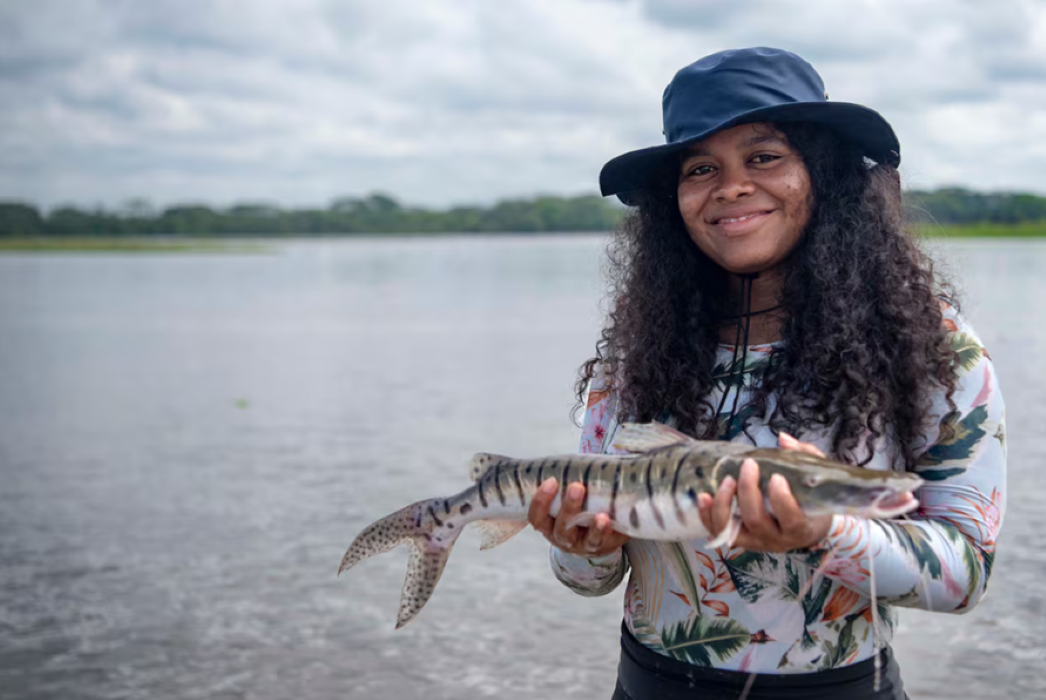
As a child on the banks of the Magdalena River, Yuvelis Morales Blanco learned to read danger in the water before she learned to read politics in speeches. Dark spots on the river meant there would be no food. That is how the fossil fuel economy first introduced itself to her world, not as abstract national development, but as contamination drifting toward the fishing nets.
One of those spills in 2018 killed thousands of animals and forced hundreds of people to relocate, including residents of her Afro-Colombian fishing community in Puerto Wilches. Morales Blanco was 16. The crisis did what environmental violence often does in Latin America: it exacerbated social inequality. It stripped away the polite language around industry, leaving only the lived truth. A community can live beside extraction for decades and still be the one paying the highest price when something breaks. Now 24, she has been awarded the Goldman Environmental Prize for helping halt fracking in Colombia, a distinction often called the Green Nobel.
The gender dimension deepens that truth. Morales Blanco is part of the first all-women Goldman Prize cohort in the award’s history. For the first time since the prize was created in 1989 by philanthropists Richard and Rhoda Goldman, all recipients of the award are women. The other winners were Iroro Tanshi, from Nigeria; Borim Kim, from South Korea; Sarah Finch, from the United Kingdom; Theonila Roka Matbob, from Papua New Guinea; and Alannah Acaq Hurley, from the United States. But the real force of Morales’ story is not the prize itself. It is what her path says about how environmental defense is being born in Latin America, from communities that have stopped waiting for outsiders to explain what harm looks like.
Morales Blanco’s language is direct and almost impossible to confuse. She says she is the daughter of the river and sees nature not as a resource, but as life itself. The Magdalena region, she says, is part of life, part of family, part of the self. That vision is not decorative. It is political. It rejects one of the oldest habits in Latin American development, the idea that land, rivers, and communities exist mainly to feed an export model. In her telling, the problem is not only fracking. It is a civilization-wide habit of imagining nature as raw material waiting for permission to be damaged.
That is why her struggle in Puerto Wilches matters beyond Colombia. It translates a local fight into a continental one.

Morales Blanco helped found Aguawil in 2019 as a youth-led anti-fracking organization. Its members organized protests and went door to door, turning technical arguments about hydraulic fracturing into the concrete language of fishers and farmers. That organizing style is revealing. In Latin America, extractive industries often enter a territory speaking the language of investment, energy, and jobs. Communities answer with the language of water, illness, soil, memory, and the right to stay where they are. The conflict is not simply between science and emotion. It is between two different definitions of value.
Fracking, as the notes describe it, has been linked to groundwater contamination, aquifer depletion, seismic activity, and serious human health impacts, including cancer and congenital disabilities. But Morales Blanco’s argument against it is even broader. She warned neighbors that promises of prosperity from increased fossil fuel production were hollow, as decades of drilling had already contaminated ecosystems, while Puerto Wilches, with its 30,000 residents, still lacked quality healthcare and education. That line should echo across the region. It names one of Latin America’s oldest betrayals.
The problem persists here because extraction often arrives with the same bargain, and the bargain is almost always unequal. Communities are asked to absorb contamination and risk in exchange for prosperity that either never comes or arrives somewhere else. The oil flows, the pipelines expand, the refinery lights stay on, yet the nearest town still lacks basic services. This pattern has marked mining zones, oil regions, dam projects, and, now, fracking debates across countries. The territory is considered essential when productive and expendable when damaged.
That is also why the rights of nature movement has gained force. Morales Blanco frames it not as a fashionable legal theory, but as a correction to a much older violence. When a community loses a river, she says, the loss is not only about water. It is about spirit, identity, and the way people understand life itself. Companies may promise energy or a refinery, but she asks the question that development discourse prefers to skip: at what cost? No one has ever lived without water, she says, but humanity has lived without fossil fuels.
There is history in that sentence. Latin America was long organized around the extraction of resources for others: silver, sugar, rubber, oil, copper, and coal. The names changed. The logic did not always change with them. That is why the region keeps producing environmental conflicts that feel modern in technology but colonial in structure. A powerful sector identifies a territory, promises national progress, and expects local sacrifice to be rational, patriotic, and quiet.

Why Violence Shadows the Green Frontier
The Colombian case also exposes another regional truth. Environmental defense in Latin America is often deadly because it threatens not only profits but also the hierarchy that decides whose life matters less.
Morales Blanco says the backlash came quickly. One resident warned she would get herself killed. Two years later, she received her first death threat. In 2022, after a peaceful protest she helped organize, armed men arrived at her home. Colombia is described in the notes as consistently among the world’s most dangerous countries for environmental defenders. In that year, more than a third of all recorded killings occurred there. She fled and temporarily relocated to France. Even in exile, the logic of the struggle remained clear. Visibility, she says, protects. Networks protect. Education protects. And above all, refusing to give up protects the possibility of a future.
This matters for Latin America because the region often celebrates biodiversity while abandoning the people who defend it. Morales Blanco herself points to the irony: Colombia is one of the most biodiverse areas on the planet and also one of the most dangerous for those working on social justice and the environment. That contradiction is not uniquely Colombian. It belongs to a wider Latin American reality where environmental defenders are praised in international speeches and threatened in their own neighborhoods.
Morales says injustice deepens when you are a woman, especially a woman of color. Her emphasis on solidarity and tenderness among women does not soften the story. It sharpens it. It suggests that in the southern part of the world, women are often pushed to the front lines of environmental struggle because they are already carrying the daily work of keeping families, food, and community life together when the land begins to fail.
Weeks after she was forced out, a Colombian court suspended fracking projects pending community consultations. Soon after, President Gustavo Petro imposed a nationwide moratorium. But the notes make clear that this victory is not settled. Colombians will elect a new president on May 31, and the ban could be reversed. Morales Blanco says the election presents two opposites, one advocating the destruction of nature and the violation of human rights, the other defending life and humanity. Yet she also insists the movement will continue no matter who wins because it is independent.
That may be the most important lesson her story offers Latin America. The region’s environmental future may not be secured first by presidents, though presidents matter. It may be secured by communities that learn to think of rivers as kin, not assets, and of political participation as a form of survival. Morales Blanco’s fight along the Magdalena is therefore not only about fracking. It is about whether Latin America will keep repeating the old extractive script or finally listen to the people who can read the water before the country admits it is poisoned.
Also Read:
Latin American Deportees Become Pawns in Washington’s New Border Geography