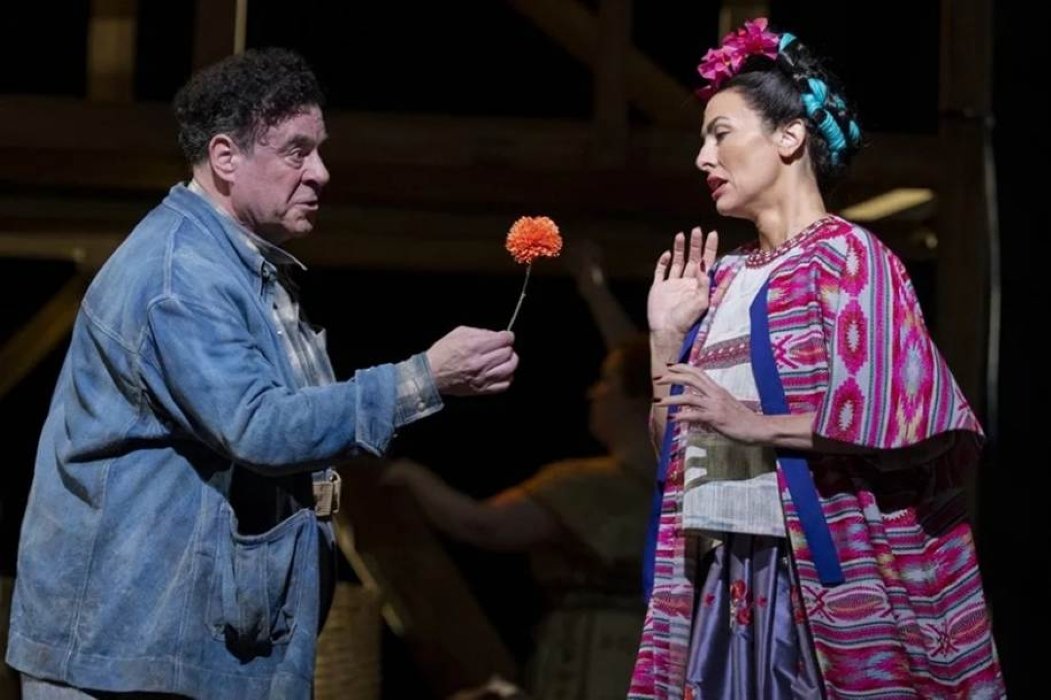
A Spanish-language opera at the Met turns Frida Kahlo and Diego Rivera into myth, not biography, revealing how Mexican art, disability, death, and Latin American identity now travel through elite cultural spaces once built to exclude them.
A Love Story in the Underworld
Frida Kahlo returns from the underworld not as a museum postcard, not as a printed face on a tote bag, not as the decorative saint of global bohemia, but as a woman still deciding whether life is worth another wound. That is the strange power of “El Último Sueño de Frida y Diego,” the Spanish-language opera about Kahlo and Diego Rivera, which premiered last week at the Metropolitan Opera in New York.
The work, with a libretto by Cuban playwright Nilo Cruz and music by U.S. composer Gabriela Lena Frank, takes its emotional engine from the myth of Orpheus and Eurydice. But here, the old European descent into death is rewritten through Mexican memory. Kahlo leaves the underworld during Día de Muertos and reunites with Rivera, who is still bound to the ache of unfinished love, unfinished art, and the unbearable fact that the dead do not return because the living miss them.
The opera does not treat Frida’s pain as an ornament. Her hesitation about returning to life comes from the body she actually endured: childhood polio, then the streetcar accident that fractured her ribs, pelvis, and spine, leaving her with chronic disability and lifelong pain. That detail matters because the global Frida industry often turns suffering into branding, flattening her into flowers, eyebrows, and resilience slogans. Onstage, according to EFE interviews and reporting, the production tries to restore the harder truth: Frida’s art did not float above pain. It argued with it every day.
Spanish baritone Carlos Álvarez plays Rivera, while U.S. mezzo-soprano Isabel Leonard embodies Kahlo. Gabriella Reyes plays La Catrina, a crucial figure in the production’s symbolic universe. Yannick Nézet-Séguin conducts most performances, with Steven Osgood stepping in for the May 22 date. Those names place the production firmly inside the highest chamber of international opera. Still, the language and imagery pull the stage south, toward Mexico, toward the Americas, toward a world where death is not simply an ending but a guest who knows the family name.

A Stage Painted Like Memory
The Met production translates the canvases of Kahlo and Rivera into theatrical space, drawing on visual references such as Rivera’s “The Making of a Fresco Showing the Building of a City” and Kahlo’s “El Sueño (La cama),” the latter recently sold in New York for $54.7 million. That price hangs in the background like a second ghost. Frida’s bed, once a site of immobility, pain, imagination, and defiance, now circulates through the financial language of elite art markets.
The opera’s surrealist charge comes through bright colors, skeletons, catrinas, and figures that slide across the stage as if death itself has learned choreography. Yet the piece’s creators have insisted that this is not a biopic. That distinction is important. A biography would have to march through dates, betrayals, exhibitions, politics, miscarriages, affairs, and public scandals. This opera chooses a different route. It enters through myth, through the final dream, through the space where love and resentment continue speaking after the body has failed.
Deborah Colker, the production’s director and choreographer, told EFE that the opera reveals Frida’s poetic side, her fragility and sensuality, and the duality between life and death, scream and silence, colors and emptiness. That framing is useful because it resists the easiest version of Kahlo, the one sold as permanent strength. Frida was strong, yes, but strength without fragility becomes propaganda. Her greatness was not that she escaped vulnerability. It was that she made vulnerability impossible to ignore.
Rivera’s presence complicates the emotional architecture. Their relationship was famously turbulent, marked by separations, returns, betrayals, political commitments, artistic rivalry, and mutual dependence. But onstage, Rivera is not merely the great muralist looming beside the wounded painter. He becomes the man left behind, the one forced to confront what art cannot rescue. His murals were public, monumental, revolutionary, designed for walls, workers, history, and crowds. Her paintings often turned inward, toward the body, the bed, the wound, the mirror. The opera places those two scales in the same underworld and lets them collide.
That collision is Mexican, but it is also Latin American. The region has long lived between mural and wound, between public revolution and private grief, between heroic image and broken body. The opera understands that Frida and Diego are not only a couple. They are an argument about how Latin America remembers itself.

Spanish at the Center of Power
The decision to perform the opera entirely in Spanish gives the production geopolitical force. At the Met, language has always carried hierarchy. Italian, German, and French have long been treated as natural languages of prestige opera. Spanish, despite its hundreds of millions of speakers and enormous cultural production, has often stood outside that central canon. A Spanish-language opera about Mexican icons at the Met is therefore not only an artistic event. It is a partial correction of cultural geography.
Frank has said the opera honors Latin American “DNA,” including the use of the marimba, an instrument with African roots popular in Central American Indigenous communities. That detail widens the work beyond Mexican nationalism. It reminds audiences that Latin American culture was formed through Indigenous survival, African memory, colonial violence, migration, Catholic ritual, popular resistance, and hybrid sound. The marimba is not decorative. It carries the history of bodies and routes that official museums often soften.
For Latin America, this matters because cultural power is never innocent. The same global institutions that once exoticized the region now depend on its artists, symbols, languages, and audiences to renew themselves. Frida Kahlo is one of the clearest examples. She has been consumed internationally, often without the political, bodily, and Mexican realities that made her work dangerous. Bringing her to the Met in Spanish can either deepen that understanding or risk turning her into another luxury object. The difference depends on whether the production allows her contradictions to remain alive.
The opera’s limited run, only seven performances through June 5, adds urgency but also reveals scarcity. Latin American stories still arrive in elite spaces as events, not habits. They appear brightly, receive applause, then make room for the old repertoire. The challenge is not whether Frida and Diego can fill a prestigious stage. They can. The challenge is whether institutions will treat Latin American languages, composers, myths, and histories as central rather than seasonal.
“El Último Sueño de Frida y Diego” succeeds most powerfully as a symbolic crossing. It takes a Greek myth, filters it through Día de Muertos, sings it in Spanish, colors it with Mexican surrealism, and places it inside one of the world’s most powerful opera houses. The result is not simply Frida returning from the dead. It is Latin America stepping onto a stage that has too often asked it to appear as flavor rather than authority.
And there, beneath the flowers, skeletons, marimba echoes, and painted beds, the old question remains. Should Frida return to life? The opera knows the answer is not simple. Life gave her pain, but also color. Death gave her silence, but also myth. Between the two, she sings, and the world listens again.
Also Read:
Mexico City Turns Dua Lipa’s Concerts Into Global Pop Diplomacy