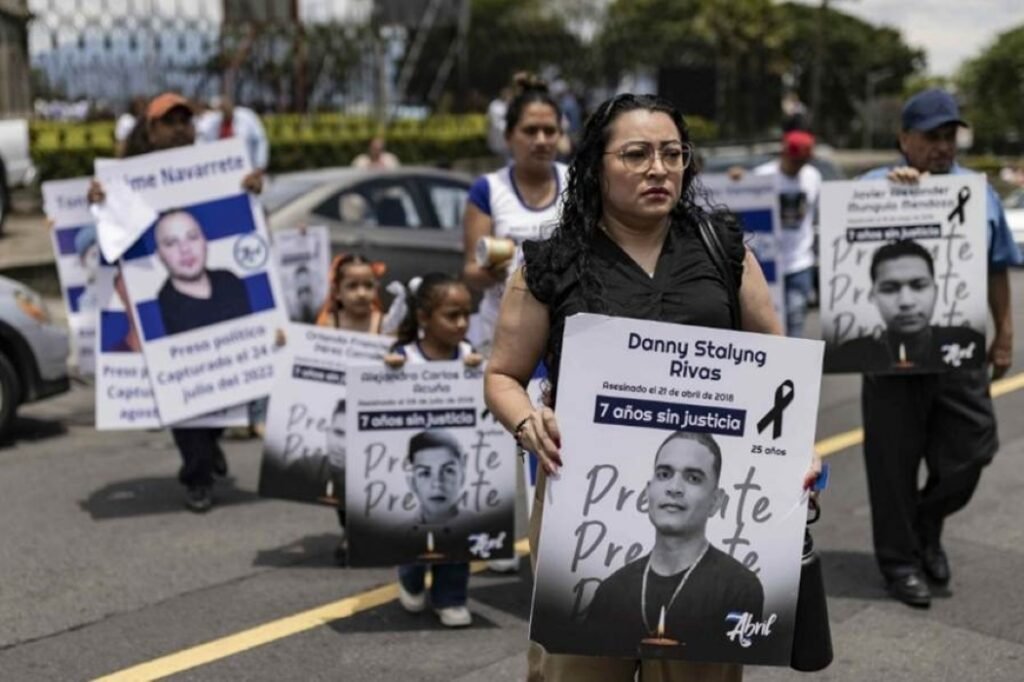
Eight years after Nicaragua’s Mother’s Day Massacre, exiled families in Costa Rica still carry names, photographs, and unanswered grief, turning a church memorial into a stubborn indictment of Daniel Ortega’s repression and Latin America’s unfinished battle with impunity and forgetting.
The Mass That Became a Country
The church in Goicoechea did not need to become Nicaragua for an afternoon. It already was, in the way exile makes a country portable. The hymn, the candle, the folded hands, the old ache in the throat. At San Francisco de Asís parish in San José, Costa Rica, Nicaraguans gathered Sunday to mark eight years since the march that should have honored mothers became one of the bloodiest days of the 2018 uprising.
According to EFE, the memorial was organized by the Asociación Madres de Abril and the Grupo de Reflexión de Excarcelados Políticos. There was a Mass for the dead, then folklore, poems, and messages from exile. It could have looked ceremonial from the outside. Inside, it was closer to evidence. A community placing memory on the altar because the courts back home have not done so.
Candelaria Díaz was there. Her son, activist Carlos Manuel Díaz, was killed during the May 30, 2018, march. Eight years later, she told EFE what the families still want. Justice. Not revenge dressed as justice, not a slogan for donors, not a commemorative plaque. Justice because, as she put it, those killed were young people with futures, families, and daughters.
That is the unbearable arithmetic of state violence. The dead are counted once by officials, again by human rights groups, and forever by mothers. EFE reported that fifteen people died in Managua and four more in other Nicaraguan cities that day. Other early counts varied, with human rights organizations and newspapers reporting different totals, including hundreds wounded. The discrepancies matter, but they also reveal the larger wound. In authoritarian systems, even numbers become disputed territory.

A Mother’s Day Turned Into Evidence
May 30 is Mother’s Day in Nicaragua, a date wrapped in flowers, radio dedications, and the soft tyranny of family ritual. In 2018, it became something else. University movements had called a march to honor mothers who had lost children during the protests that erupted in April against Daniel Ortega’s government. Protesters wore black. Families came together. Opposition estimates put the crowd in Managua at hundreds of thousands, perhaps far more, making it one of the largest demonstrations in the country’s recent history.
Then came the gunfire.
The notes cite accounts that police and paramilitary forces fired from positions around the national baseball stadium, using sniper rifles and assault weapons against demonstrators near Avenida Universitaria. People ran into the Universidad Centroamericana, the Managua cathedral, and nearby commercial spaces. Doctors and volunteers improvised care. The Mass in Costa Rica, eight years later, was not a symbolic remembrance of some distant clash. It was the continuation of that flight, that sheltering, that unfinished plea.
EFE quoted Azucena López of the Asociación Madres de Abril, saying they do not celebrate Mother’s Day, but commemorate the day their children were murdered. The sentence carries a Latin American history inside it. Mothers have often become the region’s most credible archivists of horror, not because societies protect them, but because the state assumes grief will exhaust them. In Argentina, Chile, El Salvador, Guatemala, Mexico, and now Nicaragua, mothers have walked into public life carrying portraits because institutions closed the door.
The Ortega government has long cast the 2018 protests as a coup attempt and criminal destabilization. Its opponents and human rights groups describe a campaign of repression that killed, jailed, and exiled dissidents, journalists, students, priests, and activists. Ortega, now 80, has ruled continuously since 2007. That longevity is not just personal power. It is institutional capture, security loyalty, party discipline, and the slow conversion of revolutionary memory into dynastic control.
This is what makes Nicaragua so painful for Latin America. The Sandinista myth once belonged to liberation. It carried the grammar of anti-imperial struggle, literacy campaigns, campesino dignity, and a small nation facing Washington. But myths can rot. When a government born from resistance uses the language of sovereignty to excuse prisons, exile, and bullets, it not only betrays its citizens. It contaminates the region’s moral vocabulary.

Latin America’s Oldest Unpaid Debt
The anniversary in Costa Rica also tells a second story, one about displacement. Thousands of Nicaraguans have fled since 2018, including opposition figures, reporters, human rights defenders, and relatives of victims. Costa Rica has become a refuge, a waiting room, and a wound. Exile is close enough to smell home and far enough to know you cannot return safely.
That proximity has regional weight. Latin America often treats migration as a border issue or a labor issue, but Central America knows better. Exile is political data. When mothers must mourn in another country, the crisis has crossed the frontier. When churches in San José become memorial halls for crimes in Managua, Costa Rica is not merely hosting migrants. It is absorbing the overflow of Nicaragua’s broken civic life.
Father Daniel Antonio Monge, who officiated the Mass, told EFE that Costa Ricans cannot stop thinking about their neighboring Nicaraguan family, still searching for harmony and communion. The phrasing was pastoral, but it carried a diplomatic truth. There is no stable neighborhood beside a country where justice is impossible. Authoritarianism exerts pressure. It sends refugees, legal claims, remittance dependence, security worries, and grief.
The data from that day remains stark. Nineteen dead in the EFE account from May 30, 2018. A massacre remembered in Managua, Masaya, Estelí, and Chinandega. More than a hundred people had been killed since the protests began by that point, according to the notes. No one judged for the massacre. Some opponents were later prosecuted for property damage following the chaos. That imbalance is the signature of impunity: the state investigates broken windows faster than broken bodies.
For Latin America, Nicaragua is a warning about what happens when democratic fatigue meets authoritarian stamina. Ortega did not survive only by force. He survived by outlasting outrage, fragmenting opposition, controlling institutions, and making exile feel permanent. Time becomes a weapon. Each anniversary tests whether memory can resist it.
The mothers in Costa Rica are refusing the bargain. Their folklore after Mass was not decorative. Dance, poetry, and prayer worked as civic preservation, a way of saying Nicaragua is not only the palace, the police file, or the official speech. It is also the mother who remembers the route of a march, the name of a son, the hour the shots began.
There is no easy ending here. Ortega remains in power. The dead remain unvindicated. The exiles remain outside. But the Mass in Goicoechea showed that memory has its own stubborn infrastructure. It travels by family, parish, photograph, and song.
Eight years after the massacre, Nicaragua’s wound is still speaking from Costa Rica. Latin America should listen, because impunity never stays home.
Also Read:
Guatemalan Maya Climb Chicabal Seeking Rain as Climate Anxiety Deepens