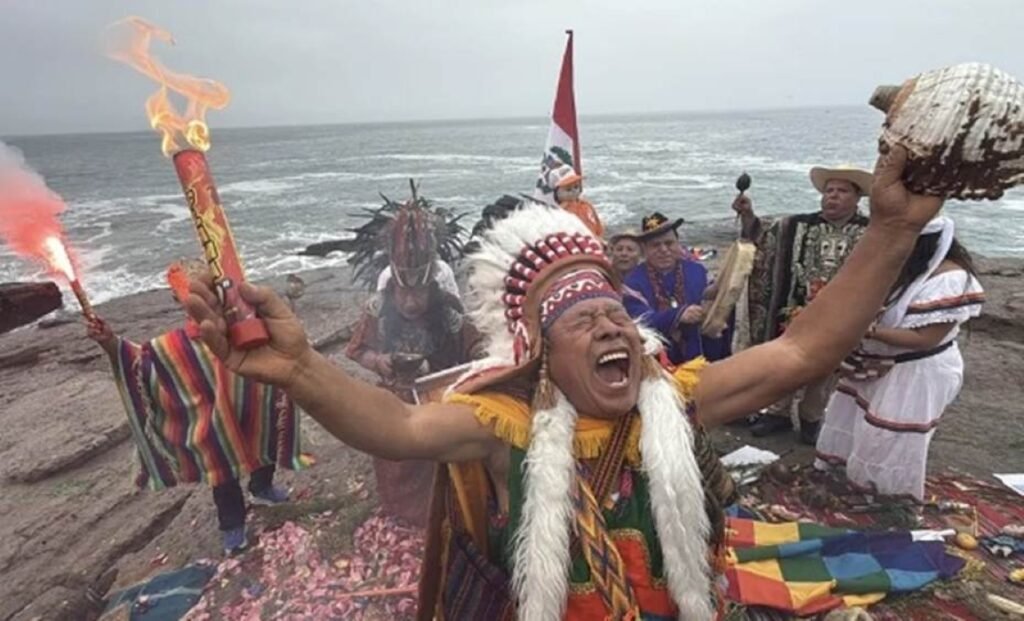
In Peru’s tense runoff week, shamans told EFE they foresee leftist Roberto Sánchez defeating Keiko Fujimori. Still, their seaside ritual revealed something larger: a country where democracy, poverty, and ancestral belief keep arguing over who gets heard next in Lima.
Rituals Beside a Nervous Sea
On a cliff south of Lima, where the Pacific throws its gray breath against the rocks and the capital pretends it can look away from the country behind it, a group of Peruvian shamans laid out the nervous theater of an election.
There were portraits of the two presidential candidates. Roberto Sánchez, the leftist running in the political shadow of former President Pedro Castillo. Keiko Fujimori, the right-wing figure whose surname still opens old wounds and old loyalties in equal measure. There was a black guinea pig, white doves, offerings to the earth and the universe, and a public prediction delivered with the certainty that polls rarely dare to use.
According to EFE, the shamans said Monday that Sánchez would become Peru’s next president in the runoff this Sunday. They also warned that if Fujimori wins, the country could face social unrest. It sounded mystical, yes. But in Peru, mysticism often walks close to politics because the formal institutions have spent years making themselves hard to believe in.
“We have made an offering and ceremony to clear the paths of the two candidates who remain,” Librana Sanadora told EFE. She said that in past elections, they had seen a woman win, but had also sensed that a “black hand” would prevent her from taking office. This time, she said, they see a man ruling.
The phrase was theatrical, but not empty. The “black hand” is not only a spiritual image. It is also a Peruvian political condition. In a country where presidents fall, Congress devours executives, corruption files multiply, and rural voters often feel summoned only when ballots are needed, unseen power is not a superstition. It is a lived suspicion.
Cleofé, a shaman of Amazonian cultures, told EFE that rituals held in the jungle and Andean highlands had pointed in the same direction: Sánchez, the candidate speaking for a wounded left and for Castillo’s abandoned base, would be the next president of Peru.
The ceremony, then, was not just about who might win. It was about who gets to say what Peru is.

A Guinea Pig Reads the Republic
The shamans performed a limpia de cuy negro, rubbing a black guinea pig as part of an ancestral cleansing ritual meant to absorb darkness and purify the candidates’ spirits. Librana Sanadora told EFE they had brought the animal to cleanse each candidate’s heart and mind, so it would take in everything dark.
To some urban readers, especially outside Latin America, the scene may appear folkloric, almost quaint. That is the easy mistake. Ritual in Peru is not decorative. It is political memory in another grammar.
The Andes and Amazon have long carried spiritual systems that survived conquest, church discipline, republican racism, and the smugness of Lima’s elites. When shamans gather before an election, they are not merely predicting a result. They are staging a counter-institution. Their tools are not surveys, party machines, or television panels. Their legitimacy comes from another archive: land, ancestors, illness, harvests, omens, and community fear.
Peru’s modern state has often treated that world as a costume for tourism and a problem when it demands power. The country sells Machu Picchu abroad while leaving many highland and rural communities with weak schools, poor roads, fragile health care, and prices that punish small farmers. It celebrates indigeneity as heritage, then recoils when indigenous or rural Peruvians vote against Lima’s preferred script.
That is why Sánchez’s candidacy, as described by the shamans, carries more than partisan meaning. He is not simply the leftist in a runoff. He is being read as the channel for accumulated resentment from provinces, farming communities, and highland voters who believe the republic has been built over them, not with them.
“The candidate Sánchez has a lot of resentment,” Librana Sanadora told EFE, adding that many presidents had failed to support campesinos and people in the provinces and highlands who want fair payment for their crops. She spoke of poverty, abandonment, and protesters coming to Lima because they feel forgotten.
That resentment should not be romanticized. It can become anger without program, revenge without reform, politics without administration. But ignoring it is worse. Peru has spent years treating rural rage as an eruption rather than a diagnosis. The country is not unstable because people protest. People protest because stability has too often meant silence from the margins.

The Fujimori Name Still Burns
Keiko Fujimori’s presence in any Peruvian runoff brings history into the room before she speaks. For supporters, the Fujimori name evokes order, security, and a hard state capable of defeating chaos. For critics, it evokes authoritarianism, corruption, human rights abuses, and the humiliation of communities treated as expendable in the name of national rescue.
This is the old Latin American bargain, always returning in new clothes: order versus justice, market confidence versus social debt, governability versus memory. Peru knows the bargain too well. So do Chile, Guatemala, El Salvador, Colombia, and Argentina in their own ways. The right promises discipline. The left promises repair. Then power arrives, and both discover that institutions are weaker than speeches.
The shamans’ warning about a Fujimori victory must be understood in that context. Librana Sanadora told EFE that if Fujimori wins a higher percentage, “Sánchez’s people” will come to Lima to defend their rights. She went further, saying that if Keiko arrives, there will be “a total disaster.”
That is not a neutral prediction. It reflects a country where many voters no longer trust the electoral result to settle the political argument. This is Peru’s danger, and Latin America’s too. Democracy can survive ideological division. It cannot easily survive when millions believe the referee, the rules, the parties, and the counting table all belong to someone else.
Peru’s crisis also speaks to the region’s spiritual politics. In much of Latin America, people do not separate the material from the sacred as cleanly as technocrats imagine. A bad harvest, a corrupt Congress, a sick child, a broken promise, and an election can belong to the same moral weather. Shamans, pastors, priests, and popular healers often become interpreters of public life because formal politics speaks in abstractions while people live in consequences.
That does not mean a ritual can predict a presidency. It means the ritual can read the emotional context beneath the ballot.
The data in the notes is not numerical so much as historical. Former President Pedro Castillo was removed after a turbulent term. A Fujimori heir is still powerful enough to reach the final round. A leftist candidate carrying provincial frustration. A group of shamans warns that one outcome may inflame the streets. In Peru, that combination is combustible because the center has stopped holding.
From the cliff, the white doves were released as symbols of peace. It was a tender image, almost too tender for the week ahead. Peru has seen many peace gestures. It needs something harder now: a political pact that does not mock the poor, a state that reaches the highlands before the riot police do, and winners who understand that victory without legitimacy is just another fuse.
The shamans say Sánchez will win. The deeper omen is not about Sánchez at all. It is about Peru still asking, after so many collapsed governments and betrayed hopes, whether democracy can hear the country beyond Lima before the roads fill again.
Also Read:
Latin Museum in Colorado Reclaims America’s Forgotten Frontier Story Now