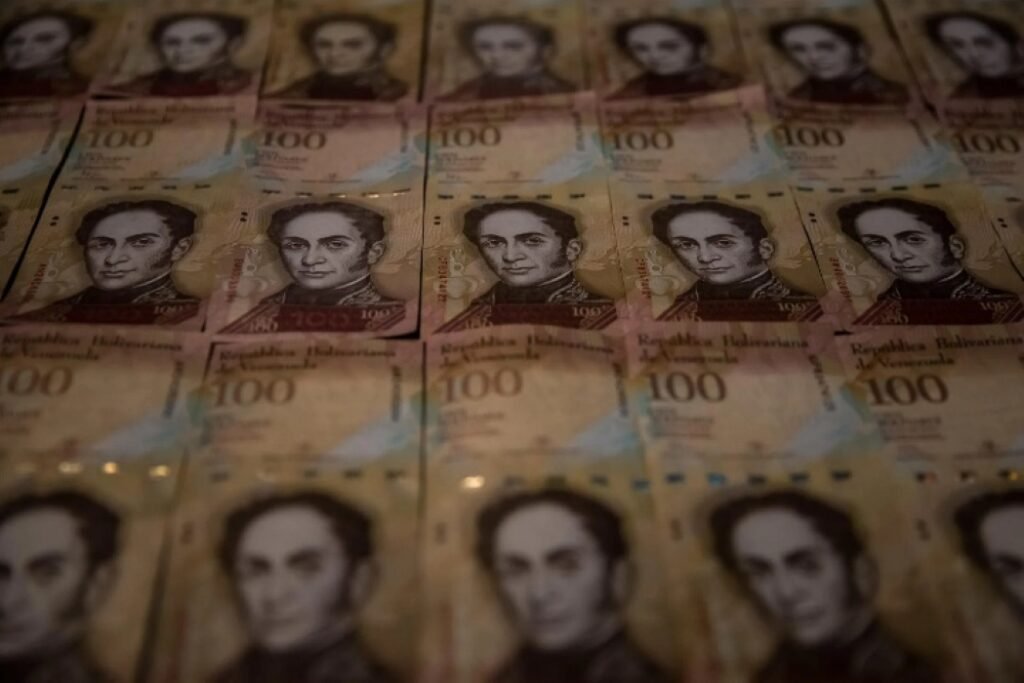
Venezuela’s bolívar is collapsing again, pushing prices higher, wages lower, and families deeper into dollar dependence as retirees protest in Caracas. The government relies on bonuses that soothe hunger today while weakening labor rights for millions of workers tomorrow.
The Price Tag Talks First
In Venezuela, the exchange rate is not a financial abstraction. It is the number whispered before rent, the number checked before a sack of rice, the number that turns a pension into bus fare. By Friday, the last business day of May, the official dollar stood at 549.37 bolívares, up from 301.37 at the start of January, according to data from the Central Bank of Venezuela reported by EFE. That means the dollar surged 82.2 percent in five months, while the bolívar lost 45 percent of its value.
The math is brutal because it is ordinary. In May alone, the dollar rose 12.2 percent from 489.55 bolívares, translating into a 10.8 percent devaluation of the bolívar in just one month. In 2025, the currency had already devalued by 82 percent, sliding from 52 bolívares per dollar to 298.14 bolívares per dollar. A country can call this an exchange adjustment. Households call it shrinking dinner.
From January to April, Venezuela accumulated 90 percent inflation, the BCV reported. That figure does not simply describe prices. It describes time. The worker paid on Monday has less money by Friday. The retiree who delays buying medicine is punished for waiting. The shopkeeper who sells in bolívares and restocks in dollars lives inside a trap set by arithmetic.

Bonuses Are Not Wages
The government’s response has been to pay supplementary bonuses in U.S. dollars. On April 30, Vice President Delcy Rodríguez announced an increase to 240 dollars for workers and 70 dollars for pensioners, EFE reported. On paper, that looks like relief. In practice, unions saw something colder: these payments do not count toward vacation pay, social security contributions, or other formal labor benefits.
That distinction is the heart of the story. A bonus can buy groceries. It cannot rebuild a labor contract. It can quiet one payday and hollow out a lifetime of rights. By keeping the official minimum wage fixed at 130 bolívares since 2022, the state preserves an almost symbolic salary base. At Friday’s exchange rate, that wage equals about 24 U.S. cents. Pensioners receive the same base amount. The bonus becomes the body. The wage becomes a ghost.
Outside the Ministry of Education and the Venezuelan Social Security Institute in central Caracas, more than 100 retirees and pensioners protested Friday, calling for what EFE described as a “dignified income” sufficient to meet basic needs. There is something painfully Latin American in that phrase. Not luxury. Not abundance. Dignity. Enough to eat, travel, pay for pills, and avoid depending on a child abroad or a neighbor with dollars.
Experts cited by EFE warned that the dollar’s rise lifts the cost of goods and services while eroding wages paid in bolívares, especially for public sector workers and some private employees. That warning understates the social split. Venezuela is not simply dollarized. It is unevenly dollarized. People who earn dollars inhabit one country. People who are paid in bolívares inhabit another. They meet at the same checkout counter, then separate at the price tag.

A Sovereignty Problem in Dollars
This is where Venezuela’s currency crisis becomes geopolitical. The bolívar’s weakness is not only a domestic economic failure. It is a quiet transfer of authority. When the dollar becomes the main reference for prices, monetary sovereignty moves out of Caracas and into a global system Venezuela does not control. The U.S. Federal Reserve does not design policy for Venezuelan pensioners, yet its currency increasingly organizes their lives.
For Latin America, that matters because Venezuela has long been more than a country in crisis. It is a symbol, a warning, a partisan weapon, a migration engine, an oil state with broken institutions and regional gravity. Every new exchange-rate jump hardens arguments on both sides of the continent’s ideological divide. The right points to Caracas and says redistribution without discipline ends in ashes. The left answers that sanctions, oil dependence, and financial isolation can suffocate any economy. Ordinary Venezuelans are left carrying both slogans in plastic shopping bags.
The collapse also pressures neighbors. A worker whose salary is worth cents has reasons to leave. A family with a relative abroad depends more heavily on remittances. Border economies absorb informal trade, cheap labor, and currency arbitrage. Governments from the Andes to the Caribbean must read Venezuela’s inflation not as a distant spreadsheet but as a regional weather system.
The bitter irony is historical. The bolívar is named after Simón Bolívar, the liberator whose dream was continental sovereignty. Today, Venezuelans often trust the dollar more than the currency bearing his name. That is not just economics. It is a cultural fracture, the kind Latin America knows well, where national myths remain grand while daily life is negotiated in foreign money.
The May numbers say the crisis is still moving. Not exploding all at once, perhaps, but grinding steadily through paychecks, pensions, and state legitimacy. Bonuses may prevent immediate collapse for some households. Still, they also reveal the government’s deeper bind: it cannot restore confidence in the bolívar, cannot fully abandon it, and cannot ask workers to believe in a salary worth less than a quarter. That leaves Venezuela living between two currencies and two truths. The state prints one. The other is believed.
Also Read:
Mexico Turns World Cup Mobility Into a Billion-Dollar Test