Category: Home

  • Venezuelan Opposition Voices Reappear as Fear Loosens Under Washington’s Shadow

    Venezuelan Opposition Voices Reappear as Fear Loosens Under Washington’s Shadow


    In Caracas, a bearded former governor records himself outside a notorious prison and says the quiet part aloud. Since Maduro’s ouster by the U.S., critics are testing speech again, while an amnesty promise raises a more complex question: who controls what comes next?

    Outside Helicoide, a Man Risks His Name Again

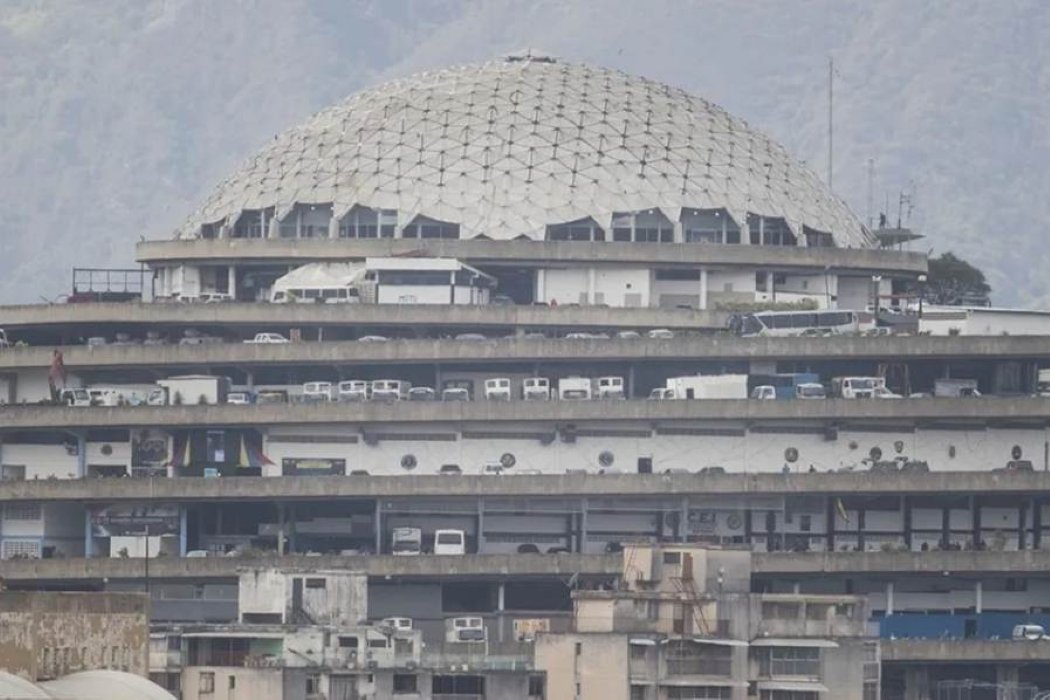
    The spiral of Helicoide sits in the capital like a building that never stopped listening. Out on the street, Andrés Velásquez holds up a phone and films himself with the kind of caution you can see in a person’s shoulders. His beard is new, bushy enough to change the way his face reads on camera, and that detail matters because the note of this moment is recognition and risk. He is outside the place that has haunted opponents for years, and he is asking for something that once could have been treated as a provocation: the release of political prisoners, all of them.

    “We must dismantle the entire repressive apparatus in the hands of the state,” Velásquez said in the video. “Venezuela will be free!”

    The trouble is not that Venezuelans suddenly forgot fear. The problem is that fear has become a daily administrative fact, the kind you plan around like traffic or power cuts, and now people are trying to live without it while the state still remains in the same hands, highlighting the ongoing barriers and the resilience needed to cope with them.

    Velásquez did not stick around to become one more government critic jailed after the 2024 presidential election. The notes say he crisscrossed the country campaigning for Nicolás Maduro’s opponent in that disputed race, then grew a thick beard, sent his children into exile, and avoided public events that could expose him to arrest. That is how private survival looks in political terms. You cut your public life into smaller and smaller pieces until you can pass as ordinary.

    After Maduro’s overthrow by the U.S., he began to speak again. First in a video on January 19 supporting Maduro’s removal while calling for new elections, then days later outside Helicoide. It is the same act twice, in slightly different keys. Saying the country needs elections. Saying the prisons need to open and saying it where people can see.

    The notes describe prominent critics emerging from hiding to test the limits of speech after years of silence, inspiring hope and resilience in the audience. Families of jailed activists are protesting outside prisons. People freed under the new climate are defying gag orders that are usually imposed as a condition of release. Media outlets are reopening airwaves to voices banished in recent years. It is not a parade. It is more like a cautious reoccupation of public space, one small act at a time.
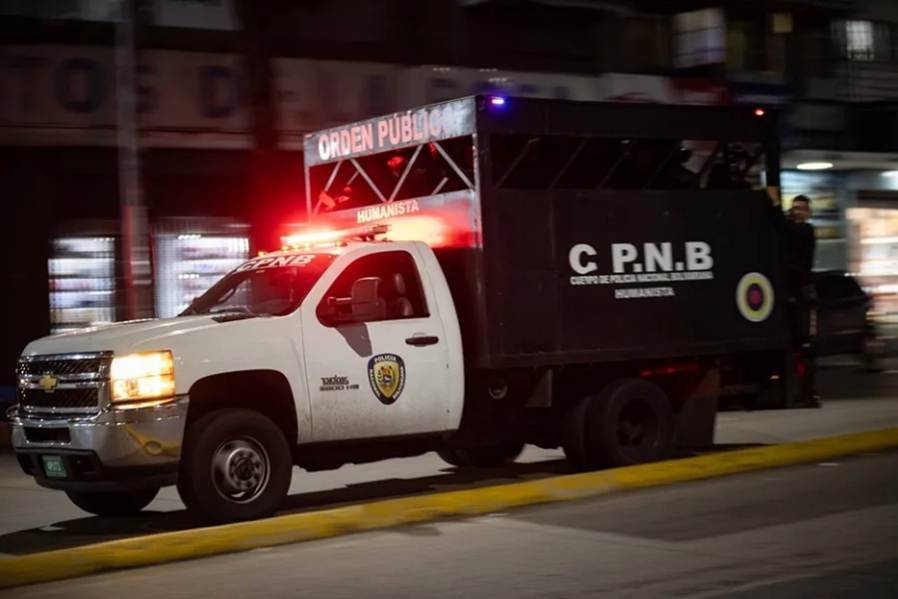
    A patrol of the Bolivarian National Police entering El Helicoide, in Caracas, Venezuela. EFE/ Ronald Peña

    A Small Opening, With a Big Hand on the Door

    Velásquez likened what is happening to glasnost, the Soviet-era policy of openness that preceded the collapse, but this opening is heavily influenced by external actors like the Trump administration, which the notes say has used financial incentives and threats of additional military strikes to carry out the president’s pledge to ‘run’ Venezuela from Washington.

    The wager here is that loosened repression might lead to a genuine civic opening. The fear is that loosened repression is simply tactical. The ultimate goal of the Trump administration’s maneuvers is still unknown, the notes say, even as the White House has praised acting President Delcy Rodríguez’s willingness to partner with the U.S. to open Venezuela’s oil reserves, combat criminal networks, and curb the influence of Iran and Russia. Opponents worry that elections and a restoration of democracy could be indefinitely delayed.

    Last week, Rodríguez, a longtime Maduro ally, announced plans for a general amnesty that could lead to the release of hundreds of opposition leaders, journalists, and human rights activists detained for political reasons. She also announced the shutdown of Helicoide, promising to transform the building into a sports and cultural complex for police and residents of the surrounding hillside slums.

    “May this law serve to heal the wounds left by the political confrontation fueled by violence and extremism,” Rodríguez said at the event, she told AP.

    Those are the words. On the ground, the questions are procedural and blunt. Who decides who counts as political? Who decides who is forgiven? Who decides what is forgotten? When the state offers amnesty without a credible change in the institutions that carried out repression, it can read like mercy and leverage at the same time, underscoring the need for genuine reform to build trust and hope.

    Pedro Vaca, the top freedom of expression expert for the Inter-American Commission on Human Rights, said the gestures are not enough without an independent judiciary and law enforcement.

    “Venezuela’s civic space is still a desert,” Vaca said, he told AP. “The few critical voices emerging are seeds breaking through hardened ground, surviving not because freedom exists, but because repression has loosened while remaining ever-present. Let us be clear: this does not mark a democratic turning point.”

    That is the sober version of the scene outside Helicoide. A man speaks, a crowd gathers, a camera records. And somewhere behind the scenes, the structures that once punished speech are still intact.
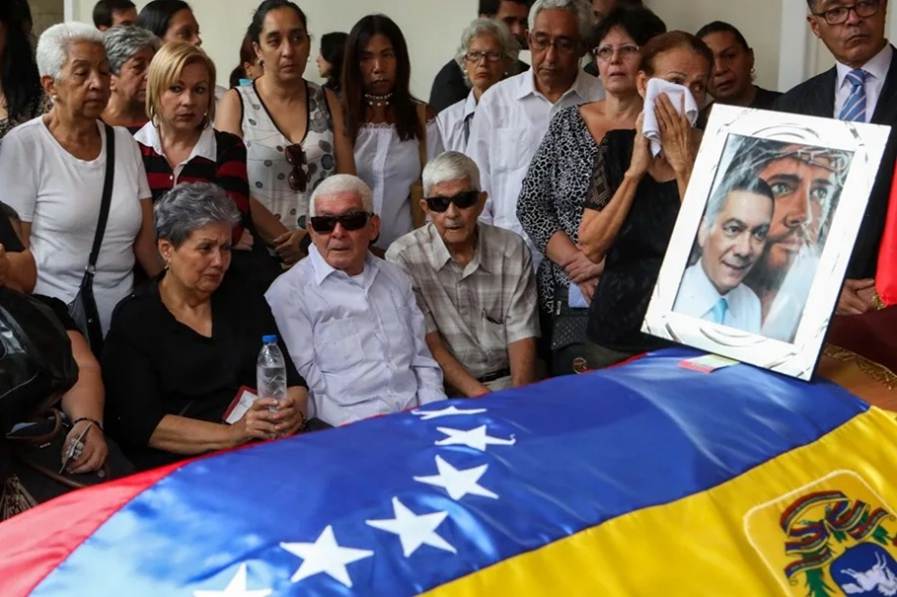
    Tribute held for councilman Fernando Albán, who died at El Helicoide in Caracas, Venezuela. EFE/Cristian Hernández

    Airwaves Crack Open as Old Reflexes Return

    The notes trace how self-censorship deepened after the July 2024 election, when Maduro launched a wave of repression marked by thousands of arbitrary detentions as he disavowed evidence showing he had lost to opposition candidate Edmundo González by more than two-to-one. Dissidents went into hiding. Independent outlets softened already cautious coverage for fear of being unplugged.

    Now, broadcasters are moving again.

    Venevision has reopened its airwaves to anti-government voices and has been covering opposition leader Maria Corina Machado’s moves in Washington since Maduro’s capture. Globovision invited back commentator Vladimir Villegas for the first time in years. Villegas was known for navigating the restricted space by keeping hardened opponents off his show. The program was abruptly canceled in 2020 after he criticized Maduro for forcing DirecTV to carry state TV in violation of U.S. sanctions, a move that led DirecTV to abandon the country along with its international news offerings. In other words, media policy became a household inconvenience. A political decision, felt as missing channels, missing windows.

    Rodríguez has not embraced meaningful public debate beyond announcing an advisory commission on political co-existence to be headed by Villegas’ brother, Culture Minister Ernesto Villegas. And already, some allies appear intent on shutting down criticism. Authorities have yet to restore full access to X, which Maduro blocked after Elon Musk accused him of stealing the 2024 vote.

    When Venevision covered Machado meeting Secretary of State Marco Rubio, Interior Minister Diosdado Cabello accused the media of playing into a plot by the Nobel Prize winner to sow chaos. “Without media attention, her notoriety fades away. Without headlines, she disappears,” Cabello warned on state TV, the notes report.

    Yet even state TV is showing cracks. The notes describe Rodríguez touring a university campus in Caracas and being confronted by a small group of student protesters. State TV did not mention the demands, but it aired the scene of Rodríguez calmly stepping away from her security entourage to “exchange ideas” with what the broadcaster called activists from “extremist parties.” A few weeks earlier, the notes say, that kind of televised friction would have been unthinkable under Maduro.

    Velásquez, in an interview, said he will continue to push the envelope while remaining wary because the repressive apparatus remains under Rodríguez and her allies. “We must continue winning back lost terrain, challenging power. An opportunity has opened up, and we can’t let it close again,” he said, he told AP. “But the biggest obstacle we have to overcome is fear.”

    In the coming weeks, he hopes to organize a public event with other opponents who have recently come out of hiding, including Delsa Solórzano, who resurfaced at a rare press conference and described living clandestinely without sunlight. “I didn’t hide because I committed any crime but because here fighting for freedom became an extremely high risk to your life, your freedom, and your safety,” she said, she told AP.

    And then there is the pressure from below, from people who paid the cost directly. Journalist and political activist Carlos Julio Rojas spent 638 days in prison, he said, describing handcuffs, denial of sunlight, and confinement in a tiny cell without a bed. Released last month, he said he was instructed never to discuss the abuse. “For me, not speaking meant I still felt imprisoned. Not speaking was a form of torture,” Rojas said, he told AP. “So, today, I decided to remove the gag and speak.”

    What stays with you is how quickly silence turns from protection into a cage. What stays with you is the idea that a country can reopen its mouth while still tasting the fear that closed it.

    Adapted from original report by The Associated Press.

    Also Read:
    Colombian Plane Crash Exposes the Hidden Cost of Regional Connectivity



    Source link

  • A Love Letter To Black Women And Children – Black History Month 2026

    A Love Letter To Black Women And Children – Black History Month 2026


    By Nyan Reynolds

    News Americas, NEW YORK, NY, Thurs. Feb. 5, 2026: There are writers who explain the world, and then there are writers who teach you how to survive inside it. For me, James Baldwin has always been the latter. His words did not merely interpret history. They warned us. They prepared us. They loved us fiercely enough to tell the truth.

    A Love Letter to Black Women and Children - Black History Month 2026
    A Love Letter to Black Women and Children – Black History Month 2026

    Baldwin gave language to a generation that had been told its suffering was imaginary and its dignity negotiable. Because of voices like his, I can walk my communities and drink water where fountains once had barriers. I can enter stores without being forced to wait in lines of humiliation. I can sit in restaurants and be served as a human being. These are not small victories. They are moral inheritances.

    Yet, there is a part of Baldwin’s story that still demands to be told, especially during Black History Month in 2026. Baldwin did not only write about laws and protests. He wrote about Black children. About their right to grow up without being spiritually crushed by a society that refuses to see them as innocent. One of his most profound offerings was his 1962 essay, My Dungeon Shook, a letter to his nephew written on the hundredth anniversary of emancipation.

    In that letter, Baldwin confessed: “I have drafted this letter five times and torn it up five times.” He could not escape the face of his nephew, which was also the face of his brother, and the face of his father, and the face of every Black boy shaped by fear before he ever learned joy. Baldwin described the boy as tough, dark, vulnerable, and moody, sounding truculent so that no one would think he was soft. Baldwin knew the armor Black boys are forced to wear. He knew how early it was given to them.

    He also knew what happens when society convinces a man that he is what it says he is. Baldwin wrote of his own father, defeated long before death, because at the bottom of his heart he believed the lie that certain people told about him. That belief made him bitter. Holy in pain. Rigid in sorrow.

    Baldwin’s letter was never meant to be sealed in history. It was meant to be read again and again by Black mothers and Black children whenever the world tried to tell them who they were.

    And here we are, in 2026, still needing that letter.

    The names alone testify that Baldwin’s warning was not outdated. Amadou Diallo. Sean Bell. Tamir Rice. Eric Garner. Michael Brown. Alton Sterling. Philando Castile. Breonna Taylor. George Floyd. Elijah McClain. These are not simply victims of incidents. They are chapters in an unfinished American sentence. They are reminders that the description Baldwin gave, tough, dark, vulnerable, moody, still clings to Black bodies in the eyes of systems built on fear.

    Many of these men and women died in the arms of institutions that saw them not as children, not as sons or daughters, but as threats. Just as Baldwin feared, so many families did not get to see their loved ones grow old. Their lives were interrupted by the same lie Baldwin named more than sixty years ago.

    What Do We Have In 2026?

    We have a moral struggle that never concluded. We have progress that looks impressive from a distance but fragile up close. We have Black people in leadership, Black people with wealth, Black people with education. These are real achievements. But opportunity does not equal safety. Opportunity does not equal justice. Opportunity does not erase fear.

    Progress is not a cover for what happens beneath the surface.

    This is where this love letter must be written, not to deny growth, but to refuse the lie that growth means arrival. This letter is to Black women and Black children, because Baldwin always understood that the burden of history sits heavily on their bodies first.

    To the Black woman, mother, aunt, grandmother, sister, who raises a child in a world that promises equality but practices suspicion, this letter says: your love is revolutionary. Your fear is not weakness. It is awareness shaped by history. You carry knowledge that textbooks avoid and politicians dilute. You know that a glittering society can still cast deadly shadows.

    It is horrifying to admit that after all the sacrifices made, after marches, after laws, after speeches, there is still a chance that your son may not reach adulthood, that your daughter may be seen as a threat rather than a child. The structures that once blocked Baldwin, Medgar Evers, and so many others have not vanished. They have learned to wear professional language and neutral uniforms.

    Some will ask, what is it that Black people are doing to move forward? They say opportunities exist now. They say the doors are open. But opening doors does not mean the house is safe. A seat at the table does not mean the knives are gone. Opportunity without justice is simply another test of endurance.

    This is why Baldwin still speaks. His letter screams into Black History Month because it reminds us that history is not a museum. It is a mirror.

    We must be honest with our children about the world they inherit. Not to frighten them, but to fortify them. Baldwin did not write to make his nephew despair. He wrote to make himself awake. He told him that the world would try to define him, but that he must not accept the definition. That love was the key, but not sentimental love. A disciplined love. A love that tells the truth.

    This love letter in 2026 says to Black women: hug your children fiercely but also teach them what the world hides beneath its shine. Teach them that their lives matter even when the news does not show it. Teach them that fear is learned, but dignity is chosen. Teach them that their ancestors survived systems that were far more explicit in their cruelty, and that survival itself is an inheritance.

    It is not enough to celebrate Black excellence while ignoring Black grief. It is not enough to parade progress while counting funerals. Black History Month cannot only be a gallery of triumph. It must also be a classroom of warning.

    Elijah McClain was on his way home listening to music. Tamir Rice was playing. Eric Garner said he could not breathe. George Floyd called for his mother. These moments reveal not only tragedy but vulnerability. They reveal how quickly innocence is erased when Black skin enters the equation. Baldwin warned that Black children would be forced to grow up too soon. He warned that they would be asked to be strong before being allowed to be young.

    This letter says: let us not pretend the danger is gone. Let us not confuse representation with redemption. Let us not treat history as something that happened instead of something that continues.

    To Black children, this letter says: you are not what fear says you are. You are not the story written about you by strangers. You are the story written by your ancestors who endured chains and still sang. You are the story written by mothers who held babies while laws denied their humanity. You are the story Baldwin tried to protect when he wrote to his nephew.

    Your softness is not weakness; your joy is not naïveté. Your vulnerability is not a liability. It is proof that the world has not yet broken you.

    But you must know the truth. You must learn the shadows as well as the light. Not because you are doomed, but because you are deserving of clarity. Baldwin believed that the greatest crime was not hatred alone, but the lie; the lie that tells a child they are inferior; the lie that tells a nation it is innocent.

    This is why this love letter must be scathing and tender at once. It must accuse injustice while embracing hope. It must say plainly that the journey continues and that pretending otherwise is itself a betrayal of those who died believing in something better.

    Black History Month in 2026 is not just a commemoration. It is a conversation with Baldwin’s ghost. It is a question he asked long ago: can America afford to be honest with itself? Can it look at the names on death certificates and admit that emancipation did not end the struggle for dignity?

    For the Black woman who wakes up every day and sends her child into a world she cannot fully protect them from, this letter says: you are not alone in your fear. History stands with you. Baldwin stands with you. Every ancestor who prayed in silence stands with you.

    Read Baldwin

    Read Baldwin to your children. Not because he is famous, but because he is faithful to the truth. Remind them that they are loved deeply and warned honestly. Remind them that their existence is not an apology. Remind them that their lives are not experiments in tolerance.

    Progress is real, but it is not complete. Representation is visible, but it is not immunity. Justice is spoken of, but it is not guaranteed.

    This is the moral responsibility Baldwin gave us. To refuse despair. To refuse denial; to refuse the lie that time alone heals injustice. Healing requires courage. It requires memory. It requires love strong enough to confront cruelty without becoming it.

    So, this love letter to Black women and children in Black History Month 2026 says simply this: the journey continues, but so does your worth. Hug your children and teach them the truth. Teach them that the past speaks not to chain them, but to guide them. Teach them that Baldwin’s letter was not an ending, but a beginning.

    And when the world feels glittering and safe, remind them of the shadows, not to frighten them, but to sharpen their vision. Because survival is not the final goal. Freedom of spirit is.

    Baldwin once wrote that love takes off the masks that we fear we cannot live without and know we cannot live within. This letter takes off the mask of comfort and reveals the work that remains. It tells Black women and children that their lives are sacred in a society that still struggles to admit it.

    Black History Month 2026

    Black History Month is not only about what we were. It is about what we refuse to become. It is about choosing dignity over denial, memory over myth, and love over fear.

    And so, this letter ends where Baldwin began, with a child’s face. A face that carries the past and the future at once. A face that must be protected not only by laws, but by truth. A face that deserves to grow old in a country brave enough to see it fully.

    That is the unfinished promise. That is the work; that is the love.

    EDITOR’S NOTE: Nyan Reynolds is a U.S. Army veteran and published author whose novels and cultural works draw from his Jamaican heritage, military service, and life experiences. His writing blends storytelling, resilience, and heritage to inspire readers.  


    Source link

  • Argentine scientists film rare “giant phantom jelly” measuring about 11 meters in the South Atlantic — MercoPress

    Argentine scientists film rare “giant phantom jelly” measuring about 11 meters in the South Atlantic — MercoPress


    Argentine scientists film rare “giant phantom jelly” measuring about 11 meters in the South Atlantic

    Thursday, February 5th 2026 – 15:14 UTC


    Researchers estimated the specimen’s total length at roughly 11 meters, a scale described in outreach terms as comparable to a school bus
    Researchers estimated the specimen’s total length at roughly 11 meters, a scale described in outreach terms as comparable to a school bus

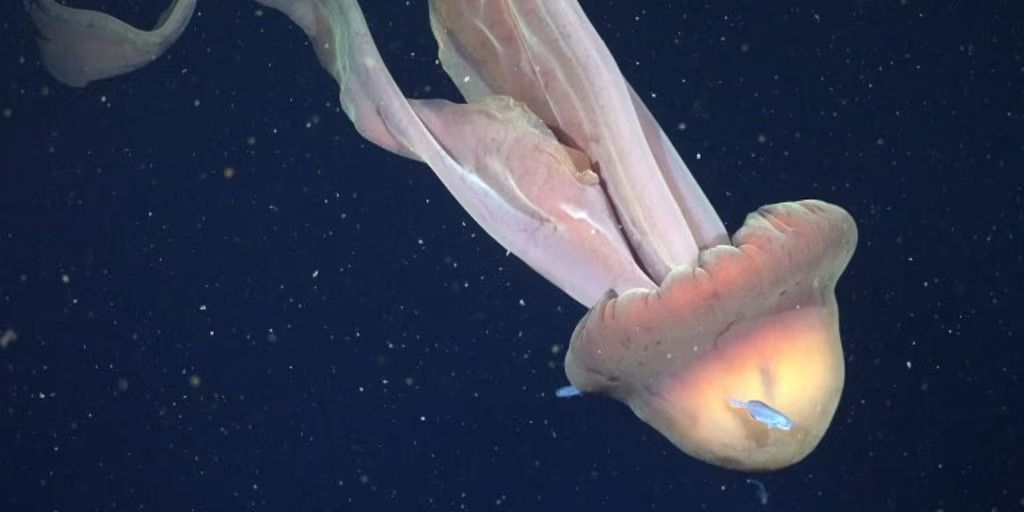
    An Argentine-led deep-sea expedition has recorded rare footage of Stygiomedusa gigantea—the so-called giant phantom jellyfish—in waters off Argentina, offering an unusual look at a species seldom observed alive in its natural environment. The animal was filmed at around 250 meters depth by the remotely operated vehicle SuBastian during the “Vida en los extremos” campaign aboard the research vessel R/V Falkor (too), involving scientists from CONICET and the University of Buenos Aires (UBA).

    Researchers estimated the specimen’s total length at roughly 11 meters, a scale described in outreach terms as comparable to a school bus. Unlike many jellyfish, S. gigantea lacks stinging tentacles and instead uses four long oral arms to capture prey such as plankton and small fish—features that make the encounter visually striking when illuminated by deep-sea cameras.

    “We were not expecting to see this level of biodiversity in the Argentine deep sea,” said expedition chief scientist María Emilia Bravo (UBA–CONICET), referring to the broader set of observations made along the continental margin. The mission’s summary also reported 28 organisms suspected to be new species, alongside extensive coral and seep habitats documented across multiple dive sites.

    Beyond the jellyfish footage, the expedition reported what it described as the largest known Bathelia candida coral reef and the country’s first documented deep-water whale fall, an event where a carcass becomes a localized food source that can sustain deep-sea communities for extended periods.


    Source link

  • Venezuela detains Alex Saab in joint operation with United States — MercoPress

    Venezuela detains Alex Saab in joint operation with United States — MercoPress


    Venezuela detains Alex Saab in joint operation with United States

    Thursday, February 5th 2026 – 05:39 UTC


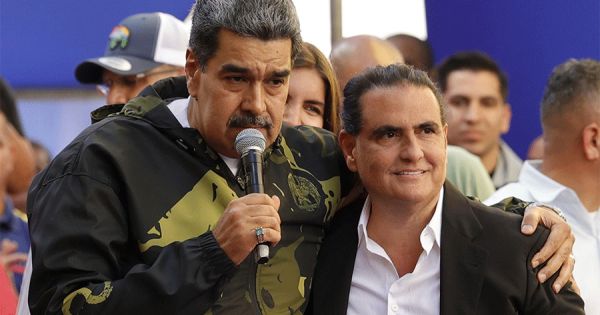
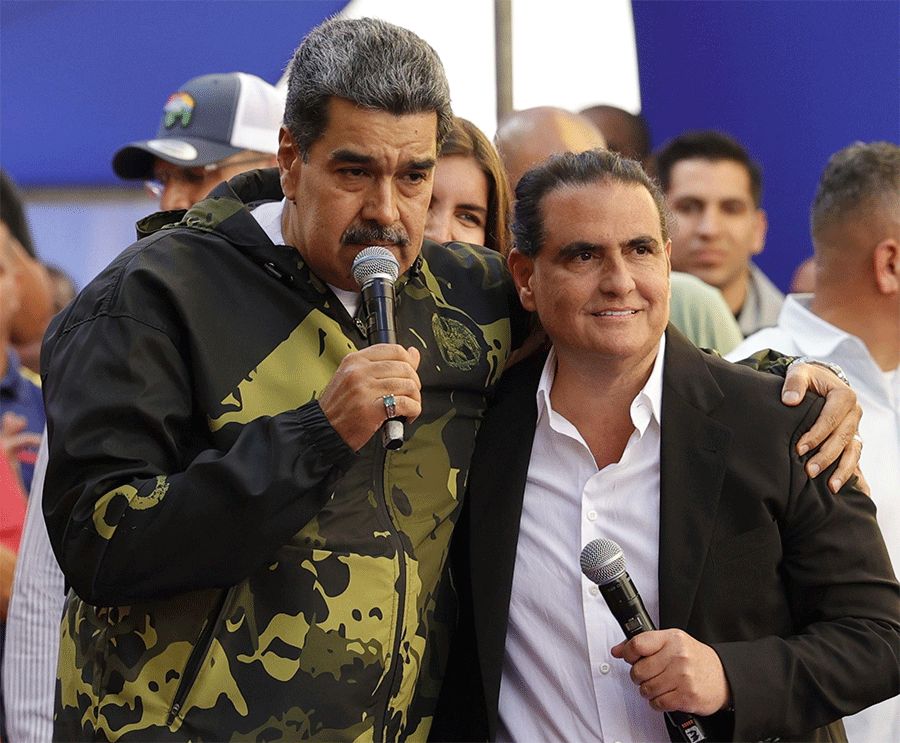
    Colombian-Venezuelan businessman Alex Saab — long portrayed by U.S. authorities as a key financial operator for Chavismo and a former Venezuelan industry minister — was detained in Caracas early Wednesday in what Colombian media described as a joint operation involving Venezuela’s intelligence service (SEBIN) and the FBI. Venezuela’s government had not issued an official confirmation by the time of publication.

     A U.S. official told Reuters under anonymity that Saab was arrested “as part of a joint operation” between U.S. and Venezuelan authorities and said he is “expected to be extradited to the U.S. in the coming days.”

    Caracol Radio reported Saab was seized around 2:30 a.m. in the upscale Cerro Verde area of Caracas and transferred to the Helicoide detention complex. The same reports said businessman Raúl Gorrín — owner of Globovisión and sanctioned by the U.S. Treasury — was also detained in the operation. Regional outlets echoed those details, though independent confirmation on the Venezuelan side remains limited.

    The accounts were swiftly contested. Reuters reported that a man cited by Colombia’s El Espectador as Saab’s lawyer, Luigi Giuliano, denied the arrest as “fake news,” while pro-government journalists posted denials on social media. Reuters also said Venezuela’s communications ministry did not respond to requests for comment, and Globovisión did not immediately respond to inquiries.

    If extradited, Saab would return to a case that has been central to U.S. efforts against corruption networks linked to Venezuela’s leadership. U.S. prosecutors have accused him of laundering money and facilitating bribery schemes connected to state-controlled exchange mechanisms and major government contracts. Saab was arrested in 2020 in Cape Verde on a U.S. warrant and later held in the United States for more than three years before being granted clemency as part of a prisoner exchange.

    That 2023 swap underscored both his political value to Caracas and Washington’s legal interest in his alleged financial networks. The Associated Press reported at the time that Saab’s release formed part of a deal tied to freeing Americans jailed in Venezuela.


    Source link

  • Pope Leo XIV set to visit Peru later in 2026, bishops say, as planning advances — MercoPress

    Pope Leo XIV set to visit Peru later in 2026, bishops say, as planning advances — MercoPress


    Pope Leo XIV set to visit Peru later in 2026, bishops say, as planning advances

    Thursday, February 5th 2026 – 05:41 UTC


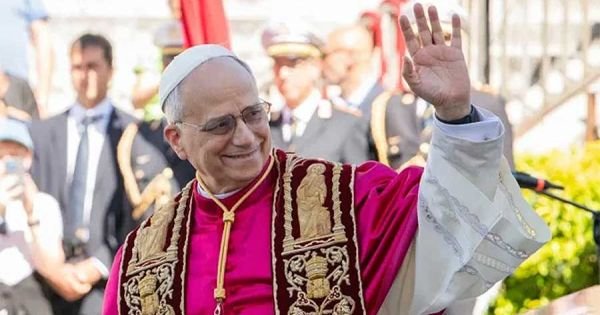
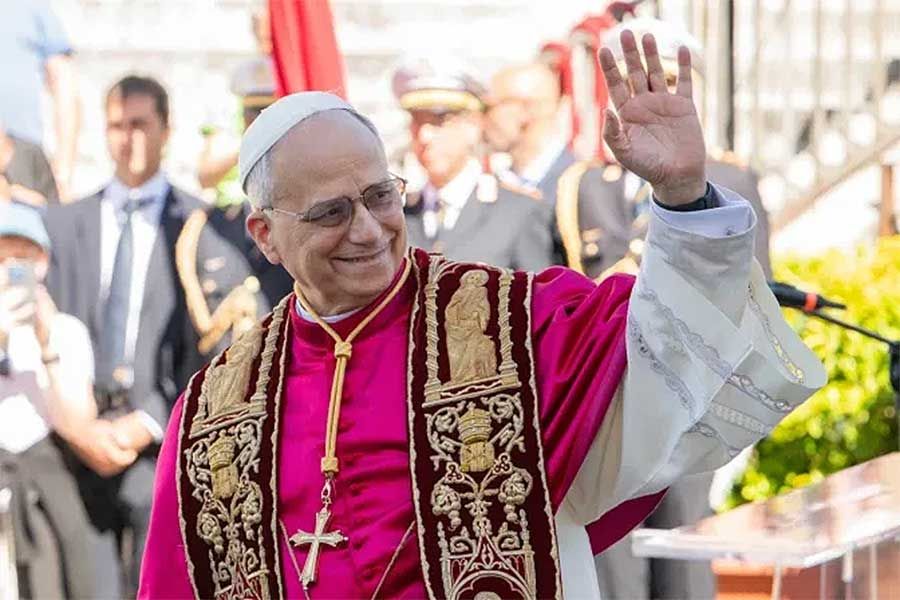
    Peru’s Catholic bishops say preparations are under way for Pope Leo XIV to travel to Peru in November or the first week of December, a trip that would take the first U.S.-born pontiff back to a country where he served as a bishop and later obtained Peruvian citizenship.

    Bishop Carlos García Camader, president of the Peruvian Bishops’ Conference, told a press briefing in Lima it was “very probable” the visit would take place in that window, putting the chances at “80%.” He said Leo had repeatedly expressed a desire to return.

    The Vatican has not published a final schedule, but the push reflects Leo’s unusual personal history in Peru. Born Robert Francis Prevost in Chicago, he spent decades in the country as an Augustinian missionary and later as bishop in Chiclayo. Residents in northern Peru remember him for hands-on pastoral work—driving to flooded areas, supporting relief efforts during crises, and keeping close ties with local clergy and parishioners.

    Momentum for the trip has grown after a high-profile series of meetings in Rome. The pope received Peru’s bishops during their “ad limina” visit and, according to Vatican sources, highlighted his bond with the country. Vatican News reported Leo told them that Peru holds “a special place” in his heart, recalling shared “joys and hardships” and the faith of ordinary Peruvians.

    The visit preparations also featured symbolic gestures: a Marian mosaic and an image of St. Rose of Lima—presented by the Peruvian delegation—were installed in the Vatican Gardens during a ceremony that Peruvian church leaders cast as a sign of continuity between Leo’s past ministry and his new global role.

    Peru’s foreign ministry has publicly cited an expectation that any papal trip could take place toward the end of 2026, potentially after Peru’s April 2026 general election, adding a political-calendar constraint to the Vatican’s complex travel planning.

    Leo has floated the idea of a broader Latin America itinerary—mentioning Peru, Argentina and Uruguay—as part of travel plans still taking shape early in his pontificate. For Peru, bishops and officials frame the potential visit as both a major pastoral event and a rare moment of international attention around a pope widely seen domestically as “Peruvian by vocation,” after years of ministry and formal naturalization.


    Source link

  • Argentina, US set to stage ‘Atlantic Dagger’ in high-profile special forces drill — MercoPress

    Argentina, US set to stage ‘Atlantic Dagger’ in high-profile special forces drill — MercoPress


    Argentina, US set to stage ‘Atlantic Dagger’ in high-profile special forces drill

    Thursday, February 5th 2026 – 12:34 UTC


    The same report said US participants are expected to include Army Green Berets, elements of the Air Force Special Operations Command, and potentially MARSOC units
    The same report said US participants are expected to include Army Green Berets, elements of the Air Force Special Operations Command, and potentially MARSOC units

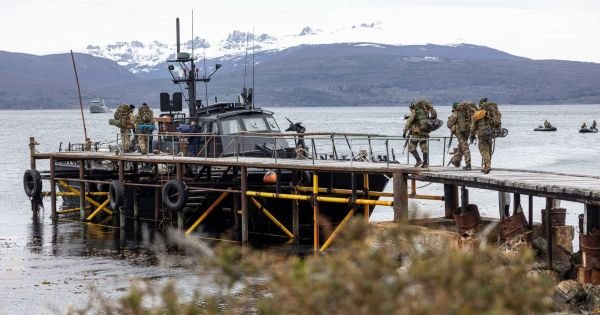
    Argentina and the United States are finalizing plans for “Daga Atlántica” (Atlantic Dagger), a joint special operations exercise expected to become one of the most politically significant bilateral defense activities in recent years—aimed at boosting interoperability, shared procedures and combined planning.

    According to Infobae, two senior sources in Argentina’s presidential palace said the exercise is penciled in for 6 April, while the exact location remains undisclosed for operational reasons. The same report said US participants are expected to include Army Green Berets, elements of the Air Force Special Operations Command, and potentially MARSOC units.

    The drill fits into a cooperation track that Buenos Aires has been formalizing since 2025. In a government release on bilateral coordination, Argentina said its Joint Special Operations Command and the US special operations component were strengthening ties to improve coordination, training and procedures—part of a broader push to institutionalize operational exchanges.

    Local business daily Ámbito Financiero previously reported that Argentine and US commands had been working on the exercise as a complex special forces training cycle designed to refine coordination across multiple units operating simultaneously at high tempo.

    While official statements have not identified the Argentine units involved, the format is consistent with SOF exercises focused on combined planning, communications, doctrine alignment and standard operating procedures. A 2025 Argentine parliamentary document described “DAGA ATLÁNTICA” as a joint-combined special operations exercise intended to build experience in the planning and synchronisation of such missions.

    Atlantic Dagger also comes against the backdrop of a broader political and military realignment between Buenos Aires and Washington under President Javier Milei.

    Beyond training, defence cooperation has included modernisation and procurement narratives. In 2024, AP reported on Argentina’s push to deepen Western defence ties—alongside moves to modernise capabilities, including the F-16 acquisition.

    For now, neither government has issued a detailed public schedule for Atlantic Dagger. Officials on the Argentine side have stressed that the core value lies less in spectacle than in interoperability: aligning tactics, techniques, procedures and command-and-control standards, while signalling a more structured security partnership between the two countries.


    Source link

  • Pope Leo XIV set to visit Peru later in 2026, bishops say, as planning advances — MercoPress

    Pope Leo XIV set to visit Peru later in 2026, bishops say, as planning advances — MercoPress


    Pope Leo XIV set to visit Peru later in 2026, bishops say, as planning advances

    Thursday, February 5th 2026 – 05:03 UTC


    Peru’s Catholic bishops say preparations are under way for Pope Leo XIV to travel to Peru in November or the first week of December, a trip that would take the first U.S.-born pontiff back to a country where he served as a bishop and later obtained Peruvian citizenship.

    Bishop Carlos García Camader, president of the Peruvian Bishops’ Conference, told a press briefing in Lima it was “very probable” the visit would take place in that window, putting the chances at “80%.” He said Leo had repeatedly expressed a desire to return.

    The Vatican has not published a final schedule, but the push reflects Leo’s unusual personal history in Peru. Born Robert Francis Prevost in Chicago, he spent decades in the country as an Augustinian missionary and later as bishop in Chiclayo. Residents in northern Peru remember him for hands-on pastoral work—driving to flooded areas, supporting relief efforts during crises, and keeping close ties with local clergy and parishioners.

    Momentum for the trip has grown after a high-profile series of meetings in Rome. The pope received Peru’s bishops during their “ad limina” visit and, according to Vatican sources, highlighted his bond with the country. Vatican News reported Leo told them that Peru holds “a special place” in his heart, recalling shared “joys and hardships” and the faith of ordinary Peruvians.

    The visit preparations also featured symbolic gestures: a Marian mosaic and an image of St. Rose of Lima—presented by the Peruvian delegation—were installed in the Vatican Gardens during a ceremony that Peruvian church leaders cast as a sign of continuity between Leo’s past ministry and his new global role.

    Peru’s foreign ministry has publicly cited an expectation that any papal trip could take place toward the end of 2026, potentially after Peru’s April 2026 general election, adding a political-calendar constraint to the Vatican’s complex travel planning.

    Leo has floated the idea of a broader Latin America itinerary—mentioning Peru, Argentina and Uruguay—as part of travel plans still taking shape early in his pontificate. For Peru, bishops and officials frame the potential visit as both a major pastoral event and a rare moment of international attention around a pope widely seen domestically as “Peruvian by vocation,” after years of ministry and formal naturalization.


    Source link

  • Lula leads first-round scenarios but faces tighter runoffs, poll suggests — MercoPress

    Lula leads first-round scenarios but faces tighter runoffs, poll suggests — MercoPress


    Brazil: Lula leads first-round scenarios but faces tighter runoffs, poll suggests

    Thursday, February 5th 2026 – 09:23 UTC


    The poll also captures a polarized electorate with meaningful fluidity. While 62% said their vote is already decided, 38% said they could still change their mind
    The poll also captures a polarized electorate with meaningful fluidity. While 62% said their vote is already decided, 38% said they could still change their mind

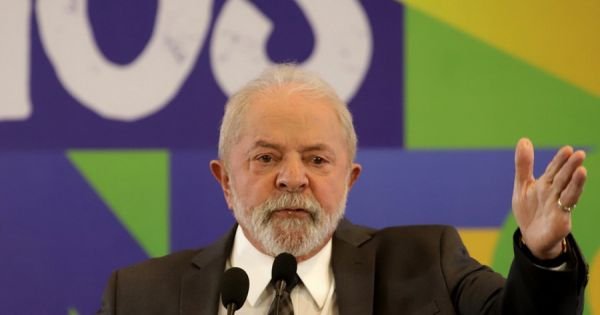
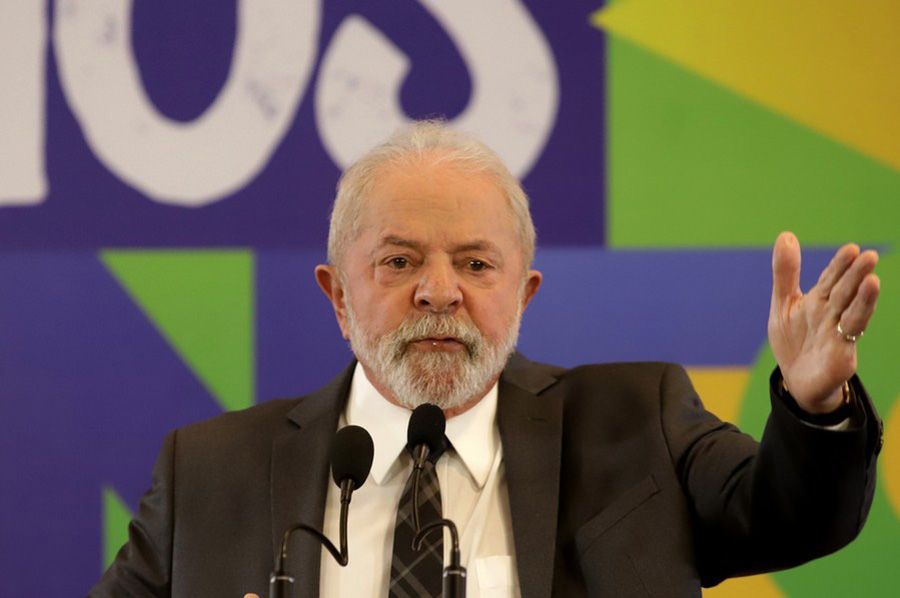
    Brazilian President Luiz Inácio Lula da Silva remains the front-runner across all first-round matchups for Brazil’s 4 October presidential election, according to a new survey by Instituto Ideia published by digital outlet Canal Meio.

    The poll also indicates Lula would still edge potential opponents in a second round on 25 October, but by margins that sit within the survey’s error band.

    In the first-round simulations highlighted by Meio, Lula polls around 39%–40%, followed by names linked to Jair Bolsonaro’s political field: Senator Flávio Bolsonaro, former first lady Michelle Bolsonaro, and São Paulo Governor Tarcísio de Freitas, generally ranging between 32% and 35% depending on the lineup tested. Other center-right figures — including PSD governors Ratinho Júnior and Eduardo Leite and Goiás Governor Ronaldo Caiado — trail well behind in the single digits in the scenarios published.

    The more consequential finding for investors and party strategists is the runoff picture. The survey shows Lula at 45.8% vs 41.1% against Flávio Bolsonaro; 44.7% vs 42.2% against Tarcísio; and 45.0% vs 40.7% against Michelle Bolsonaro. With a ±2.5 percentage-point margin of error, all three are described in Brazilian coverage as statistical ties.

    Methodologically, CNN Brasil reported that the Meio/Ideia study interviewed 1,500 voters by telephone between 30 January and 2 February, with a 95% confidence level, and that it was registered with Brazil’s electoral court.

    The poll also captures a polarized electorate with meaningful fluidity. While 62% said their vote is already decided, 38% said they could still change their mind. Both Lula and Flávio Bolsonaro lead in rejection: 44% said they would not vote for Lula under any circumstances, compared with 34% who said the same about Flávio.

    On government approval, the survey points to a challenging environment for the incumbent: Lula’s administration is shown with higher disapproval than approval (around 51.4% disapprove versus 46.6% approve), and 44.7% rate the government as “bad or very bad,” according to the published tables.

    Veja emphasised that the findings sharpen the debate over a right-wing succession plan without Jair Bolsonaro on the ballot, while business circles in São Paulo continue to float Tarcísio despite his public reluctance to run. Meio, meanwhile, underscored Flávio Bolsonaro’s gains in spontaneous responses and the persistence of a hard, two-pole political landscape.


    Source link

  • The RRS Shackleton incident when an Argentine destroyer opened fire on the research vessel — MercoPress

    The RRS Shackleton incident when an Argentine destroyer opened fire on the research vessel — MercoPress


    The RRS Shackleton incident when an Argentine destroyer opened fire on the research vessel

    Thursday, February 5th 2026 – 00:36 UTC


    ARA Almirante Storni was a former US destroyer Fletcher Class
    ARA Almirante Storni was a former US destroyer Fletcher Class

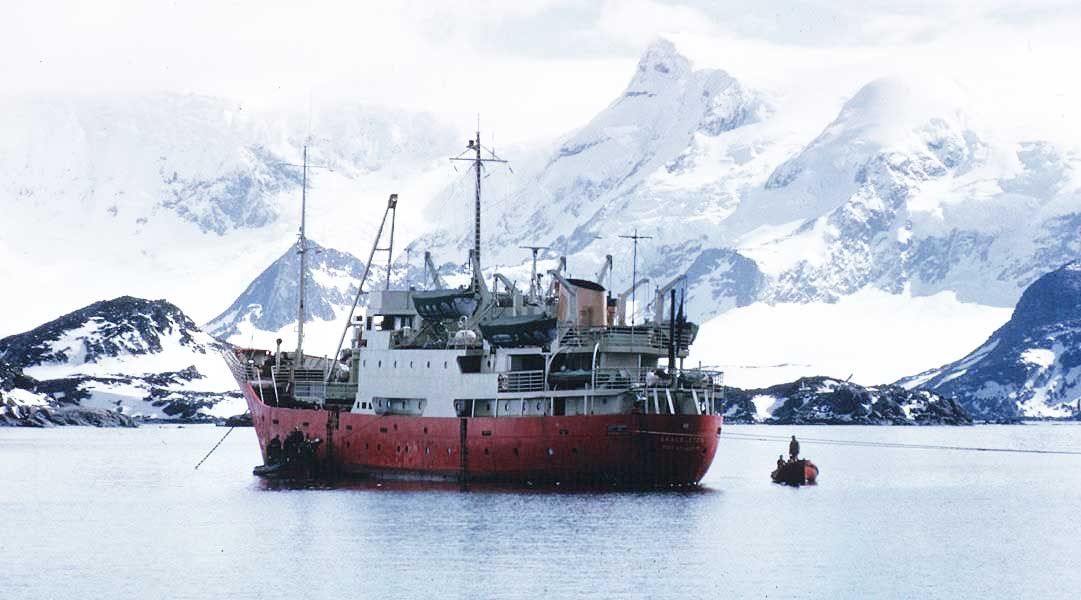
    RRS Shackleton built in Sweden was operated by the Falkland Islands Dependencies Survey (FIDS), British Antarctic Survey, BAS, and NERC (NERC) in the Antarctic from 1955 to 1983. 
    RRS Shackleton built in Sweden was operated by the Falkland Islands Dependencies Survey (FIDS), British Antarctic Survey, BAS, and NERC (NERC) in the Antarctic from 1955 to 1983. 

    On this day but in 1976 a very serious incident occurred in the South West Atlantic when the British research vessel RRS Shackleton was intercepted and fired upon by the Argentine destroyer ARA Almirante Storni, some 78 miles south of Cape Pembroke in the Falkland Islands.

    The Argentine navy attempted to force the vessel to sail to the port of Ushuaia, in Tierra del Fuego, but Captain Philip Warne refused, continued toward the Falkland Islands, and received support from the British Governor. 

    The Almirante Storni fired three shots across the RRS Shackleton’s bows at 12:30 GMT 4 February to force it to stop. The RRS Shackleton was conducting a scientific survey and returning from a mission.

    The incident occurred amid high tension, shortly after the announcement of a British survey team (the “Shackleton Report”) to investigate the economic and social future of the Falklands, plus the potential for alternative industries to complement the static sheep/wool situation.

    Captain Warne consulted with Falklands Governor Neville French and informed the Argentines he was carrying explosives and continued to the Falklands despite further threats to shell the hull.

    The Argentine destroyer followed the Shackleton until it reached the safety of the Falkland Islands. The vessel was subsequently detained for 10 days in Port Stanley, and Captain Warne was later awarded an OBE for his handling of the situation. 

    As can be expected the following day the Under Secretary for Foreign and Commonwealth Affairs, Edward Rowlands explained in Parliament what measures the British government had taken.

    “On learning of the incident, I immediately instructed the chargé d’affaires at Buenos Aires to deliver the strongest protest to the Argentine Government and to request that the Argentine destroyer immediately be ordered to stop harassing the ´Shackleton´“. Rowlands also protested to the Argentine chargé in London in equally vigorous terms.

    Furthermore, “I have made very clear to the Argentine Government that we do not expect a repetition of this incident and that any further incidents will call into question the basis of our commercial and political relationship. I am sure the House will not expect me to think aloud about action we might have to take in the light of further incidents. I can confirm that there are 37 Royal Marines on the Islands.

    Rowlands added that HMS ”Endurance” was in Port Stanley and “her helicopters proved useful in reconnaissance work in yesterday’s incident. We shall obviously consider what further action is required in the light of developments and the response to our demands from the Argentine Government.”

    We shall do everything possible to cool the situation because we appreciate the worries and concern of the Islanders. I am not quite sure what our next course of action should be or what steps should take, especially in view of the fact that we have no ambassador in Buenos Aires and the Argentine does not have an ambassador here (*). However, we shall take every possible diplomatic initiative to cool the situation.

    Mr- Rowlands insist that “the government are conscious of our responsibilities to the Islanders, as previous Governments have been. The Argentine chargé d’affaires did not give me an explanation when I saw him last night. They have served a note upon us saying that they claim the waters for 200 miles around the Falkland Islands as part of their claim for the Islands and dependencies themselves. However “the position of the Government is very clear. We respect the wishes of the Falkland Islanders”.

    Following the March 1976 military coup, the new Argentine Junta launched Operation Sol, secretly establishing a military outpost, Corbeta Uruguay, on Southern Thule in the South Sandwich Islands. Britain protested the move but did not take military action at the time. On 19–20 June 1982 a British special force in Operation Keyhole, recovered Southern Thule. A 10-person Argentine garrison surrendered without resistance to Royal Marines from the frigate HMS Yarmouth.

    (*) On October 1975, the Argentine military Junta withdrew its ambassador to London and requested that Britain recall its own ambassador in January 1976.


    Source link

  • Brazilian oil and gas production record in 2025, 4,987million boe/d — MercoPress

    Brazilian oil and gas production record in 2025, 4,987million boe/d — MercoPress


    Brazilian oil and gas production record in 2025, 4,987million boe/d

    Thursday, February 5th 2026 – 01:00 UTC


    More specifically oil production reached 3,770 million barrels per day, (BBL/d), a record and 12,3% higher than the 2024 production, 3,358 million barrels per day.
    More specifically oil production reached 3,770 million barrels per day, (BBL/d), a record and 12,3% higher than the 2024 production, 3,358 million barrels per day.

    Brazil daily production of oil and natural gas in 2025 reached the equivalent of 4,987 million boe/d, a new record, according to the country’s Petroleum National Agency, ANP.

     The previous record is from 2023, with a daily production equivalent of 4,344 million barrels (boe/d), meaning the 2025 production has been 12.7% higher and 13.3% above the 4,322 million daily output of 2024.

    The volumes were published in the ANP December Monthly newsletter of oil and natural gas production released on Monday with consolidated volumes of the whole year 2025.

    More specifically oil production reached 3,770 million barrels per day, (BBL/d), a record and 12,3% higher than the 2024 production, 3,358 million barrels per day.

    As to natural gas in 2025, the average volume averaged 179 million cubic meters per day (m3/d), also a historic record, equivalent to a 17% increase over the previous year, when it reached 153 million cubic meters per day.

    Last year the main oil and natural gas production originated in the so called pre-salt deposits, on average 79,63% of Brazilian output. The remaining post-salt and on land deposits were equivalent to 15,45% and 4,92% respectively of the total daily production


    Source link

Translate »