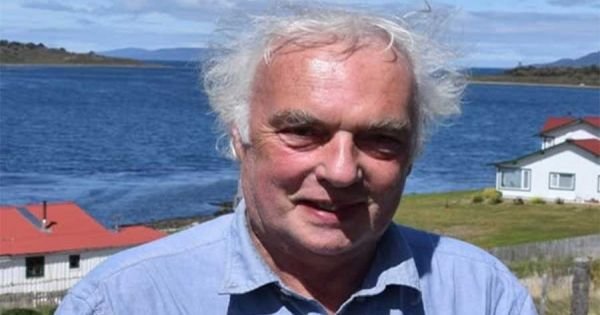
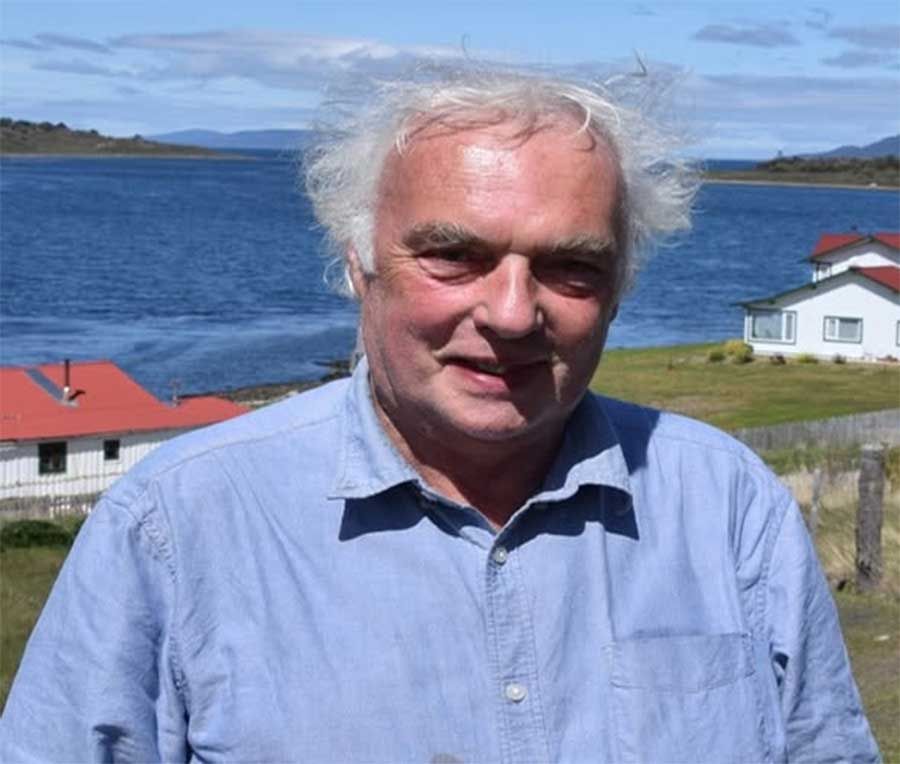
Archeologist Dr Robert Philpott explored Pt Louis, a settlement at the heart of Falklands history
Friends of the Falkland Islands Museum and the Jane Cameron National Archives is inviting to a conference by archeologist Dr. Robert Philpott, who will be sharing his discoveries in the settlement of Port Louis on February 10.
There is no more historically significant Falklands settlement than Port Louis. Control of the small town – never more than a village in reality – passed between France, Spain, the United Provinces of the River Plate and Britain.
Pt Louis hosted Charles Darwin and Robert Fitzroy, and it was the stage for dastardly murders and angry confrontations between nations, the repercussions of which are felt to this day. There is no more fascinating Falklands settlement.
Archaeologist Dr Robert Philpott surveyed Pt Louis, and will share his discoveries with IMA, again the date, 10 February, 7.00 pm London time
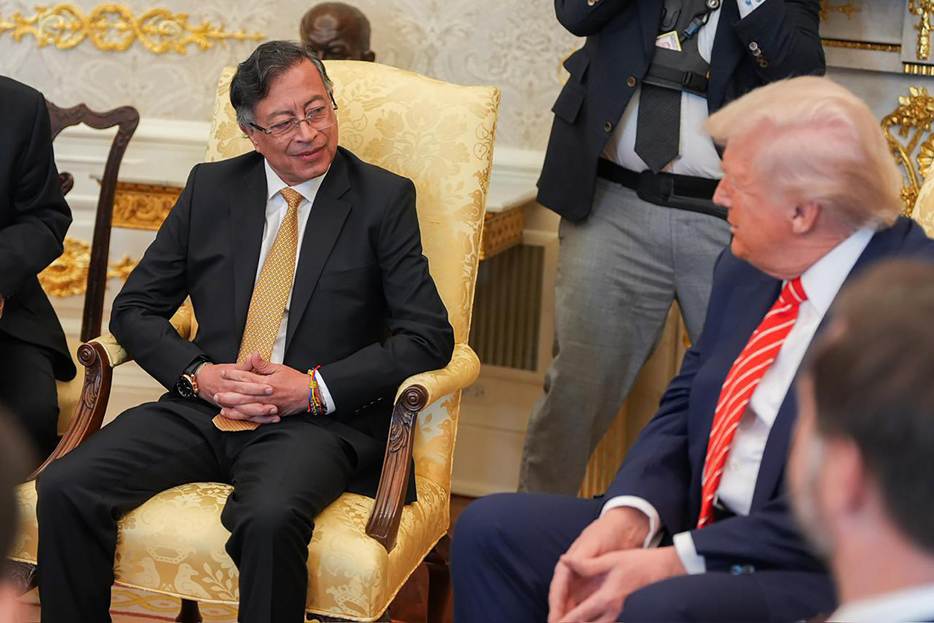
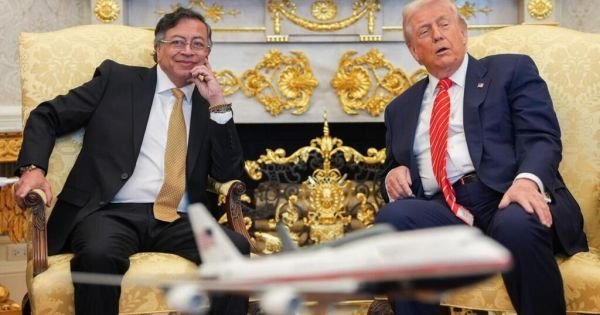
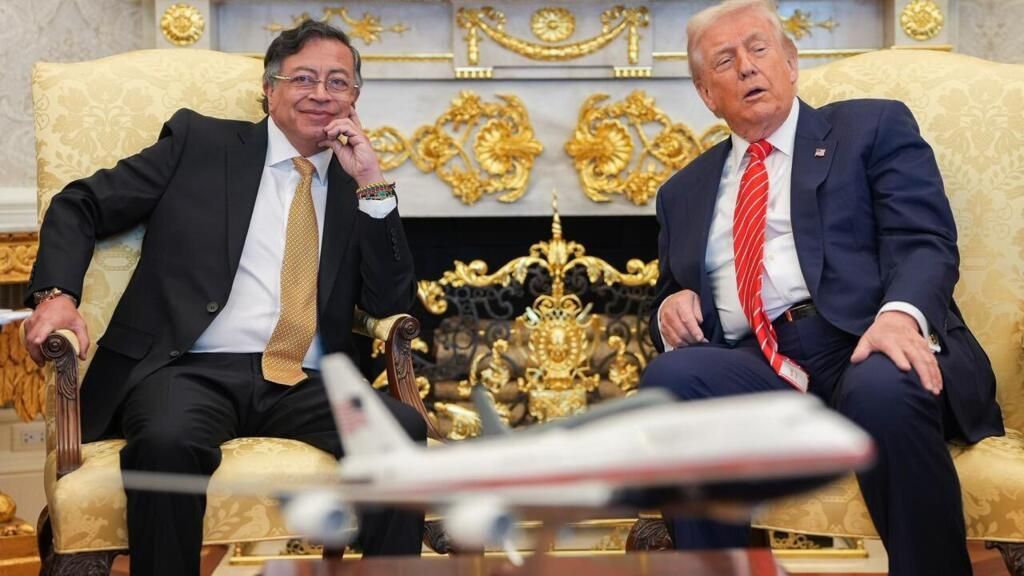
In a two-hour White House meeting, President Trump called Colombia’s Gustavo Petro “great” and posed for smiling photos. Behind the warmth sat sanctions talk, cocaine politics, and a Caribbean border dilemma that both leaders now frame as shared work ahead.
Smiles First, Then the Reading Between the Lines
The telling moment did not happen behind closed doors. It happened later, in motion, when a visiting president was already halfway back into the mess of cameras, sidewalks, and protocols that make Washington feel like a stage built on deadlines.
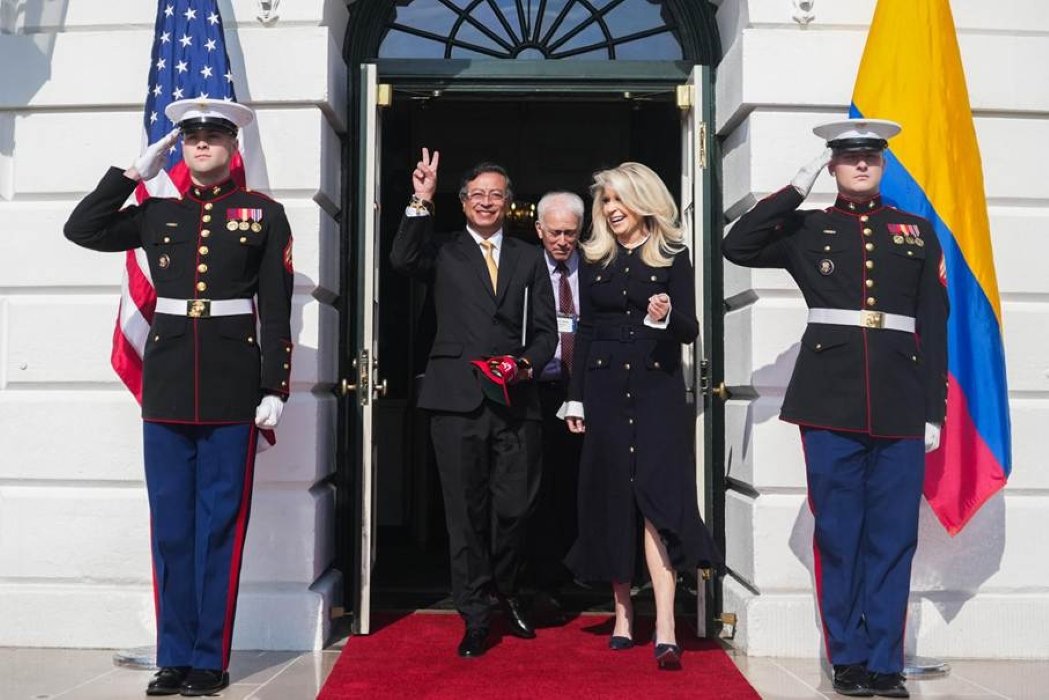
Gustavo Petro, leaving the White House, was spotted carrying a red MAGA hat.
It is the kind of detail that would have sounded implausible a month ago, given the year of ideological sparring and online rancor between Petro and President Trump. Yet there it was, the hat bright against the more neutral palette of official visits. And Petro, according to the notes, said he added an S to the cap Trump gifted him, turning the slogan into his own: “Make America Great Again.”
That minor edit, one letter, suggests what Tuesday’s meeting became. Not a surrender, not a showdown, but a careful attempt to step around the worst version of each other. A photo opportunity that also functioned as damage control.
Many had feared the opposite. Trump has used White House visits to ambush foreign leaders and assert dominance. Colombia is also central to Trump’s stated mission to crush transnational drug trafficking networks. The ingredients for a clash were already laid out: deportations, U.S. military boat strikes in waters the administration has described as used by drug traffickers, and a relationship strained enough that U.S. officials revoked Petro’s visa last fall and imposed sanctions on him along with members of his family and his government.
For this trip, the United States issued Petro a short-term visa. The trouble is that a short-term visa is not only paperwork. It is a message about leverage, and about who is allowed into the room and on what terms.
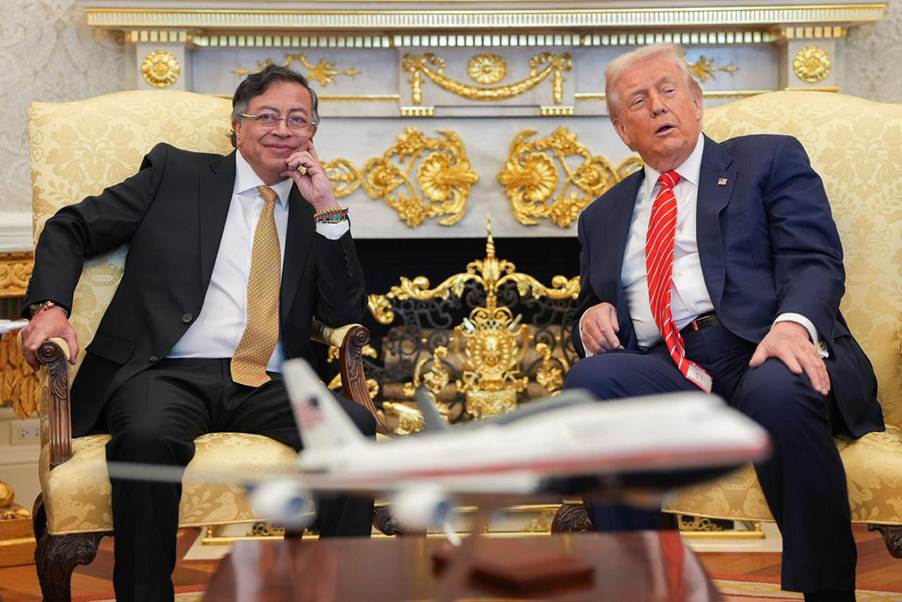
And yet the first images from the meeting were almost cheerful. After more than two hours in private, photos emerged of both leaders smiling broadly with top officials. Trump also gave Petro a signed copy of “Trump: The Art of the Deal,” with a dedication: “You are great.” Another photo showed a note from Trump saying, “I love Colombia.”
Diplomacy can be made of text as much as treaties. Sometimes a sentence is the treaty.
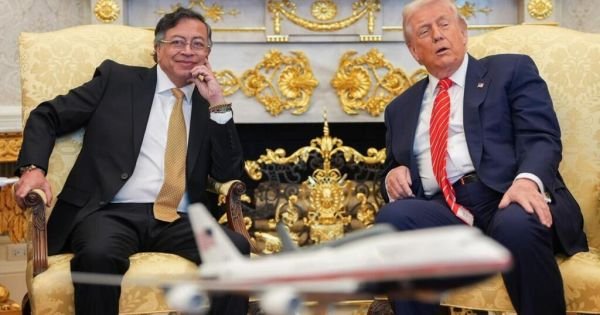
Gustavo Petro (left), alongside his U.S. counterpart, Donald Trump, during a meeting yesterday at the White House in Washington, United States. EFE/ @infopresidencia
A Caribbean Map Under the Table
At a news conference after the White House visit, Petro said he left feeling “optimistic and positive,” while also warning that the Caribbean was now the “eye of the storm” of U.S. foreign policy. It was a pivot that sounded like Petro being Petro, mixing warmth with warning, praise with geography.
His remarks, delivered at the Colombian Embassy in Washington, centered on what he described as a “difficult” moment for Colombia and Venezuela. He said he proposed renewing Colombia’s bond with the United States through a joint crackdown on drug trafficking groups active on both sides of the Colombian-Venezuelan border, and through investment in clean energy that could supply both countries with electricity.
This is where the friendly photos stop doing the work. Petro’s pitch was not simply about policing. It was about linking security to infrastructure, narcotrafficking to energy, the border to the grid. In Latin America, those links are rarely theoretical. Armed groups exploit state absence. Smugglers thrive where governance is thin. Electricity and legitimacy often rise or fail together.
Trump, for his part, described the meeting as good. When asked if they had reached any agreement on counternarcotics efforts, he said, “We worked on it, and we got along very well.” Afterward, he also said the two were working on other matters, including sanctions.
That last detail is the shadow in the frame. Sanctions were not the public centerpiece, but they were not absent. Petro later told a Colombian radio station he rated the meeting a nine out of ten, and said not even a second had been spent discussing the sanctions or his visa issues. That is a striking claim given the context, and it also reads as a strategy. In a relationship marked by power imbalance, choosing what to say about what you did not discuss can be as pointed as admitting what you did.
A month earlier, the atmosphere had been sharper. After a U.S. military raid in Venezuela that ousted Nicolás Maduro, Trump suggested Colombia could be next. Then came an amicable phone call a few days later, arranged by Colombia’s ambassador, Daniel García-Peña, with the help of Senator Rand Paul, and Trump announced that Petro would visit Washington.
On Monday, Trump implied the Venezuelan raid had changed Petro’s posture. He said the two would talk about drugs, emphasizing that tremendous amounts of drugs come out of Colombia. This is the steady refrain behind every shift in tone. Colombia is framed as both a partner and a problem: Ally and origin point. A country invited into the Oval Office and warned at the same time.
Gustavo Petro (left), alongside his U.S. counterpart, Donald Trump, during a meeting yesterday at the White House in Washington, United States. EFE/ @infopresidencia
Gifts, Extradition, and an Old Codependency
It remains unclear whether any concrete agreements emerged from the meeting. That uncertainty is not unusual. High-level visits often create an atmosphere before they produce documents.
Still, a few actions and symbols clustered around the trip. It is customary for visiting leaders to bring gifts, and Petro reportedly gave Trump chocolate and coffee produced through efforts meant to replace coca cultivation with other products. Even the gifts carried policy inside them, a quiet argument that rural livelihoods are part of counternarcotics, not an afterthought.
On Tuesday, the Colombian government also extradited to the United States an accused high-ranking leader of an organized crime group. That move, placed alongside the visit, read like a reminder of capability and cooperation, and also like an offering in a relationship where proof of seriousness is continually demanded.
Despite the rancor of the past year, the logic underneath has not changed. “It wasn’t in the interest of the U.S. to be in conflict with its most strategic ally on narcotrafficking,” said Gimena Sánchez, a Colombian human rights activist at the Washington Office on Latin America. “No matter who has been in charge of both countries,” she said, “that codependency has always been understood.”
Codependency is a blunt word, but it fits. Colombia sits inside U.S. domestic politics whenever drugs do, and U.S. pressure shapes Colombian choices even when Colombia objects. The wager here is whether two leaders who pride themselves on bluntness can accept that reality without reigniting the relationship.
For now, the scene ends with that red hat in Petro’s hands, a prop turned into punctuation. One letter added. One phrase tweaked. A small, careful act that said what the meeting itself never reasonably could: this relationship may be tense, but it is not optional.
Cold cream cheese creates a lumpy filling no matter how long someone mixes. The chunks never fully disappear, even with a stand mixer running. Room-temperature dairy blends smooth in half the time. Most cheesecake disasters trace back to refrigerator-cold ingredients hitting the mixing bowl.
A platform called ProteinCheesecake.co is teaching proper cheesecake technique alongside 27+ macro-verified options. The site features high-protein cheesecake recipes delivering 20-35 grams of protein per slice through smart ingredient swaps. Temperature control separates amateur results from bakery-quality texture. Every protein chef learns the room temp rule first.
Why Temperature Controls Texture
Low-fat cream cheese softens at room temp for 30-45 minutes. Greek yogurt reaches its ideal consistency after sitting out similarly. Add cottage cheese after warming slightly for smoother blending.
Cold ingredients require aggressive mixing that incorporates excess air. The cheesecake filling develops bubbles, leading to surface cracks. Gentle mixing of room-temperature ingredients prevents structural problems completely.
Full-fat cream cheese softens faster than low-fat versions. Plan ahead and remove dairy from the fridge earlier. The small bowl test works: press a finger into the cheese. The indent should remain without resistance.
Cottage Cheese Processing Secrets
Cottage cheese looks lumpy and watery straight from the container. A food processor transforms curds into silky smooth consistency in 60 seconds. Pulse until completely liquified before adding to the cheesecake filling.
Skipping the processing step creates chunky filling nobody wants. The curds stay visible in finished slices. Even more protein comes from cottage cheese versus cream cheese alone. The processing step stays non-negotiable for professional results.
Sweetener Selection Beyond White Sugar
White sugar works, but spikes calories unnecessarily. Granulated sweetener alternatives include monk fruit or erythritol for sugar-free versions. Maple syrup adds complexity beyond plain sweetness.
Liquid sweetener options like honey or maple syrup adjust easily. Reduce slightly for less sweet preferences. Low-carb diets benefit from zero-calorie granulated options. Great recipe feedback confirms sweetener swaps work seamlessly.
Crust Preparation Affects Everything
Graham cracker crust needs proper packing for structural integrity. Press firmly using a flat-bottomed glass or measuring cup. The prepared crust should feel solid before filling is added.
Melted butter binds graham cracker crumbs together. Too little butter creates a crumbly crust that falls apart. Too much makes the crust greasy and soggy. The ratio matters precisely.
Store-bought crust works fine when time is limited. A prepared crust saves 15 minutes of active work. Store-bought crust sounds practical for weeknight protein dessert cravings.
Crustless option eliminates carbs for strict low-carb followers. Line the pan with parchment paper only. The cheesecake releases cleanly without crust support. Calories drop another 100-150 per serving.
Baking Temperature and Timing
Preheat oven to 325 degrees for gentle cooking. Higher temperatures cook edges too fast while leaving centers raw. Low and slow prevents cracking and ensures even texture throughout.
Baking time varies based on pan size and filling thickness. Check after 45 minutes by gently shaking the pan. The edges should set while the center jiggles slightly like gelatin.
Cool completely at room temperature before refrigerating. Rapid temperature changes cause surface cracks. The cheesecake needs gradual cooling over 2-3 hours. Patience prevents cosmetic disasters.
Fridge Overnight Requirements
High-protein cheesecake needs to be refrigerated overnight for proper texture development. The filling firms up as it chills completely. Cutting too early creates messy slices that don’t hold shape.
Chill for a minimum 6 hours, but overnight works best. The flavor improves after 24 hours in the fridge. Plan ahead when serving for special occasions or meal prep.
Flavor Additions Beyond Vanilla
Vanilla extract forms the base for most recipes. Lemon zest brightens the filling with citrus freshness. Juice from one lemon adds tang without watering down the mixture.
Chocolate versions swirl cocoa into half the batter. Marble effect looks impressive with minimal effort. Berry compotes get dolloped on top before baking. The fruit bakes into the surface slightly golden and delicious.
High-Protein Mini Cheesecakes Advantages
Individual portions bake faster than full-sized versions. High protein mini cheesecakes finish in 18-22 minutes total. Line muffin tins with papers for easy removal after cooling.
Portion control happens automatically with single-serving sizes. Each mini delivers 15-20 grams of protein perfectly measured. Kids request mini versions for lunchbox treats. Adults appreciate grab-and-go protein dessert options.
Protein Powder Integration Tips
Add protein powder to the dry ingredients before mixing with dairy. Vanilla protein powder enhances vanilla extract flavor naturally. The powder distributes evenly when added early in the process.
Protein cheesecake recipe variations use different powder types. Whey blends smoothest in most applications. Plant proteins work but may slightly affect texture. Even more protein results from combining powder with high-protein dairy.
Freeze for Extended Storage
Cheesecake freezes beautifully for 2-3 months wrapped tightly. Slice before freezing for individual portions ready to thaw. One slice thaws in the fridge overnight perfectly.
Texture stays creamy after freezing, unlike some desserts. The protein content remains stable through freeze-thaw cycles. Meal prep protein dessert becomes realistic for monthly planning.
Recipe Card Navigation
Latest posts appear prominently on the site homepage. More posts link to seasonal variations and special flavors. The recipe card format keeps instructions clear and concise.
Review recipe comments before trying unfamiliar flavor combinations. Other bakers share helpful tips and common mistakes. Great recipe ratings indicate reliable formulas worth attempting first.
ProteinCheesecake.co proves high protein cheesecake recipes succeed when temperature and technique align properly.
Frequently Asked Questions
Can I use Greek yogurt instead of some cream cheese in protein cheesecake?
Yes, Greek yogurt replaces 30-50% of cream cheese in protein cheesecake recipes while adding tanginess and boosting protein content significantly.
How do I make a gluten-free graham cracker crust for high protein dessert?
Use certified gluten-free graham crackers or substitute almond flour mixed with melted butter for a gluten-free crust base.
Does adding lemon zest change the texture of cheesecake filling?
No, lemon zest adds bright citrus flavor without affecting texture, though lemon juice should be limited to avoid thinning the filling.
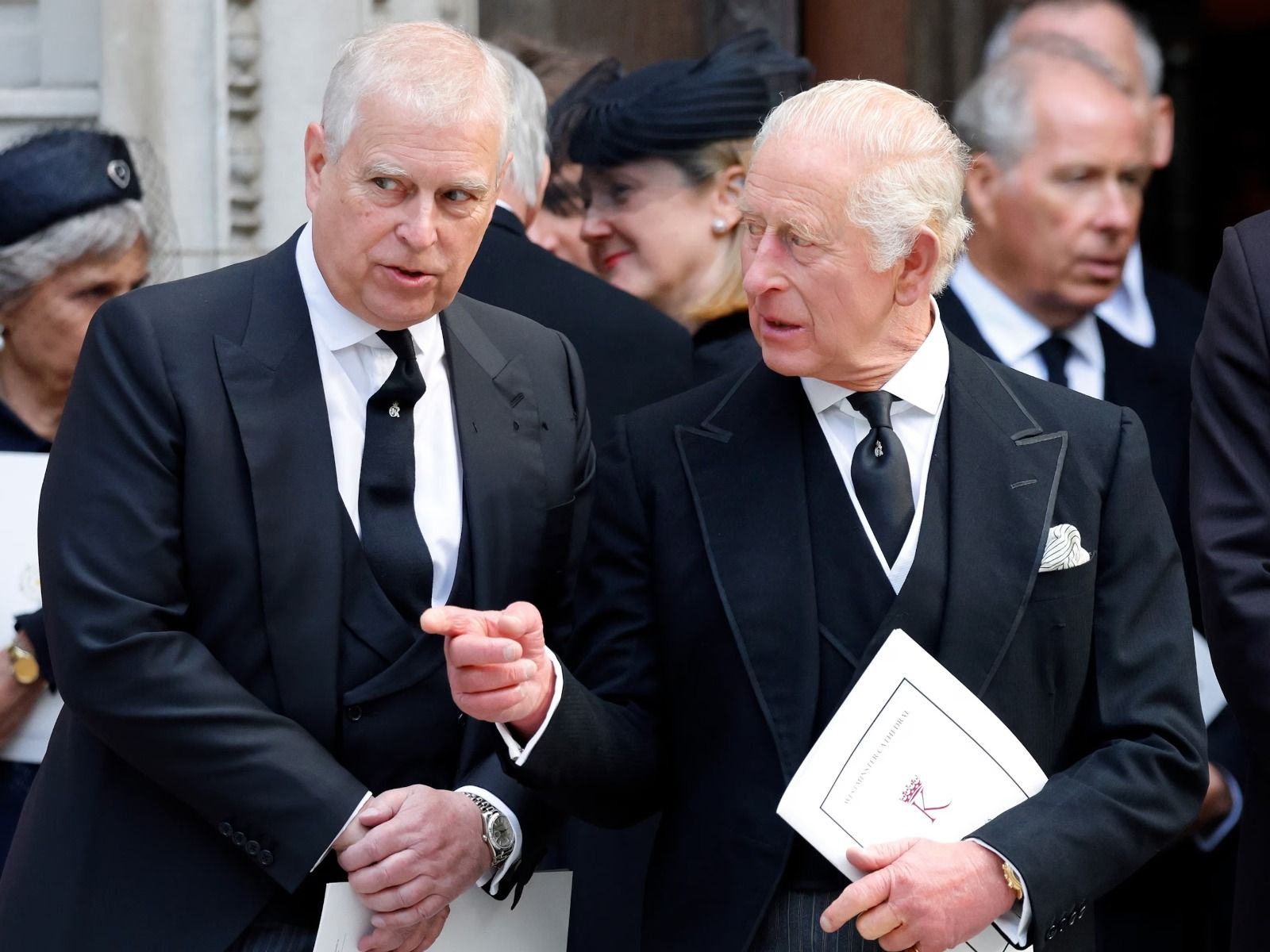
Andrew’s departure was carried out discreetly during the night with the former Duke of York relocating to a smaller property on the King’s privately owned Sandringham estate
King Charles III has forced his brother Andrew Mountbatten-Windsor to vacate Royal Lodge, the 30-room Windsor estate home he has occupied for years, amid renewed scrutiny stemming from newly surfaced Epstein-related material and a fresh police review of allegations tied to the late financier.
Andrew’s departure was carried out discreetly during the night with the former Duke of York relocating to a smaller property on the King’s privately owned Sandringham estate. The move follows the latest batch of U.S.-released Epstein files, which, according to Reuters, include indications that Andrew remained in touch with Epstein for an extended period after Epstein’s 2008 conviction—details that have reignited public backlash in Britain.
The relocation comes as UK police assess new claims raised by lawyers representing a woman who alleges she was flown to Britain in 2010 by Epstein for a sexual encounter with Andrew at Royal Lodge. The woman was not British and was in her 20s at the time, her lawyer Brad Edwards said in comments carried by the BBC and echoed by British outlets. Thames Valley Police said they are “assessing information” linked to the allegation, ITV reported.
Documents show Epstein proposed introducing Andrew to a Russian woman, a detail that has added to the political and media storm around the royal household.
The episode revives a longer-running dispute over Andrew’s living arrangements and the monarchy’s strategy for limiting reputational fallout. Andrew had previously resisted pressure to leave Royal Lodge, citing a long lease arrangement, while Charles has taken steps to distance the institution from the scandal. In late 2025, the King escalated efforts to strip Andrew of remaining titles and privileges as scrutiny intensified.
Andrew stepped back from public duties in 2019 and in 2022 settled a civil lawsuit brought by Virginia Giuffre, who alleged she was abused by him when she was 17—claims he denied. Giuffre died last year, and that the new allegation is separate from her case.
British media have framed the latest developments as a test of the monarchy’s crisis management. The Times described Andrew’s exit as “humiliating” and reported that the timing accelerated after the latest revelations. The Guardian reported growing pressure from senior political figures for Andrew to cooperate with U.S. investigators, even as Buckingham Palace maintains a policy of limited public comment.
News Americas, FORT LAUDERDALE, FL, Weds. Feb. 4, 2026: Haitians in Miami’s Little Haiti gathered in prayer Tuesday night, giving thanks after a federal judge blocked the termination of Temporary Protected Status, (TPS),for Haitians – a move hailed by Haitian American leaders as a critical lifeline for immigrant families.
Haitian American Congresswoman, Sheila Cherfilus-McCormick, praised the ruling, which halts the potential removal of more than 350,000 Haitians living and working in the United States.
“This is a major win for South Florida and for our strong immigrant communities,” Cherfilus-McCormick said in a statement. “This decision confirms what we all know to be true: our nation cannot be at its greatest without Haitian immigrants, who contribute close to $3.4 billion annually to our economy.”
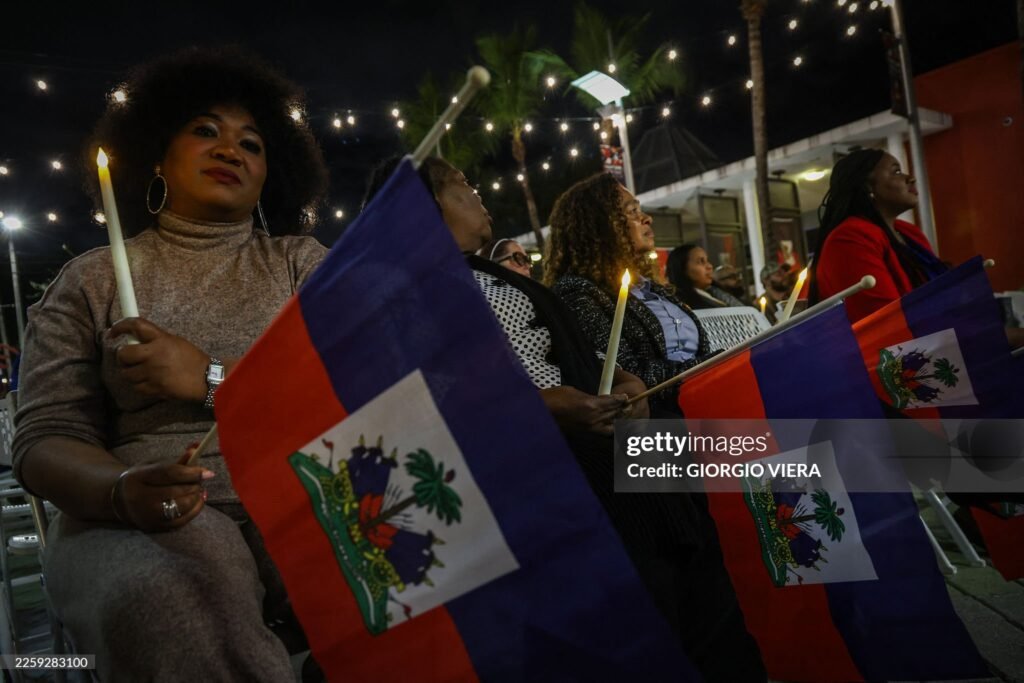
People attend a candlelight vigil for Haitians living in the US under the Temporary Protected Status (TPS) immigration program in Miami, Florida on February 3, 2026. Late on February 2, federal judge Ana C. Reyes of the Federal District Court in Washington, blocked the Trump administration from ending TPS for an estimated 350,000 Haitian immigrants. The status, which offers protection from deportation and work authorization, was set to expire on Feb. 3. (Photo by Giorgio Viera / AFP via Getty Images)
At the prayer vigil held at the Little Haiti Cultural Complex, a small but emotional crowd lit candles and prayed for stability, protection, and the opportunity to continue building their lives in the United States.
The ruling allows more than 350,000 Haitian immigrants nationwide — including an estimated 158,000 in Florida — to remain in the country and continue working, at least temporarily. For many families, the decision brought a measure of relief, tempered by ongoing uncertainty about the future.
“The past five years, what Haiti’s been dealing with — we are not ready,” said Fabiola Barthelemy, a Haitian American who has lived in the U.S. for decades, speaking to CBS News. “The crisis is real. Children are being raped and gangs are still active. Sending people back is like a death sentence to me.”
Although Barthelemy is a U.S. citizen, many members of her family are not. Her daughter, Elizabeth Barthelemy, said the prospect of her relatives being forced to return to Haiti is devastating.
“It would make me feel mad, frustrated, sad and depressed,” she told CBS Miami. “My cousins are like my family. I would go with them.”
Community leaders and elected officials echoed those concerns, stressing that TPS recipients are law-abiding, contributing members of society — not criminals.
On Monday, U.S. District Judge Ana Reyes temporarily blocked the Trump administration’s move to end TPS for Haitians nationwide.
Local officials say the decision offers critical breathing room but does not guarantee a permanent solution.
The sharpest moves came in Wall Street, where Argentine ADRs fell as much as 33%
Argentine stocks and hard-currency bonds fell on Tuesday, hit by a risk-off turn in global markets and fresh domestic uncertainty tied to the stalled overhaul of inflation measurement following Marco Lavagna’s departure from INDEC.
In Buenos Aires, the S&P Merval dropped 2.2%, taking early-February losses close to 5%, while dollar-denominated sovereign bonds slipped about 0.6% on average, according to Infobae. The JPMorgan country-risk gauge climbed to 503 basis points, its highest since Jan. 26.
The sharpest moves came in Wall Street, where Argentine ADRs fell as much as 33%. Bioceres Crop Solutions sank up to 33% and Globant slid roughly 12% in New York trading, Infobae said. Vista Energy also dropped after Bloomberg reported a planned stake sale by an Abu Dhabi investor.
Argentina’s pullback tracked a weaker U.S. close, with the Nasdaq Composite under pressure as investors reassessed the outlook for software and AI-linked names. Reuters said the downturn reflected fears that new AI tools could intensify competition for established software makers, weighing on sentiment across the sector.
Locally, commentators framed the move as a mix of profit-taking after a strong January rally and renewed caution over the policy outlook. Economist Gustavo Ber was quoted in La Nación and Ámbito describing the session as a “pause” after recent gains.
The market action also coincided with Economy Minister Luis Caputo confirming payments to the International Monetary Fund and reiterating that the government is not prioritising a return to international debt markets in the near term—key signals for investors tracking reserve accumulation and disinflation under President Javier Milei.
Colombian President Gustavo Petro said his first face-to-face meeting with U.S. President Donald Trump in Washington went better than expected, pointing to a tentative thaw after months of public insults and policy clashes that had pushed the bilateral relationship toward open confrontation.
The talks, held Tuesday at the White House, lasted roughly two hours and took place behind closed doors, without a joint statement or the usual welcoming ceremony. The low-key format underscored both the desire to cool tensions and the sensitivity of unresolved disputes.
Petro described the conversation as cordial and said ideological differences did not dominate the discussion. He also posted what he described as a handwritten note from Trump praising Colombia, a gesture that contrasted sharply with earlier rhetoric.
Trump later called the meeting “very good,” saying the two sides reached understandings on counter-narcotics measures and were also “working on other issues, including sanctions,” without providing details. In a separate media appearance, Petro rated the meeting a “9 out of 10.”
Substantively, Petro said drug trafficking dominated the agenda. He asked Washington to help pursue major traffickers operating outside Colombia — including in the United States — and sought U.S. mediation in his diplomatic dispute with Ecuador’s Daniel Noboa.
Venezuela also surfaced. The leaders discussed potential Venezuelan gas exports through Colombia and broader regional security questions, while he floated a role for state oil company Ecopetrol in energy-linked initiatives tied to Venezuela’s recovery.
The détente comes after a fraught 2025 marked by the U.S. revoking Petro’s visa and later imposing sanctions amid disputes that blended Gaza, migration, and drug policy, Reuters reported. On the eve of the meeting, EFE quoted Trump saying Petro had changed his attitude “a lot” and that he expected a good discussion focused on narcotics.
No concrete deal was announced publicly and that deep differences remain — including over Venezuela, where Petro has criticised the capture of Nicolás Maduro, and over how to curb cocaine flows from a country that remains the world’s top coca producer.
While the Big Mac Index is a light, illustrative gauge rather than an official exchange-rate model, the result lands amid a local debate on competitiveness and a weak dollar
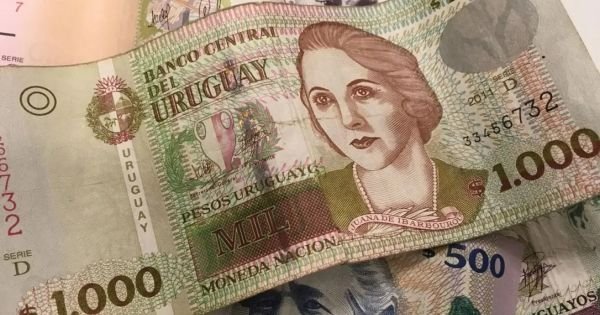
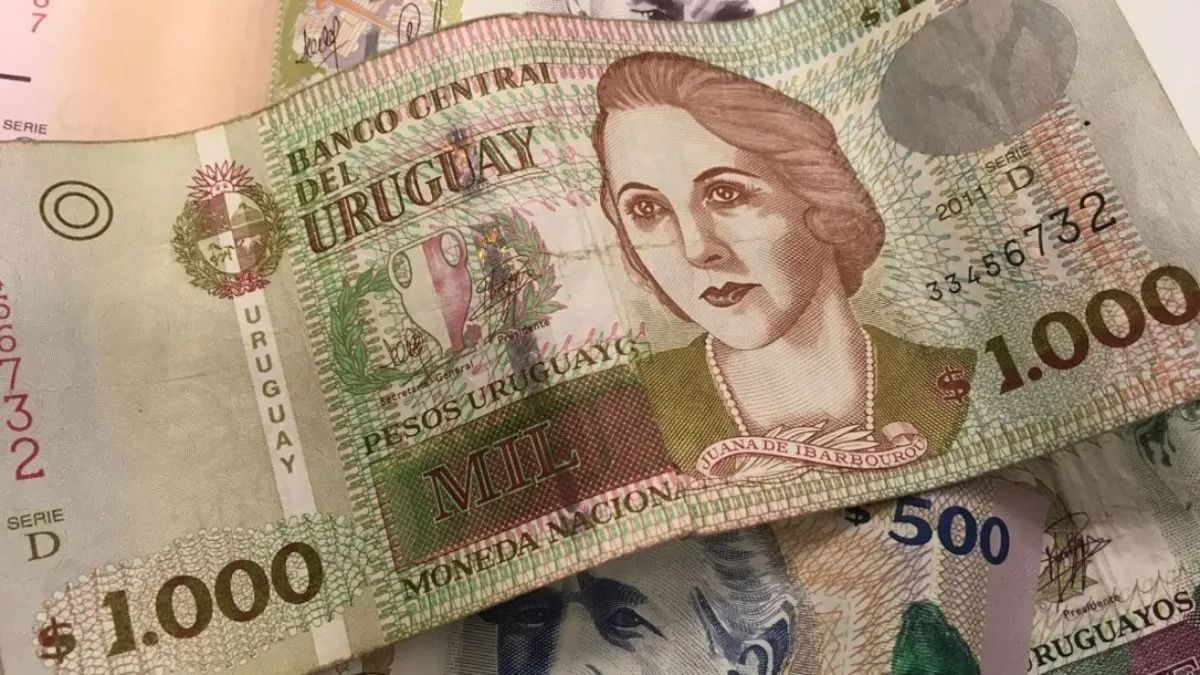
Uruguay’s peso has been labelled the world’s most “overvalued” currency against the U.S. dollar on a GDP-per-capita-adjusted basis, according to the latest Big Mac Index published by The Economist and cited by Uruguayan media. Under the adjusted methodology, the peso is estimated to be 83.9% above its implied “long-run equilibrium.” In the unadjusted ranking, Uruguay places second, with 43.1% overvaluation, behind the Swiss franc.
The index hinges on a straightforward comparison: in January, a Big Mac cost UYU 339 (US$ 8.76) in Uruguay versus US$ 6.12 in the United States at prevailing market rates. That gap implies an “equilibrium” exchange rate of UYU 55.39 per dollar, well above current levels, according to the local summary of the index.
While the Big Mac Index is a light, illustrative gauge rather than an official exchange-rate model, the result lands amid a local debate on competitiveness and a weak dollar. Finance Minister Gabriel Oddone has argued the move is driven by global dynamics and warned that a misaligned exchange rate can spill into the real economy. “This situation affects real activity and has consequences for investment, growth and employment,” he said during an official briefing posted by the ministry.
Oddone also outlined steps aimed at cushioning the impact: the Treasury is negotiating FX forward purchases to meet foreign-currency obligations and coordinating similar strategies with state-owned companies, while fast-tracking a package of competitiveness measures. “We understand that today’s dollar price is attractive enough to bring forward purchases,” he said, as quoted by Montevideo Portal.
On the monetary side, the Central Bank of Uruguay cut its policy rate by 100 basis points to 6.5% on January 26, framing the move within its inflation-targeting strategy and the goal of maintaining convergence toward its target.
Market expectations compiled by the central bank do not point to a sharp reversal: the BCU’s Economic Expectations Survey shows a median exchange-rate forecast of around UYU 40.19 per dollar by end-2026.
Colombian President Gustavo Petro said his first face-to-face meeting with U.S. President Donald Trump in Washington went better than expected, pointing to a tentative thaw after months of public insults and policy clashes that had pushed the bilateral relationship toward open confrontation.
The talks, held Tuesday at the White House, lasted roughly two hours and took place behind closed doors, without a joint statement or the usual welcoming ceremony. The low-key format underscored both the desire to cool tensions and the sensitivity of unresolved disputes.
Petro described the conversation as cordial and said ideological differences did not dominate the discussion. He also posted what he described as a handwritten note from Trump praising Colombia, a gesture that contrasted sharply with earlier rhetoric.
Trump later called the meeting “very good,” saying the two sides reached understandings on counter-narcotics measures and were also “working on other issues, including sanctions,” without providing details. In a separate media appearance, Petro rated the meeting a “9 out of 10.”
Substantively, Petro said drug trafficking dominated the agenda. He asked Washington to help pursue major traffickers operating outside Colombia — including in the United States — and sought U.S. mediation in his diplomatic dispute with Ecuador’s Daniel Noboa.
Venezuela also surfaced. The leaders discussed potential Venezuelan gas exports through Colombia and broader regional security questions, while he floated a role for state oil company Ecopetrol in energy-linked initiatives tied to Venezuela’s recovery.
The détente comes after a fraught 2025 marked by the U.S. revoking Petro’s visa and later imposing sanctions amid disputes that blended Gaza, migration, and drug policy, Reuters reported. On the eve of the meeting, EFE quoted Trump saying Petro had changed his attitude “a lot” and that he expected a good discussion focused on narcotics.
No concrete deal was announced publicly and that deep differences remain — including over Venezuela, where Petro has criticised the capture of Nicolás Maduro, and over how to curb cocaine flows from a country that remains the world’s top coca producer.
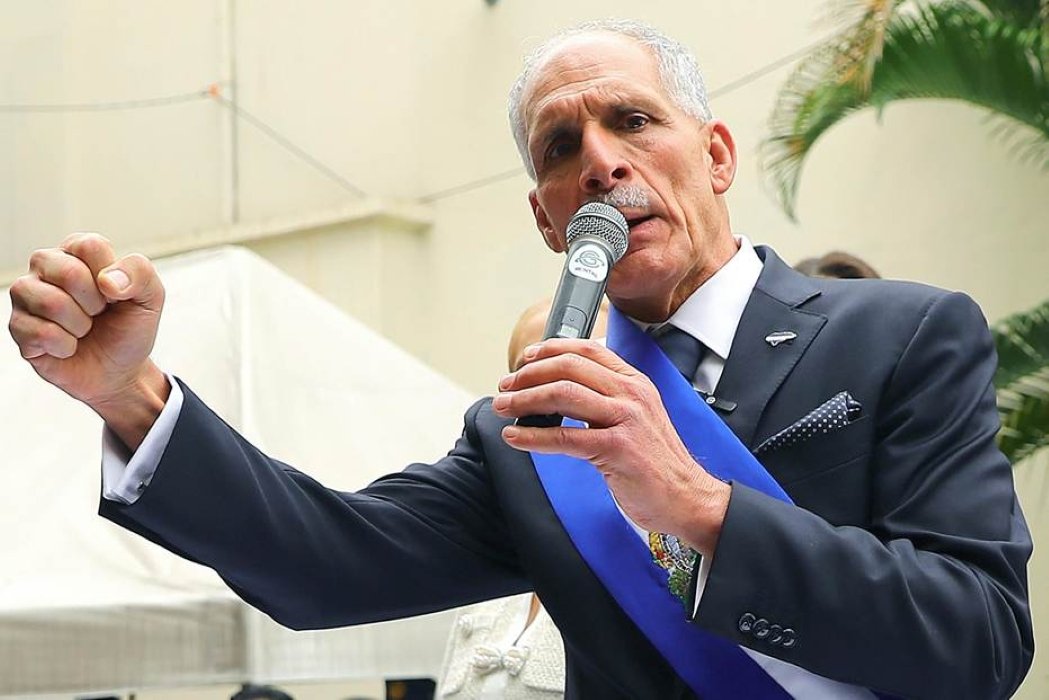
Nasry Tito Asfura took office in a small, plain ceremony that felt like a message. Outside, supporters packed the streets under heavy security. Inside, Honduras quietly changed presidents while arguments about fraud, Congress, and U.S. alignment hung in the air.
A One-Hour Inauguration with a Thousand Unsaid Things
He did not enter like a man expecting a stadium.
Nasry “Tito” Asfura walked into the congressional chamber without taking the corridor of honor where the press and guests were gathered. He wore a simple dark blue suit. He held his wife’s hand. Lissette Del Cid wore white. There was visible shyness in the way he greeted the few people present and the new head of Congress, as if the room itself were smaller than the moment.
The ceremony lasted about an hour at the seat of Honduras’ legislature, a sharp contrast with predecessors who took power in a soccer stadium in events described in the notes as heavily adorned and long. The international community was there, but only as diplomatic delegations, not as the centerpiece. The structure was basic and familiar: the national anthem, a church blessing, military cadets standing guard, the constitutional oath, and the blue-and-white presidential sash.
The sensory detail is in the soundscape more than the décor. A national anthem in an echoing chamber. A prayer spoken aloud. The soft shuffle of uniforms. The kind of official quiet that makes you hear your own breathing.
Asfura’s speech matched the staging. Twelve minutes. Direct. He talked about shrinking the state, security, health, the economy, and nodded at “peace.” He did not lavish the room with greetings. He did not perform well in front of the cameras.
“Honduras no te voy a fallar, vamos a estar bien. Dios los bendiga a ustedes a sus familias, dios bendiga a Honduras,” he said.
The trouble is that in Honduras, words like peace and stability land on ground that is already cracked. A minimalist inauguration can signal discipline, or austerity, or a desire to reset the optics. It can also signal something else: a presidency arriving with low legitimacy, choosing to keep the celebration contained.
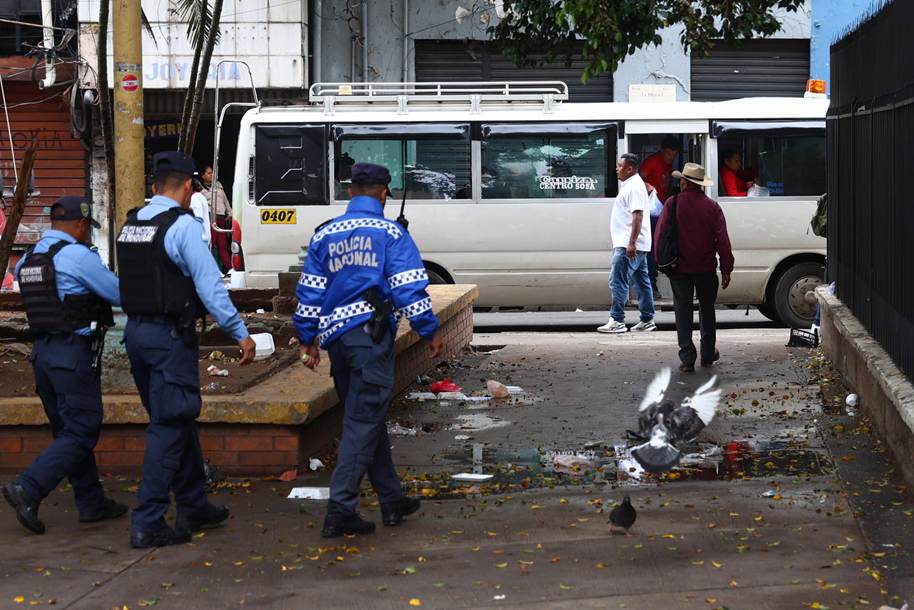
Members of the Honduran police patrol a street last week, in Tegucigalpa, Honduras. EFE/ Carlos Lemos
A First Decree, and the Shadow of the Past
Asfura did not mention the international community in his remarks. He did not mention the United States either, despite the hurried support he received before the election. He also did not mention former president Juan Orlando Hernández, from the same National Party, who was pardoned by U.S. President Donald Trump from a drug trafficking conviction in 2024, one day after the election Asfura won.
Silence is never neutral in a transition like this. What this does is force the audience to fill in the gaps with what they already know.
His first act as president was not a foreign policy statement or a significant security announcement. It was a signature. He signed a decree to put the presidential airplane up for sale, an aircraft acquired during Hernández’s administration and not used by the outgoing president, Xiomara Castro.
It is an image designed to travel easily. A plane was sold. The state cut down to size—a rejection of elite comfort. In a country where trust in institutions is already thin, symbolic austerity can feel like a simple answer to a complicated question.
Throughout the ceremony, Asfura crossed himself repeatedly. He rarely separated from his wife, now the first lady. In the final minutes of his remarks, he narrated a Catholic prayer.
There is a phrase that keeps returning in moments like this, not because it is cynical but because it is true: in a fragile democracy, even the choreography becomes an argument.
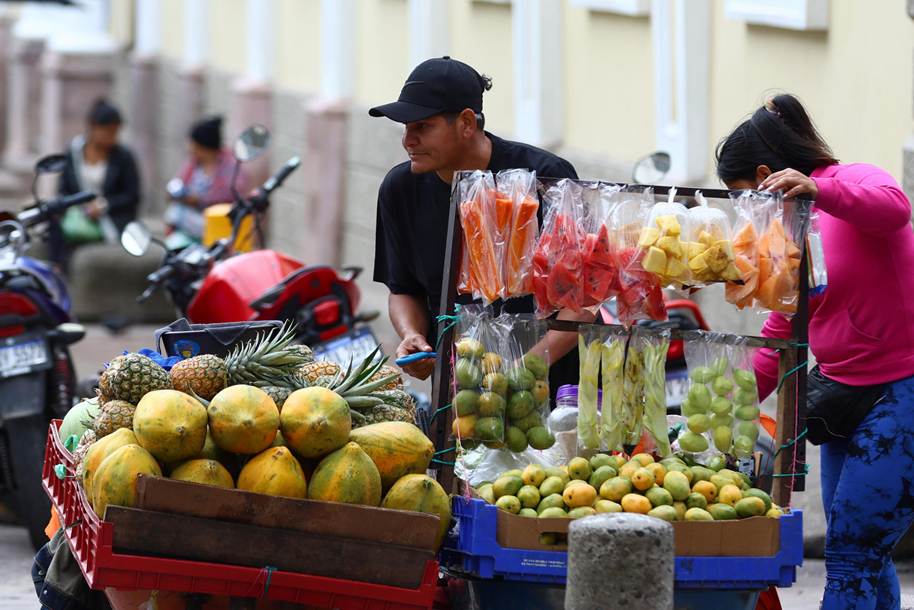
People sell goods last week, in Tegucigalpa, Honduras. EFE/ Carlos Lemos
Outside the Chamber, a Crowd and a Congress Waiting
While the parliamentary hall remained lightly decorated and sparsely attended, the streets around the legislature told a different story. Supporters crowded the area with Honduran flags, chanting “Sí se pudo,” under a strong military deployment that had been guarding the zone for days.
After the oath, Asfura walked the corridor where the media waited and climbed a small platform. He repeated, with more force, that Honduras would be fine. He blessed again. He did not stop to speak to reporters. He moved quickly to an outdoor stage beside Congress, where the crowd received him with cheers.
He is described in the notes as a construction businessman of Palestinian origin. His rise comes after an election process marked by tension, a one-month delay in releasing official results from the November 30 vote, and a narrow margin over Salvador Nasralla of the Liberal Party.
The incoming government is stepping into a transition already conditioned by distrust. The outgoing administration, led by Xiomara Castro, did not support the handover. Castro’s party, LIBRE, denounced electoral fraud. The atmosphere grew hostile for weeks, with frustrated attempts at mobilization and without backing from international observers, according to the notes.
And then there is the Congress, the arena that will define how much of Asfura’s program is real and how much is rhetorical. The balance is fragmented: 49 seats for the National Party, 41 for the Liberal Party, 35 for LIBRE, and marginal representation for others. The National Party can seek a simple majority, but qualified majorities will require negotiation, likely with the Liberal Party, described as internally divided and shaped by transactional vote logic.
This is where governance becomes less about speeches and more about arithmetic.
The broader assessment in the notes is blunt: Honduras enters a new political phase with a fragile transition, a profound crisis of confidence in the political-electoral system, and low legitimacy for the incoming government. The election is described as widely questioned due to institutional and technical-legal irregularities, including doubts about the TREP and special counts, within an electoral architecture essentially unchanged since 2004 and adjusted in 2021.
Stability, in this framing, is not a destination. It is a negotiation.
For the Trump administration, Honduras is described as a key partner on migration, regional security, and geopolitical alignment, especially after Trump’s personal endorsement of Asfura. But the notes warn of risks arising from structural impunity, institutional capture, the prioritization of private interests, and the weakening of civic space.
This is the policy dispute at the heart of the new presidency: whether Honduras will pursue a private-sector, investment-driven agenda that rebuilds confidence, or whether that agenda will widen old wounds, especially for human rights defenders, Indigenous and Garifuna communities, and rural areas already marked by socio-territorial conflicts.
The foreign policy alignments listed in the notes are explicit. Reestablishing diplomatic relations with Taiwan. Returning to the World Bank’s investment dispute mechanism through ICSID. Continuing cooperation on security, extradition, and immigration control. Maintaining the Palmerola Soto Cano military base. Potentially reactivating or reconfiguring the ZEDES, the special economic zones are widely criticized for a lack of transparency.
The wager here is whether a tighter alliance with Washington will buy Honduras breathing room, or whether it will deepen asymmetries without confronting what drives migration and instability: corruption, poverty, violence, and impunity.
Asfura’s inauguration was short. The questions waiting for him are not. In Honduras, a president can enter through a side corridor and still carry the full weight of a contested system on his shoulders.